
A beginner surf lesson is a structured, instructor-led session that takes you from dry land to riding your first waves, typically within two hours. The industry term for this format is a “learn to surf” lesson, and every reputable surf school builds it around the same core sequence: safety briefing, land drills, and in-water practice on broken whitewater waves. You will not be thrown into deep water and told to figure it out. The entire session is designed to get you standing on a board as quickly and safely as possible, with a professional beside you every step of the way.
1. What does a beginner surf lesson actually cover?
A beginner surf lesson covers ocean safety, the pop-up technique, paddling basics, and wave catching, all in shallow water. First lessons prioritize ocean safety literacy over athletic performance, focusing on coordination and awareness rather than strength. That means even if you are not a strong swimmer or athlete, you can participate fully. Hhsurf structures its lessons around this same principle, putting safety and confidence before speed.
2. What safety measures and equipment are involved?
Your instructor covers ocean safety before you ever touch the water. The briefing includes reading wave zones, spotting rip currents, understanding hand signals, and knowing how to fall safely without injuring yourself or others. Lessons are conducted in shallow, waist-deep water with direct instructor supervision, making the experience accessible regardless of your fitness level or age.
Standard equipment provided at most surf schools includes:
- Foam surfboard (longboard style): Wider and more buoyant than a fiberglass board, giving you far more stability.
- Surf leash: Attaches the board to your ankle so it does not drift away after a wipeout.
- Rash guard or wetsuit: Protects your skin from sun, board friction, and water temperature.
Pro Tip: Rinse your rental equipment with fresh water after each session. Salt buildup degrades foam and rubber over time, and instructors notice when students treat gear with care.
The foam board is not a beginner compromise. Staying on beginner-friendly equipment supports steady progress because buoyancy is the single biggest factor in early success. Switching to a smaller board too soon is one of the most common mistakes new surfers make.
3. How a beginner surf lesson is structured from land to water
A well-run lesson follows a clear four-phase structure. A good lesson includes a safety briefing on the beach, land pop-up practice, in-water whitewater surfing with instructor help, and immediate feedback. Each phase builds directly on the one before it.
| Phase | Purpose | Approximate duration |
|---|---|---|
| Safety briefing on beach | Ocean awareness, hazard ID, hand signals | 15–20 minutes |
| Land pop-up drills | Build muscle memory for standing up | 20–25 minutes |
| Shallow water entry and paddling | Practice paddling and board control | 15–20 minutes |
| Whitewater wave catching | Apply skills with instructor assistance | 60–70 minutes |
The land pop-up drill gets the most time for a reason. Surfing relies on physical sensation rather than intellectual understanding, so your body needs to rehearse the movement before the ocean adds chaos to the equation. Instructors have you repeat the pop-up on the sand until it feels automatic.
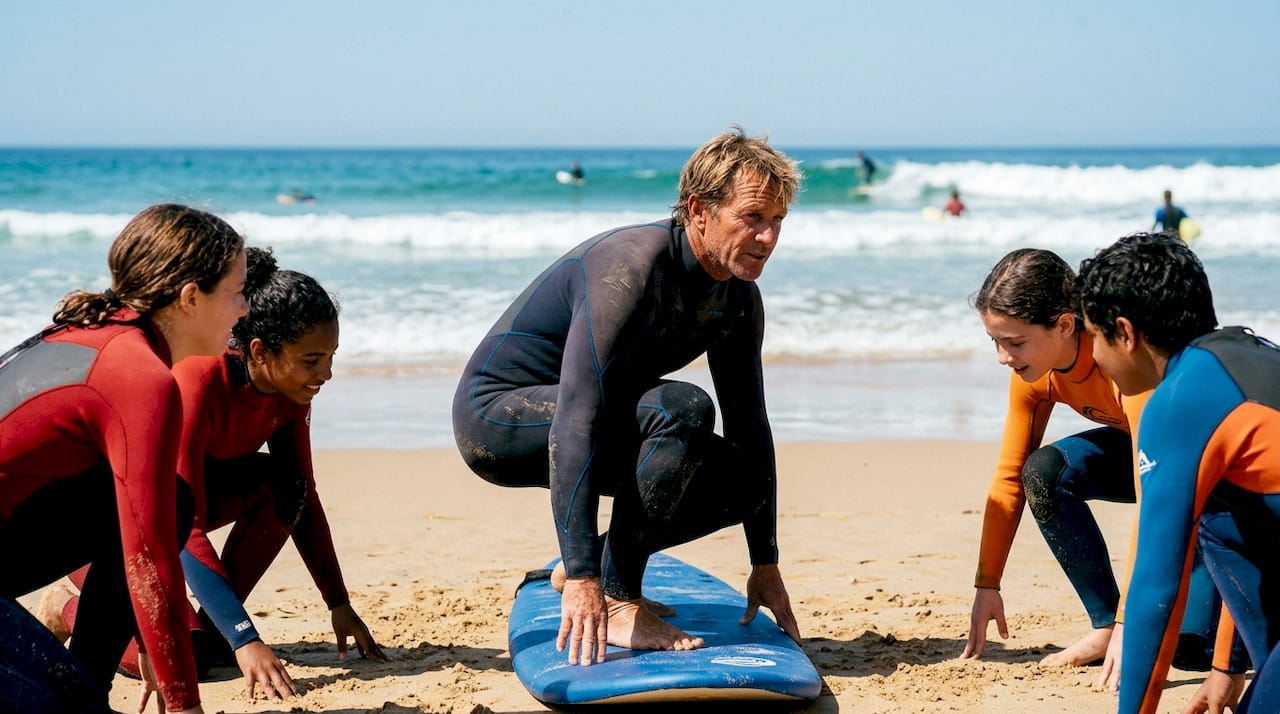
Once you enter the water, your instructor positions you on the board, reads the incoming waves, and gives you a push at the right moment. That timing assistance is critical in the first session. You focus entirely on standing up while the instructor handles the variables you cannot yet read.
4. What techniques beginners focus on during the lesson
The pop-up is the single most important skill in your first lesson. It is the motion of going from lying flat on the board to standing in one fluid movement. Professional instructors prioritize teaching one skill at a time, starting with standing and balancing before layering in paddling and wave timing. That sequencing prevents the frustration that comes from trying to manage too many variables at once.
Key techniques covered in a first lesson:
- Paddling: Lying centered on the board and using long, deep arm strokes to generate speed.
- Pop-up: The explosive move from prone to standing, landing with feet shoulder-width apart.
- Surf stance: Front foot angled at roughly 45 degrees, back foot perpendicular to the stringer (the board’s center line), knees bent.
- Balance and weight distribution: Keeping your center of gravity low and your gaze forward, not down at your feet.
Foot placement is where most beginners struggle first. Standing too far back on the board causes the nose to lift and slows you down. Standing too far forward buries the nose and sends you over the front. Your instructor corrects this in real time after every wave.
Falling is part of the process, not a sign of failure. Learning to fall away from the board and cover your head protects you and builds comfort with the ocean’s unpredictability.
Pro Tip: After your lesson, practice the pop-up on a yoga mat at home. Ten repetitions a day for a week will make your next session noticeably smoother.
5. What progress beginners can realistically expect
Realistic expectations prevent early discouragement. Beginners can expect to catch around 50 whitewater waves during a 2-hour lesson to build confidence and muscle memory. That wave count matters because repetition is how your body learns the pop-up, not how many times you read about it.
Beginner surf progression explained in clear stages:
- Session 1–3: Catching whitewater waves with instructor assistance, standing for 2–5 seconds at a time.
- Session 4–6: Catching whitewater waves independently, improving balance and stance consistency.
- Session 7–10: Reading small waves without help, beginning to steer the board slightly.
- Beyond session 10: With regular practice of 2–3 sessions per week, beginners often progress to catching unbroken green waves within 8–12 weeks.
Frequent, structured surf lessons with professional feedback yield faster progression compared to self-taught learning. Instructors provide immediate correction tailored to your specific errors, which compresses the learning curve significantly. You can learn more about the beginner surf zone and wave selection to understand why whitewater practice is the right starting point.
Signs you are ready to move beyond beginner lessons:
- You catch whitewater waves consistently without instructor assistance.
- Your pop-up is fast and lands in a stable stance every time.
- You can paddle out and position yourself without guidance.
- You understand basic surf etiquette and right-of-way rules.
6. How beginners overcome common fears and challenges
Fear is the most underrated obstacle in learning to surf. Common concerns include not being a strong swimmer, being out of shape, wiping out in front of others, and not understanding how the ocean behaves. Every one of these fears is addressable within the lesson structure itself.
Lessons are conducted in shallow, waist-deep water with an instructor within arm’s reach. You do not need to be a competitive swimmer. You do not need to be young. Hhsurf regularly works with adults in their 40s, 50s, and beyond who catch their first waves in a single session.
Ocean literacy is the most powerful fear reducer. Surfers progress best when they understand ocean safety rules before attempting more challenging waves. When you know what a rip current looks like and how to respond, the ocean feels less random and more readable. That knowledge replaces anxiety with awareness.
Practical mindset shifts that help:
- Treat every wipeout as data, not failure. Each fall tells you something about your balance or timing.
- Focus on the process of standing, not the outcome of riding far.
- Trust your instructor’s timing. Fighting the wave or hesitating on the push is the most common cause of missed waves.
- Celebrate small wins. Standing for three seconds on your first wave is a genuine achievement.
Key Takeaways
A beginner surf lesson delivers the fastest results when it follows a structured sequence of safety, land drills, and high-volume whitewater wave practice under direct instructor supervision.
| Point | Details |
|---|---|
| Lesson structure matters | Every session follows safety briefing, land drills, and in-water whitewater practice for best results. |
| Equipment supports learning | Foam longboards and leashes are provided and are the right tools for building early confidence. |
| One skill at a time | Instructors teach standing first, then paddling and timing, to avoid overwhelm and build momentum. |
| Wave count drives progress | Catching around 50 whitewater waves per session builds the muscle memory needed to advance. |
| Realistic timeline | With consistent practice, most beginners reach green waves within 8–12 weeks or about 10 sessions. |
What I have learned from watching beginners catch their first waves
The moment a first-timer stands up on a wave is one of the most reliable smiles I have ever seen. It does not matter if they are eight years old or fifty-five. That split second of balance changes something in how they see themselves in the water.
What I have noticed after years of watching this happen is that the beginners who progress fastest are not the most athletic. They are the ones who stop trying to think their way through the pop-up and just let their body do what it practiced on the sand. Surfing is a physical language. You learn it by speaking it, not by studying it.
The biggest mistake I see instructors make is rushing students to green waves before they have truly owned the whitewater. There is no glory in catching a green wave if your stance is still shaky. The whitewater phase is where real surfers are built. It is repetitive, yes. It is also where you develop the automatic responses that keep you safe and upright when the ocean gets unpredictable.
My honest advice: book at least three lessons before you decide whether surfing is for you. The first lesson is mostly about surviving the experience. The second is where you start to feel it. The third is where it clicks. One session is never enough data.
— Johann
Hhsurf beginner surf lessons in Waikiki
Hhsurf, the Hans Hedemann Surf School in Waikiki, teaches beginners using the exact structured approach described in this article. Certified instructors guide you through the safety briefing, land drills, and in-water wave catching with individual attention throughout the session. The goal is simple: you stand up on your first lesson.
Waikiki’s gentle, consistent waves make it one of the best learning environments in the world. Hhsurf provides all equipment, including foam boards, leashes, and rash guards. Whether you are booking for yourself, your family, or a group, beginner surf lessons at Hhsurf are designed to get you riding waves with confidence from day one.
FAQ
How long is a typical beginner surf lesson?
Most beginner surf lessons run approximately two hours, covering a safety briefing, land pop-up drills, and in-water wave catching with instructor assistance.
Do I need to know how to swim to take a surf lesson?
Strong swimming ability is not required. Lessons are conducted in shallow, waist-deep water with an instructor supervising at all times, making them accessible to most fitness levels.
What should I wear to my first surf lesson?
Most surf schools provide a rash guard or wetsuit along with the surfboard and leash. Wear a swimsuit underneath and apply reef-safe sunscreen before you arrive.
How many waves will I catch in my first lesson?
Beginners typically catch around 50 whitewater waves in a two-hour session. That volume of repetition is what builds the muscle memory needed to progress.
How long does it take to surf green waves as a beginner?
With consistent practice of 2–3 sessions per week, most beginners reach unbroken green waves within 8–12 weeks, or roughly 10 structured sessions.
0 Comments