
A surf buddy is a designated companion who surfs with you to provide mutual safety monitoring, motivation, and shared skill development in the water. The term comes directly from the buddy system, a safety practice that dates back to at least 1942, originally used in military and hazardous-environment training. Applied to surfing, the concept means two surfers pair up intentionally, not just casually, to watch out for each other across every session. Understanding what does surf buddy mean goes beyond friendship. It defines a relationship built on accountability, encouragement, and shared progress in the ocean.
What does surf buddy mean for your safety in the water?
A surf buddy is your first line of defense against the ocean’s real risks. Rip currents, unexpected wipeouts, and disorientation after a heavy wave are all situations where a second set of eyes can make a critical difference. Beginners especially underestimate how quickly conditions can shift at an unfamiliar break, and peer-based risk management through a surf buddy fills the gap that no lifeguard or app can fully cover.

Effective surf buddies act as an unofficial safety team in the water, not just friends who happen to surf together. This means actively checking on each other after heavy waves, wash-throughs, or long hold-downs. A common misconception is that a surf buddy is simply a social companion. The reality is that the role demands consistent attention and communication throughout the session.
The buddy system also helps surfers respect personal limits and observe safety protocols, especially in cold water or strong currents. When you know someone is watching, you are less likely to push past your comfort zone recklessly. That accountability is built into the structure of the relationship.
Key safety behaviors every surf buddy pair should practice:
- Check in after every wipeout. Make eye contact or signal to confirm your partner surfaced safely.
- Agree on a meeting point. If you get separated by a current, know where to regroup on the beach.
- Communicate before paddling out. Discuss the conditions, the break, and any personal limits before entering the water.
- Stay within visual range. Drifting too far apart defeats the entire purpose of the system.
Pro Tip: Before paddling out at any new break, spend five minutes on the beach with your surf buddy identifying rip currents, entry and exit points, and any hazards. This two-minute conversation has prevented more incidents than any amount of in-water reaction time.
How does a surf buddy support motivation and emotional confidence?
Surfing consistently is harder than it looks. Early morning alarms, cold water, flat spells, and intimidating lineups all chip away at motivation. A surf buddy solves this problem by creating social accountability. When someone else is counting on you to show up, skipping a session feels different than canceling on yourself.
The emotional support a surf buddy provides goes deeper than just showing up together. Mental blocks and fear in the lineup are real barriers, especially for beginners paddling into bigger surf for the first time. Having a trusted partner nearby who can offer a calm word or a simple nod of encouragement can shift the entire experience. Fear shrinks when someone you trust is right there with you.
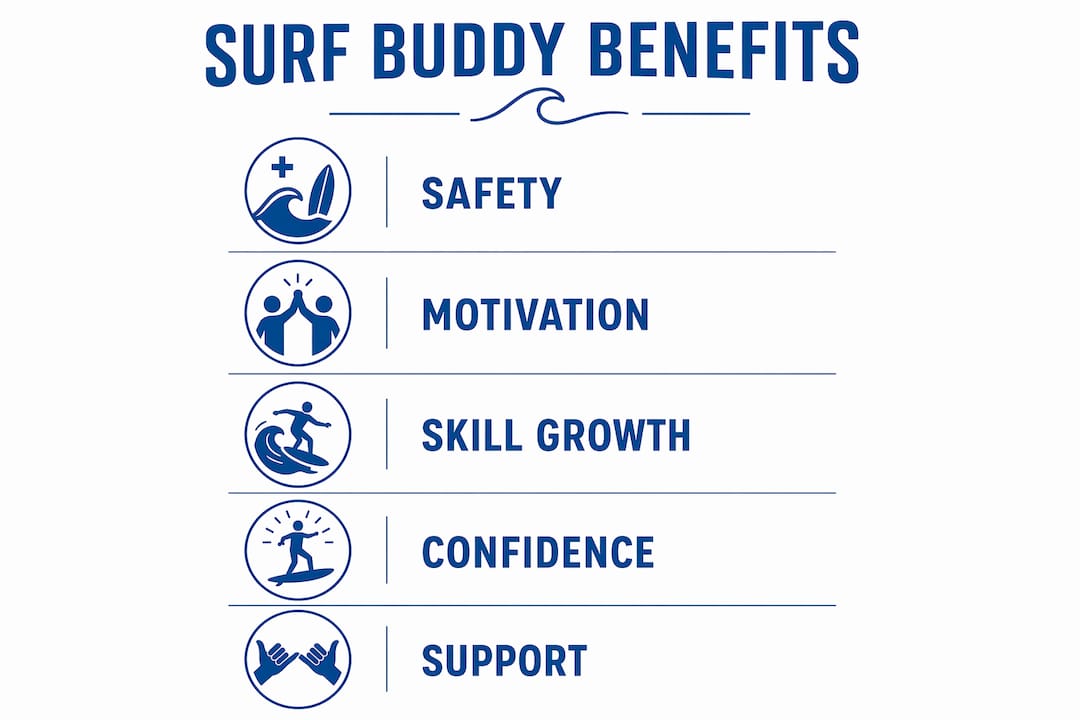
Shared enjoyment also amplifies the fun of surfing in ways that solo sessions simply cannot match. Celebrating a clean ride, laughing off a bad wipeout, and reading the ocean together all build a bond that keeps surfers coming back. The social dimension of surfing is one of its most underrated qualities.
Benefits of the surf buddy relationship for motivation:
- Consistent session attendance. Social commitment reduces the chance of skipping sessions due to low motivation.
- Shared stoke. Celebrating each other’s rides reinforces positive feelings about the sport.
- Reduced fear response. A familiar presence in the water lowers anxiety at new or challenging breaks.
- Honest encouragement. A good surf buddy tells you when a wave is within your ability, not just what you want to hear.
Pro Tip: If you feel hesitant about paddling into a bigger set, tell your surf buddy out loud. Saying it removes the pressure of pretending you are fine, and a good partner will either paddle with you or give you the honest read on whether the wave is actually within your range.
How do surf buddies help each other improve faster?
Skill development accelerates when you surf with a partner at a similar level. Successful surf partnerships thrive when both surfers share comparable experience. A significant skill gap creates pressure on the less experienced surfer and frustration for the more advanced one. The session stops being collaborative and starts feeling like a performance review.
When skill levels align, the feedback loop becomes genuinely useful. Your surf buddy sees your rides from the water in a way that no beach observer can. They notice if your pop-up is too slow, if you are dropping your back knee, or if you are consistently missing the wave’s sweet spot. That real-time, in-water perspective is something even video review cannot fully replicate.
Progression through a surf buddy relationship follows a natural pattern:
- Observe each other’s rides. Watch your partner’s technique from the lineup and note one specific thing to mention after the session.
- Share one tip per session. Limit feedback to one constructive point. Too much at once creates confusion, not improvement.
- Celebrate small wins. Acknowledge every milestone, whether it is a first green wave, a cleaner turn, or simply paddling out through a bigger break than before.
- Set shared goals. Agree on a skill target for the month, such as riding unbroken waves or improving paddle timing. Shared goals create shared accountability.
- Rotate who chooses the break. Alternating who picks the session location exposes both surfers to different wave types and conditions, which accelerates overall development.
The how to surf fundamentals become easier to apply when someone is watching and reinforcing them in real time. Learning in isolation means relying entirely on self-assessment, which is notoriously unreliable for beginners.
What are the best ways to find a surf buddy today?
Finding the right surf buddy has changed significantly with digital tools, but the core principle remains the same. Compatibility matters more than proximity. A surf buddy who surfs at a completely different level, has opposite scheduling, or approaches the ocean with a different mindset will create friction rather than support.
Modern platforms have addressed this with mutual-consent matching systems where surfers create profiles listing their skill level, home break, and session preferences. Both parties must agree before a connection is made. This intentional structure prevents the frustration of mismatched pairings and ensures both surfers are genuinely compatible before they ever paddle out together.
| Method | Best for | Key advantage |
|---|---|---|
| Surf lessons and camps | Beginners | Shared goals build natural bonds fast |
| Digital matching platforms | All levels | Skill-based filtering and mutual consent |
| Local surf clubs and groups | Intermediate surfers | Established community and regular sessions |
| Social media surf groups | All levels | Wide reach, location-specific communities |
| Surf travel groups | Advanced surfers | Shared trip goals create strong bonds |
Many enduring surf buddy relationships start in structured environments like surf lessons or camps, where shared goals and shared learning create natural bonds. The group setting removes the awkwardness of approaching a stranger in the lineup and replaces it with a common purpose.
Digital tools support initial connections, but the strongest bonds develop in the water through shared experiences. Technology gets you to the first session. What happens in the lineup determines whether the relationship lasts. A friend surf trip is one of the fastest ways to solidify a surf buddy relationship because shared adventure compresses the bonding process.
Pro Tip: When evaluating a potential surf buddy, pay less attention to their current skill level and more attention to their attitude in the water. A surfer who stays calm after a bad wipeout, respects the lineup, and communicates clearly is a better long-term partner than someone with better technique but poor water temperament.
Key Takeaways
A surf buddy is a safety partner, motivator, and skill accelerator. The relationship works best when both surfers share similar skill levels, communicate openly, and treat each other as genuine teammates in the water.
| Point | Details |
|---|---|
| Surf buddy definition | A designated companion who provides mutual safety monitoring, motivation, and skill feedback in the water. |
| Safety is the primary role | Surf buddies act as an informal safety team, checking on each other after wipeouts and in strong currents. |
| Skill matching matters | Mismatched skill levels create pressure and reduce session quality for both surfers. |
| Best connections start in person | Structured environments like surf lessons build stronger bonds than digital matching alone. |
| Motivation is a real benefit | Social accountability keeps surfers showing up consistently, even in less ideal conditions. |
Why I think most surfers undervalue the surf buddy relationship
The surf culture tends to celebrate independence. Solo dawn patrol sessions, charging unfamiliar breaks alone, figuring it out without asking for help. I get the appeal. There is something genuinely satisfying about reading a wave on your own and committing to it without anyone’s input.
But after years of watching surfers at every level, the ones who progress fastest and stay in the sport longest almost always have a consistent surf buddy. Not because they need someone to hold their hand, but because the feedback loop is irreplaceable. You cannot see your own pop-up. You cannot feel your own hesitation the way someone watching you can. A good surf buddy is a mirror that the ocean does not provide.
The safety argument is even more straightforward. I have seen strong swimmers get caught in rip currents at breaks they thought they knew. I have seen experienced surfers take a board to the head and need a moment to collect themselves. None of those situations were catastrophic because someone was there. The outdoor adventure surfing community talks a lot about reading conditions and respecting the ocean. A surf buddy is part of that respect.
My advice for choosing a surf buddy is simple. Find someone whose attitude in the water you admire, not just their skill level. Skill can be developed. A calm, communicative, safety-conscious partner is rare and worth more than any amount of technical ability.
— Johann
Where to find your surf buddy and start surfing together
The best place to meet a lasting surf buddy is in the water, learning alongside someone with the same goals. Structured surf lessons create exactly that environment, pairing you with other surfers at your level while professional instructors build your foundation.
Hhsurf offers surf lessons in Waikiki designed for beginners and all skill levels, with professional instructors who prioritize safety and real progression from the very first wave. The group setting means you are not just learning to surf. You are meeting the people who may become your most trusted surf buddies. Hhsurf also offers Waikiki surf lessons with a track record of getting students standing on their boards within a single session, which is exactly the kind of shared win that starts a lasting surf buddy relationship.
FAQ
What is the surf buddy system?
The surf buddy system is a safety practice where two surfers pair up to monitor each other throughout a session. It originates from the buddy system developed in 1942 for use in hazardous environments.
Why is having a surf buddy important for beginners?
Beginners face the highest risk at unfamiliar breaks, where rip currents and disorientation are most likely. A surf buddy provides real-time safety monitoring and emotional support that significantly reduces those risks.
How do I find a surf buddy with a similar skill level?
Surf lessons, local surf camps, and digital platforms with mutual-consent matching are the most reliable methods. Structured learning environments are especially effective because shared goals create natural compatibility.
Can a surf buddy actually help me improve faster?
Yes. A surf buddy watches your rides from the water and provides immediate, specific feedback that self-assessment cannot replicate. Shared goals and consistent sessions also accelerate progression compared to surfing alone.
What makes a good surf buddy relationship?
Similar skill levels, open communication, and a shared commitment to safety are the three defining qualities. Attitude in the water matters more than technical ability when choosing a long-term surf partner.
0 Comments