
An intermediate surfer is defined as someone who consistently catches unbroken green waves, executes controlled pop-ups, and initiates basic maneuvers like bottom turns and trimming. That baseline is the starting point, not the finish line. This intermediate surf techniques guide covers the exact skills you need to move beyond it: sharper wave selection, faster pop-ups, essential maneuvers, smarter board choices, and the mental preparation to handle bigger surf. The techniques here reflect 2026 coaching methods used by professional instructors, including the team at Hhsurf in Waikiki.
What does an intermediate surf techniques guide actually cover?
The gap between intermediate and advanced surfing is not about talent. It is about precision in five areas: pop-up mechanics, wave selection, maneuver execution, board fit, and mental readiness. Most surfers stall at the intermediate level because they repeat the same habits in the water without fixing the root causes on land. This guide addresses each area with specific drills, technical cues, and equipment guidance so you can build real, measurable progress.
How do you refine your pop-up and paddling for faster wave catching?
The pop-up is the single most practiced skill on land and the most commonly executed wrong in the water. The most common mistake is a two-stage pop-up: hands push first, then feet follow. That delay costs you the wave.
The fix is a simultaneous foot placement. Both feet land at the same time, low and centered, with your chest staying close to the board through the transition. Fluid, simultaneous foot placement with a low body position gives you better balance and a faster wave transition than any other adjustment.
Land drills that build real muscle memory
- Lie flat on the floor or a board on the sand.
- Place your hands flat under your chest, not beside your shoulders.
- Explode into your surf stance in one motion. Both feet land together.
- Hold the position for two seconds and check your stance width and knee bend.
- Repeat 10–20 times daily.
Performing 10–20 pop-up reps on land daily produces faster takeoff speed and better balance within one to two weeks. That is not a long time investment for a skill that determines whether you catch the wave or miss it.
Paddling efficiency matters just as much. Efficient paddling requires a high elbow entry and long, full strokes to maximize power and conserve energy before catching a wave. Short, choppy strokes tire your shoulders and leave you too far back in the lineup when the set arrives.
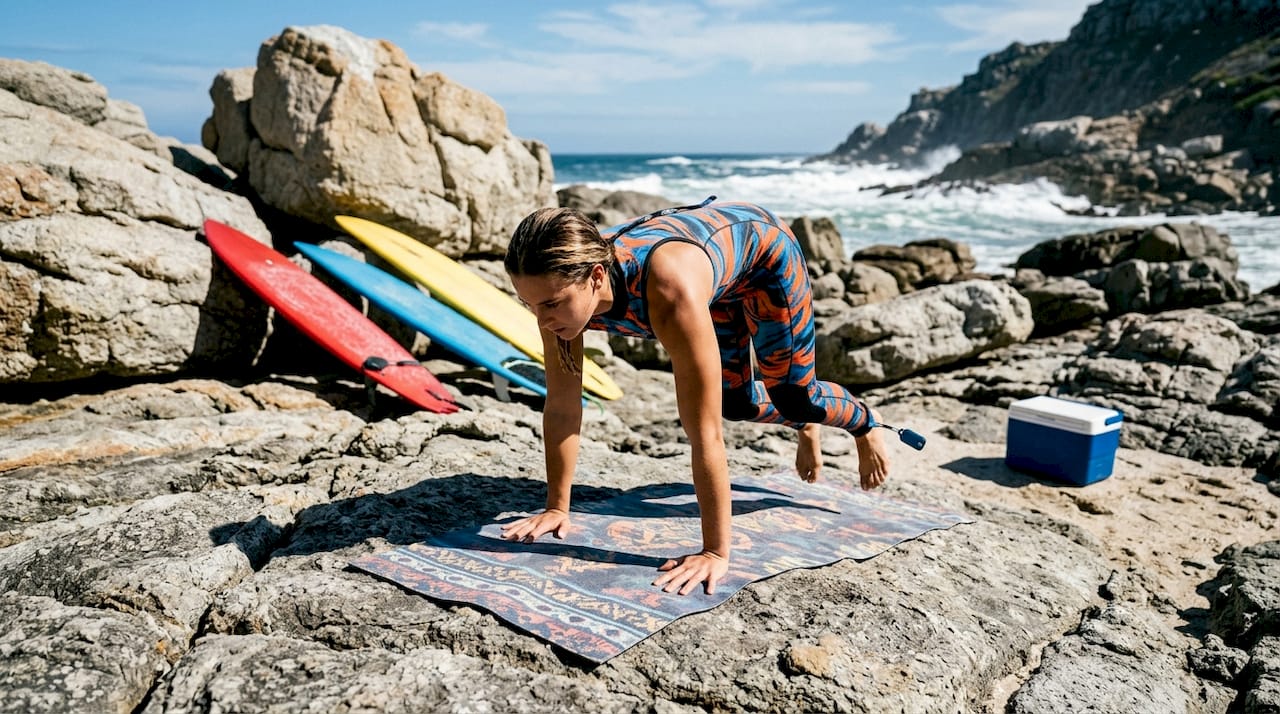
Pro Tip: Film your pop-up from the side during a session. If your hips rise before your feet land, you are doing a two-stage pop-up. Fix it on land before your next session.
How does wave selection change your progression?
Wave selection is the most overlooked factor in advancing from intermediate to advanced surfing. Positioning in front of the right section of the wave increases both practice quality and energy efficiency. You can paddle hard all session and still get fewer quality rides than a surfer who picks two good waves per set.
Strategic wave selection means:
- Sitting at the peak. The peak is where the wave first breaks. Surfers who sit inside or outside the peak consistently get caught in the impact zone or miss the takeoff window entirely.
- Reading the horizon. Sets arrive in patterns. Watch the water outside the lineup for the dark lines that signal incoming waves. This gives you three to five seconds of extra positioning time.
- Using rip currents as channels. Rip currents pull water back out to sea. Paddling through a rip channel rather than fighting whitewater gets you to the lineup faster and with less energy spent.
- Surfing lefts and rights. Lineup awareness and confidence riding both directions is a 2026 benchmark for intermediate surfers. If you only ride one direction, you cut your wave count in half at most breaks.
Pro Tip: Spend the first five minutes of every session sitting in the water without paddling for waves. Watch where the best waves break, where other surfers position themselves, and where the current moves. That five minutes pays off for the rest of the session.
For more on lineup rules and right-of-way, the surfing etiquette guide at Hhsurf covers the unwritten rules that keep the lineup safe and functional.
What are the essential surfing maneuvers for intermediate surfers?
Maneuver progression follows a specific order. Skipping steps creates bad habits that are harder to fix later.
-
Bottom turn. The bottom turn is the foundation of every other maneuver. Without a committed drive off the bottom, top turns lack power and speed, which limits your ability to progress to advanced carving. To execute it: as you drop down the wave face, compress your knees, shift your weight onto your heels or toes depending on direction, and drive your leading shoulder toward the wave. The goal is to redirect your speed up the face, not kill it.
-
Trimming. Trimming means adjusting your foot position to maintain speed along the wave face without turning. Shift weight slightly forward to speed up and slightly back to slow down. Most intermediate surfers stand too far back, which stalls the board.
-
Top turn. A top turn happens at the top of the wave face. Drive off the bottom turn, reach the lip, and redirect your board back down the face. The key is timing: hit the turn as the lip begins to pitch, not after it has already broken.
-
Cutback. A cutback brings you back toward the breaking part of the wave when you have outrun the power source. Start with a wide, sweeping arc rather than a sharp snap. The arc teaches your body the weight transfer before you add speed.
How rail engagement and wave energy drive your speed
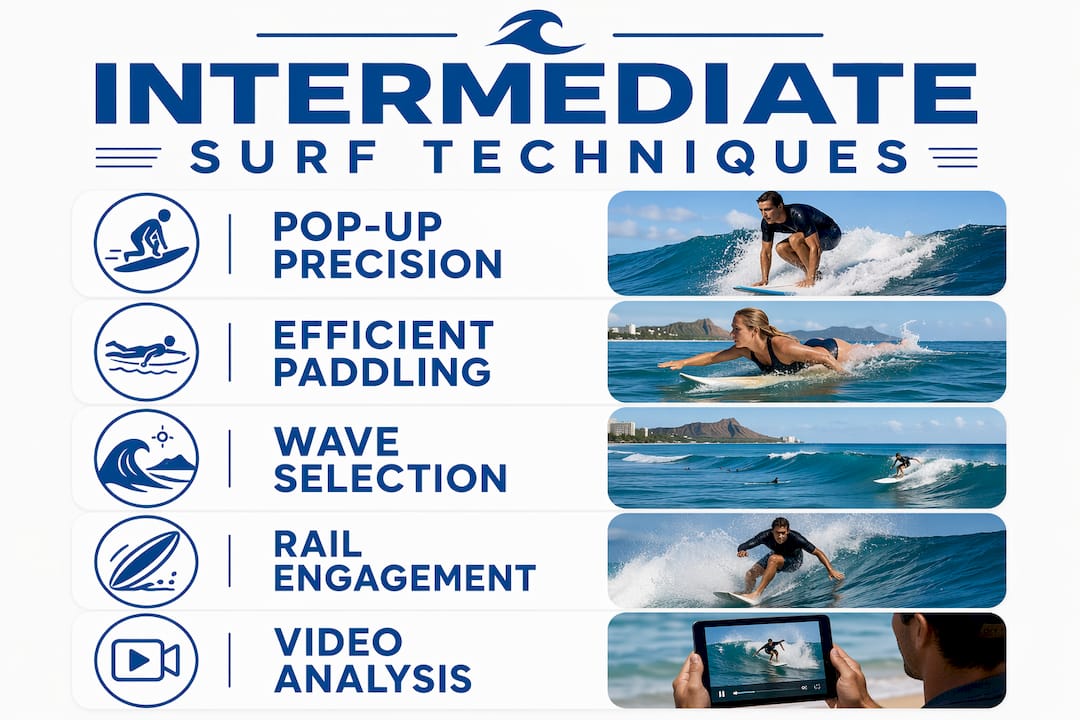
Speed during a ride comes primarily from rail engagement and wave energy management, not from paddling harder once you are on the wave. Compressing through the trough and extending through the shoulder pumps momentum through the board. This is the physical mechanic behind pumping: you are using the wave’s own energy, not fighting it.
Why video analysis accelerates maneuver learning
Advanced coaching sessions typically include 30 minutes of video review alongside in-water instruction. Video reveals errors that feel invisible from inside the ride: a dropped shoulder on the bottom turn, a wide back foot, or a late weight shift on the cutback. Structured coaching with video analysis accelerates skill acquisition by allowing precise identification of subtle technique errors that self-correction alone cannot catch.
| Maneuver | Key focus | Common mistake |
|---|---|---|
| Bottom turn | Drive and compression | Standing too upright, losing speed |
| Trimming | Weight distribution | Too far back, board stalls |
| Top turn | Timing at the lip | Turning too late after the lip breaks |
| Cutback | Wide arc, weight transfer | Turning too sharp before building speed |
How do you choose the right surfboard as an intermediate surfer?
Board choice is one of the fastest ways to either accelerate or stall your progression. Downsizing too aggressively impairs both paddling and maneuvering. A surfer weighing 70 kilograms should ride boards in the 46–54 liter volume range rather than jumping to a low-volume shortboard prematurely. The right volume lets you paddle into waves with less effort, which means more rides and more practice per session.
| Board type | Volume range | Best for |
|---|---|---|
| Funboard | 55–70L | Building confidence on green waves |
| Hybrid | 40–55L | Transitioning to sharper turns |
| Shortboard | 25–40L | Advanced carving and steep waves |
Fin configuration also affects how the board responds. A thruster setup (three fins) gives you drive and control through turns. A twin fin setup is looser and faster but less stable. Intermediate surfers generally benefit from a thruster until their bottom turn is consistent enough to handle a looser board.
Proper volume choice balances challenge with manageable paddling and control. The goal is a board that challenges you without punishing every small mistake.
How do you prepare mentally and physically for bigger waves?
Bigger waves require a different kind of preparation. Physical fitness alone does not get you there.
- Visualization. Before paddling out, picture the wave, your takeoff, and your first turn. Athletes across board sports use pre-performance visualization to reduce hesitation and increase execution speed.
- Cardiovascular training. Paddling through larger surf demands sustained aerobic output. Running, swimming, and cycling all build the base fitness you need to stay calm and functional when a set catches you inside.
- Plyometric training. Explosive leg strength directly improves your pop-up speed and your ability to generate power through turns. Box jumps, squat jumps, and lateral bounds are the most transfer-relevant exercises for surfing. The cross-training guide at Hhsurf covers these exercises in detail.
- Hip flexibility. Tight hips restrict your stance width and limit your ability to compress through turns. Daily hip flexor stretches and yoga-based mobility work pay off directly in the water.
Surfing bigger waves requires combined mental and physical preparation. Fear management and visualization work together with plyometrics and cardio to build the mind-body readiness that critical wave conditions demand.
“The surfers who progress fastest in bigger surf are not the ones with the most courage. They are the ones who have prepared their bodies and their minds before they ever paddle out.”
Pro Tip: Practice breath holds in a pool or calm water to build comfort with being underwater. Knowing you can hold your breath for 20–30 seconds longer than you think removes a significant source of panic in wipeouts.
Key Takeaways
Mastering intermediate wave riding techniques requires consistent land practice, strategic wave selection, and the right board volume before any other variable.
| Point | Details |
|---|---|
| Pop-up precision | Practice 10–20 simultaneous foot-placement reps daily to build takeoff speed within two weeks. |
| Wave selection first | Positioning at the peak and reading the horizon delivers more quality rides than paddling harder. |
| Bottom turn is foundational | Every advanced maneuver depends on a committed, powerful drive off the bottom. |
| Match board volume to weight | A 70kg surfer needs 46–54L of volume to paddle efficiently and practice maneuvers consistently. |
| Mental prep is non-negotiable | Visualization and breath training reduce hesitation and improve execution in bigger surf. |
What I have learned coaching intermediate surfers past the plateau
The most common reason intermediate surfers stop progressing is not lack of time in the water. It is lack of precision in how they use that time. I have watched surfers paddle out five days a week for two years and make almost no measurable improvement because they repeat the same flawed pop-up and the same passive wave selection every single session.
The surfers who break through fastest share one habit: they practice one specific thing per session. Not “work on my turns.” One thing. The left rail on the bottom turn. The timing of the foot placement. The arc width on the cutback. That level of focus produces changes you can see on video within a week.
Wave selection is the other piece most surfers undervalue. Catching a mediocre wave and riding it to the beach feels productive. Sitting in the lineup, watching three waves pass, and then committing fully to the fourth one teaches you ten times more. The fourth wave is the one with the right peak, the right speed, and the right section for the turn you are practicing.
Mental readiness for bigger surf is not about being fearless. It is about building enough physical preparation that fear does not override your decision-making. The surfers I have seen freeze in overhead surf are almost always the ones who skipped the fitness work. The ones who trained for it paddle out with a plan.
— Johann
Hhsurf surf lessons for intermediate surfers in Waikiki
Hhsurf offers personalized surf lessons in Waikiki designed specifically for intermediate surfers ready to move beyond the basics. Professional instructors use video analysis and targeted feedback to identify the exact technique errors holding you back, whether that is a two-stage pop-up, a passive bottom turn, or poor wave selection habits.
Waikiki’s consistent, well-shaped waves make it one of the best environments in the world for practicing intermediate wave riding techniques at your own pace. Sessions are structured to give you maximum water time with direct coaching, not generic instruction. If you are ready to accelerate your progression with expert guidance, book a surf lesson with Hhsurf and put these techniques into practice with a professional in the water beside you.
FAQ
What defines an intermediate surfer?
An intermediate surfer consistently catches unbroken green waves, performs controlled pop-ups, and initiates basic maneuvers like bottom turns and trimming. Lineup awareness and confidence riding both lefts and rights are the 2026 benchmarks for this level.
How many pop-up reps should I practice on land?
Performing 10–20 pop-up repetitions daily builds the muscle memory needed for faster takeoffs and better balance, with noticeable improvement typically appearing within one to two weeks.
What is the most important maneuver for intermediate surfers?
The bottom turn is the foundational maneuver. Without a committed drive off the bottom, every other turn lacks power and speed, which blocks progression to advanced carving and cutbacks.
What board volume should a 70kg intermediate surfer ride?
A surfer weighing 70 kilograms should ride a board in the 46–54 liter volume range. Dropping below that volume too early impairs paddling efficiency and reduces the number of quality practice rides per session.
How does video analysis help intermediate surfers improve faster?
Video analysis identifies subtle technique errors that are impossible to feel from inside the ride, such as a dropped shoulder or a late weight shift. Structured coaching with video review accelerates skill acquisition by giving you precise, correctable feedback after every session.
0 Comments