
Looking forward means fixing your gaze on the horizon, the shore, or your exit point rather than staring down at your board. That single habit is the fastest way to improve your balance, timing, and wave reading as a beginner. Try this right now on the beach: do a pop-up on dry sand, and the moment you rise, snap your chin up and lock your eyes on a fixed point at eye level. Hold it for three seconds. That’s the whole drill. Do it ten times before you paddle out and you’ll feel the difference on your first wave.
Pro Tip: During a lesson or self-coaching session, pick a landmark on the shore before you paddle. The second you pop up, find it. That one cue replaces a dozen technical reminders.
Table of Contents
- Why does looking forward actually improve your surfing?
- Where should you look at each phase of the ride?
- Common gaze mistakes and how to fix them fast
- Drills you can do today to build lasting gaze habits
- How instructors teach the “look forward” habit
- How long before you notice a real difference?
- Key Takeaways
- Why gaze is the one habit that changes everything
- Want faster results? Here’s what a focused lesson looks like
- Sources and further reading
Why does looking forward actually improve your surfing?
The eyes lead the body in surfing. Where your gaze goes, your head follows. Your head moves, your shoulders rotate, your hips shift, and the board tracks that line. It’s a chain reaction that starts with your eyes, not your feet.
Beginners almost always stare at the board. It feels logical — you’re balancing on a moving surface, so you watch your feet. But looking down at the board actually reduces stability. When your gaze drops, your peripheral vision disappears, and peripheral vision is what picks up wave-shape changes before they throw you off. Look up and your brain processes the whole environment. Look down and it processes a patch of foam.
There’s a learning-science angle here too. Curiosity-driven scanning activates prefrontal learning circuits and dopamine-mediated consolidation, which helps new motor patterns lock in faster. In practical terms: when you’re actively looking ahead and reading the wave, you’re not just balancing better. You’re learning faster. One coaching observation captured this directly — a novice who usually rode briefly was able to ride significantly longer after a single cue to look ahead. That’s not a fluke; it’s the biomechanics working exactly as they should.
- Gaze up = peripheral vision active — you catch wave changes before they knock you off
- Head position drives shoulder and hip alignment — your body steers where your eyes point
- Looking down stalls the board — fixating on the nose is one of the most common causes of nose-dives.
- Active visual scanning accelerates motor learning — curiosity and attention speed up skill consolidation
Pro Tip: If you keep losing balance, ask yourself where your eyes are. Nine times out of ten, they’re on the board.
Where should you look at each phase of the ride?
Knowing that you should look forward is one thing. Knowing where to look at each specific moment is what actually changes your surfing.
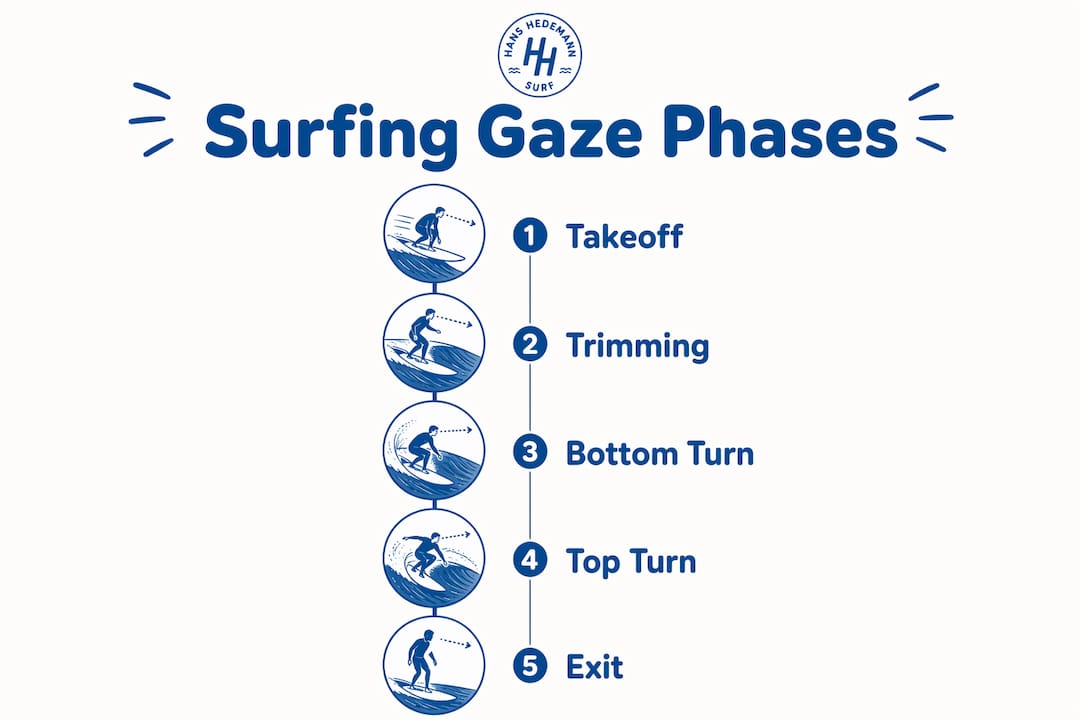
Takeoff: Fix your eyes on the horizon or a point on the shore. This stabilizes your head during the pop-up and sets your body line before the wave even starts moving you.
Trimming (riding straight or across the face): Shift your gaze to the shoulder of the wave — the unbroken section ahead of you. This tells you how much time you have and where the wave is going to break next.
Bottom turn: Look up toward the lip or the section you want to hit. Your shoulders will follow your eyes and drive the rotation. If you look at the water in front of your board, the turn flattens out.
Top turn: Look back down toward the trough or your exit line before you even complete the top of the turn. Looking through the turn keeps the rotation alive. Stop your gaze mid-turn and the maneuver fades.
Exit: Find open water. This matters for safety as much as technique. Target fixation is real — you steer toward whatever you stare at. Look at another surfer or a rock and you’ll drift toward them. Look at open water and you’ll go there instead.
Common gaze mistakes and how to fix them fast
Most beginners make the same four errors. Here’s how to spot and correct each one in-session.
-
Looking down at the board. The most common mistake. Fix: pick a shore landmark before paddling and find it the instant you stand. Verbal cue: “Chin up, find the shore.”
-
Target fixation on a hazard. You see another surfer or a rock and you can’t stop looking at it. Fix: immediately redirect your gaze to open water. Cue: “Look where you want to go.” The board will follow.
-
Stopping your gaze mid-turn. You look into the turn but stop tracking before the maneuver finishes. The turn dies. Fix: keep your eyes moving through the full arc until you reach your exit point. Cue: “Look through it, not at it.”
-
Locked shoulders from a fixed stare. When your eyes stop moving, your shoulders freeze and your hips stop rotating. Fix: let your eyes lead actively. If your shoulders feel stuck, your gaze has probably stopped. A gentle head rotation unlocks the chain. Note: avoid sudden, sharp head snaps — rotate smoothly to protect your neck.
Drills you can do today to build lasting gaze habits
Progress comes from repetition across three environments: land, foamie, and open water. Work through them in order.
Land drills
Do ten pop-ups on dry sand or a yoga mat. Each time you rise, snap your eyes to a fixed point at eye level — a tree, a lifeguard tower, anything. Hold the gaze for three full seconds before stepping off. Add a head-leads-hips drill: stand in surf stance, pick a point 45 degrees to your left, and rotate your head to it. Your shoulders and hips should follow automatically. Repeat ten times each direction. Land drills that link head movement to torso rotation shorten the transfer time to in-water turns considerably.
Foamie and pool drills
On a foamie in the whitewash, practice kneeling rides while holding your gaze on the shore. Once comfortable, move to standing rides and focus only on your exit point — not the wave, not your feet. Aim for five to eight clean runs per session where your eyes never drop.
In-water progressions
Start on green (unbroken) waves and practice takeoff gaze only. Once that’s automatic, add bottom-turn focus: look up at the lip before you initiate the turn. Finally, link the bottom turn to a top turn using the exit-point cue from the turn section above.
| Stage | Focus | Reps per session | Progress signal |
|---|---|---|---|
| Land pop-up drill | Horizon lock on rise | ten | Eyes stay up for 3 seconds consistently |
| Foamie kneeling ride | Shore gaze hold | five to eight runs | No gaze drops during the ride |
| Green wave takeoff | Horizon/shore fix | Every wave | Longer, more stable rides |
| Bottom turn | Look up to lip | 5–ten turns | Cleaner arc, less flat turns |
| Linking turns | Exit-point tracking | Every wave | Fluid turn-to-turn connection |
Film yourself from the shore or ask a friend to watch. Even a 30-second clip will show you immediately whether your chin is up or your eyes are dropping. Video feedback is one of the fastest ways to close the gap between what you think you’re doing and what’s actually happening.
Pro Tip: In a crowded lineup, always check your exit before you pop up. Knowing where open water is before the wave hits removes the hesitation that causes gaze to drop. Check the beginner surf zone guidelines for safe practice spots.
How instructors teach the “look forward” habit
Good instructors don’t just say “look up.” They build the cue into every phase of the lesson. At Hhsurf, the teaching methodology combines verbal prompts with immediate physical setup — stance, shoulder alignment, and head position are set on the beach before a student ever touches the water. The verbal cues (“look to the shore,” “look through the turn”) are paired with hands-on positioning so the student feels the correct alignment, not just hears about it.
Video review accelerates this significantly. When a student sees their own gaze dropping on a replay, the correction clicks in a way that verbal instruction alone rarely achieves. Teaching “look forward” as an explicit lesson objective with immediate video replay is one of the most reliable ways to speed adoption in beginner classes.
Qualified instructors assess gaze and balance together — they watch where a student’s eyes go during the pop-up, not just whether they stand up. A student who stands but looks down is building the wrong habit from day one. The fix is always the same: redirect the eyes first, and the body follows.
What to expect in a focused lesson: your instructor will set your gaze target on the beach, cue it verbally during each wave, and review your position afterward. Many students notice a measurable difference within the same session. For a full picture of what a first lesson covers, the step-by-step lesson guide walks through the structure in detail.
How long before you notice a real difference?
Most beginners feel the impact of looking forward within their first session. Rides get longer, nose-dives drop off, and turns start to feel less accidental. After a few sessions, the habit often starts to become automatic — you stop thinking about it and just do it.
Measurable signs you’re improving: longer rides on the same waves, cleaner bottom turns with more arc, fewer wipeouts caused by nose-dives, and the ability to spot the wave shoulder and adjust your line before the section closes.
What stalls progress? Anxiety is the biggest one. When you’re nervous, your eyes drop to the board as a comfort reflex. Inconsistent practice is the second staller — gaze habits need repetition across multiple sessions to consolidate. Wrong waves matter too: if you’re practicing on waves that are too powerful or too fast, survival mode kicks in and technique goes out the window. Stick to appropriate beginner waves until the habit is solid.
If you plateau after six or more sessions, ask an instructor to watch specifically for gaze. Request video feedback and ask: “Can you tell me where my eyes are going during the pop-up?” That single question will surface the issue faster than any amount of self-analysis.
Key Takeaways
Looking forward is the single most impactful habit a beginner can build — it drives balance, timing, and wave reading through one connected chain of gaze, head, shoulders, hips, and board.
| Point | Details |
|---|---|
| Definition | Look at the horizon, shore, or exit point — never down at the board. |
| Top drill | Ten beach pop-ups with eyes locked on a fixed point; hold for three seconds each. |
| Phase-specific cues | Horizon at takeoff, wave shoulder while trimming, exit point through every turn. |
| Safety reminder | Look at open water, not hazards — you steer toward whatever you stare at. |
| Hhsurf approach | Hhsurf combines verbal cues, physical setup, and video review to build the gaze habit from the first lesson. |
Why gaze is the one habit that changes everything
The conventional wisdom in beginner coaching focuses heavily on foot position, stance width, and arm placement. Those things matter. But in my experience watching beginners progress, the single fastest unlock is almost always gaze. A student can have perfect foot placement and still wipe out on every wave because their eyes are glued to the nose of the board.
What most people underestimate is how deeply the eyes are wired into the body’s balance and rotation systems. It’s not a metaphor when coaches say “the board follows the eyes.” It’s a literal description of how the vestibular system and proprioception interact with visual input. Fix the eyes and you fix the chain. Leave the eyes looking down and no amount of foot adjustment will compensate.
The other thing worth saying: looking forward isn’t just a technique. It’s a mindset shift. Mindful surfing — staying present and curious rather than anxious and reactive — produces the same open, forward gaze that good technique requires. The two reinforce each other. Students who approach waves with curiosity rather than fear naturally look ahead. Students who look ahead naturally feel more in control and less afraid. Start with the eyes and the confidence follows.
Want faster results? Here’s what a focused lesson looks like
Hhsurf’s private surf lessons in Waikiki are built around exactly this kind of targeted improvement. Instead of generic “stand up and ride” coaching, a gaze-focused session starts on the beach with explicit visual targets, moves to foamie runs with instructor feedback on every wave, and wraps with a short video review so you can see your own progress. Most students leave their first session riding longer and with noticeably more control.
Before booking, ask your instructor three things: Do you use video feedback? Will you cue my gaze specifically during each wave? Is this a small group or private session? At Hhsurf, the answer to all three is yes. Book a Waikiki surf lesson and tell them you want to work on looking forward. That one request will shape the whole session around the habit that moves the needle fastest.
Sources and further reading
- Look ahead! An impromptu surf lesson — Surfer Today: a short, readable account of how one coaching cue produced immediate improvement in a novice
- Look Where You Want to Go — Trax Surf: the clearest single-source explanation of gaze mechanics, target fixation, and board-steering
- Look Through Your Turns — San Diego Surfing School: turn-specific gaze coaching and land-drill recommendations
- Curiosity, Dopamine, and Learning — Surf Science: the learning-science case for curiosity-driven practice
- Mindful Surfing as Exposure Therapy — Bodhi Surf + Yoga: how presence and mindset connect to technique
- Why Learning to Surf Can Be Great for Your Mental Health — The Conversation: psychologist-reviewed piece on confidence, consistency, and lesson completion
- Hhsurf How to Surf — Hhsurf’s teaching methodology page, including verbal cue and video-feedback practices
- Mobility and Athletic Longevity — HTK Training: mobility drills that support torso rotation and neck comfort during repeated gaze practice
0 Comments