
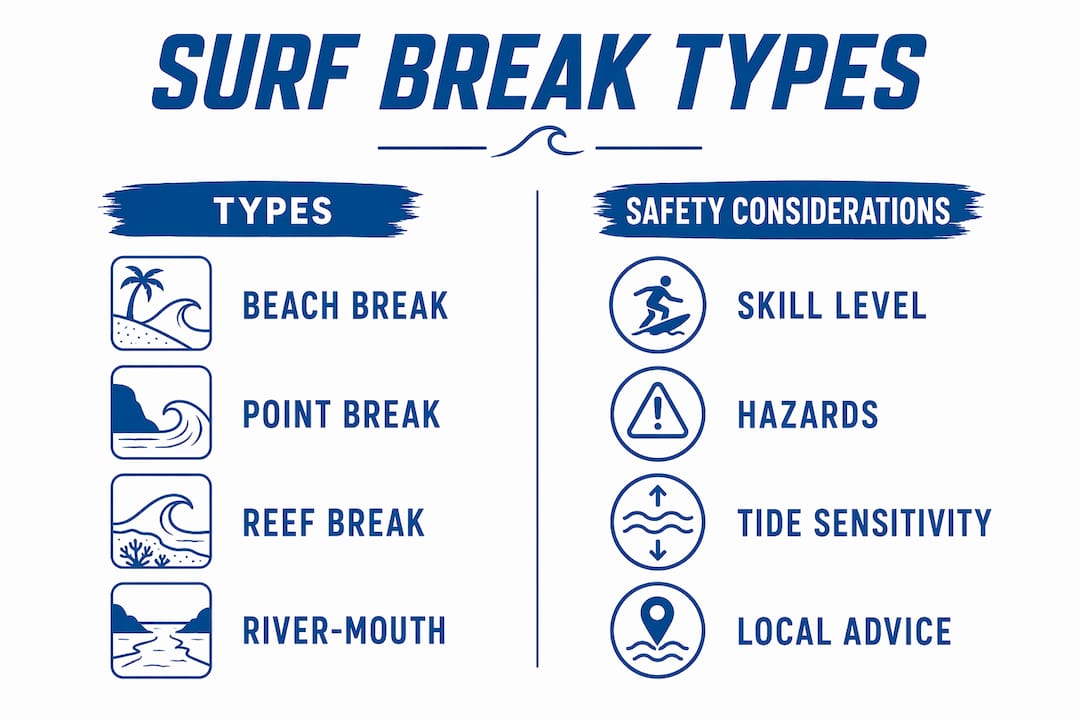
A surf break is the specific place where a wave begins to break in a way a surfer can ride it, shaped by whatever lies on the seabed or along the coast beneath it. The three primary types are beach breaks, point breaks, and reef breaks, with river-mouth and artificial wave pools rounding out the full picture.
Quick skill guide:
- Beginners: Beach breaks are your best starting point. Sandy bottoms forgive wipeouts, and small-swell days keep conditions manageable.
- Intermediate to advanced: Point breaks offer long, consistent rides once you can read a lineup.
- Advanced only: Reef breaks, especially hollow barreling spots, carry real hazard from shallow rock or coral beneath you.
Table of Contents
- How waves actually break: seabed, swell, tide, and wind
- Beach breaks are where most beginners start
- Point breaks give you the longest rides in surfing
- Reef breaks: powerful, hollow, and unforgiving
- River-mouth and standing-wave breaks
- Jetties, piers, shipwrecks, and wave pools
- How to choose the right break for your skill level
- Why surf breaks matter beyond the lineup
- Key Takeaways
- What instructors actually show beginners first
- Ready to learn on a real wave?
- Useful sources and further reading
How waves actually break: seabed, swell, tide, and wind
The seabed is the engine behind every surf break. When an ocean swell rolls into shallower water, the bottom of the wave slows down while the top keeps moving, pitching the crest forward and breaking it. The exact shape of that seabed, what coastal scientists call bathymetry, determines whether the wave peels cleanly, barrels, or collapses all at once.
Four forces work together at every break:
- Seabed shape: Sandbars, reefs, headlands, and rocky shelves all redirect and concentrate wave energy differently.
- Swell direction and period: A swell hitting a headland at an angle produces a peeling wave; one hitting a flat sandbar straight-on can produce a closeout.
- Tide level: Many breaks only work at certain tides. A reef that barrels at low tide may be a flat, unrideable wall at high.
- Wind: Offshore wind (blowing from land to sea) grooms wave faces; onshore wind chops them up.
Pro Tip: Waves typically start breaking when water depth reaches roughly 1.3 times the wave height. That’s why a two-foot swell breaks in shallower water than a ten-foot swell, and why the same spot can look completely different between tides.
Beach breaks are where most beginners start
A beach break is a wave that breaks over a sandy bottom, usually over submerged sandbars sitting offshore. Sandbars shift constantly with tides, storms, and currents, which means the peak (the spot where the wave first pitches) moves around from day to day. That unpredictability is actually fine for beginners, because the sandy bottom is forgiving when you fall.
What to know before paddling out at a beach break:
- Closeouts happen: When a sandbar is flat or the swell is too large, the whole wave breaks at once with no rideable shoulder. Pick smaller swell days.
- Rip currents: Channels between sandbars funnel water back out to sea. Learn to spot them from shore before you enter.
- Shorebreak is different: A shorebreak breaks directly on the sand at the water’s edge due to a steep beach slope. There’s almost no rideable face, and the wave can slam you into the sand hard enough to cause injury. Avoid it.
Classic U.S. beach breaks include Huntington Beach in California, where consistent sandbars produce workable waves year-round, and Trestles near San Clemente, a mixed complex that blends beach-break sections with reef and point influences.
Point breaks give you the longest rides in surfing
A point break forms when swell wraps around a headland, rocky point, or jetty and peels along the coastline in one direction. Because the wave is bending around a fixed geographic feature, the break tends to be more consistent than a beach break and produces long, clean rides that let surfers link multiple turns.
What makes point breaks special:
- Predictable peak: The wave almost always breaks in the same spot, so you can position yourself accurately.
- Long rides: A well-shaped point break can give you a ride of 200 yards or more on a good swell.
- Crowd factor: That consistency draws crowds. Learning surf etiquette, especially right-of-way rules, matters more here than at a scattered beach break.
Malibu (First Point) in California is the textbook example of a classic point break, a gentle, long-waving right-hander that has introduced generations of surfers to the format. Rincon, also in California, steps it up: longer, more powerful, and a favorite for experienced longboarders and shortboarders alike when winter swells arrive.
Reef breaks: powerful, hollow, and unforgiving

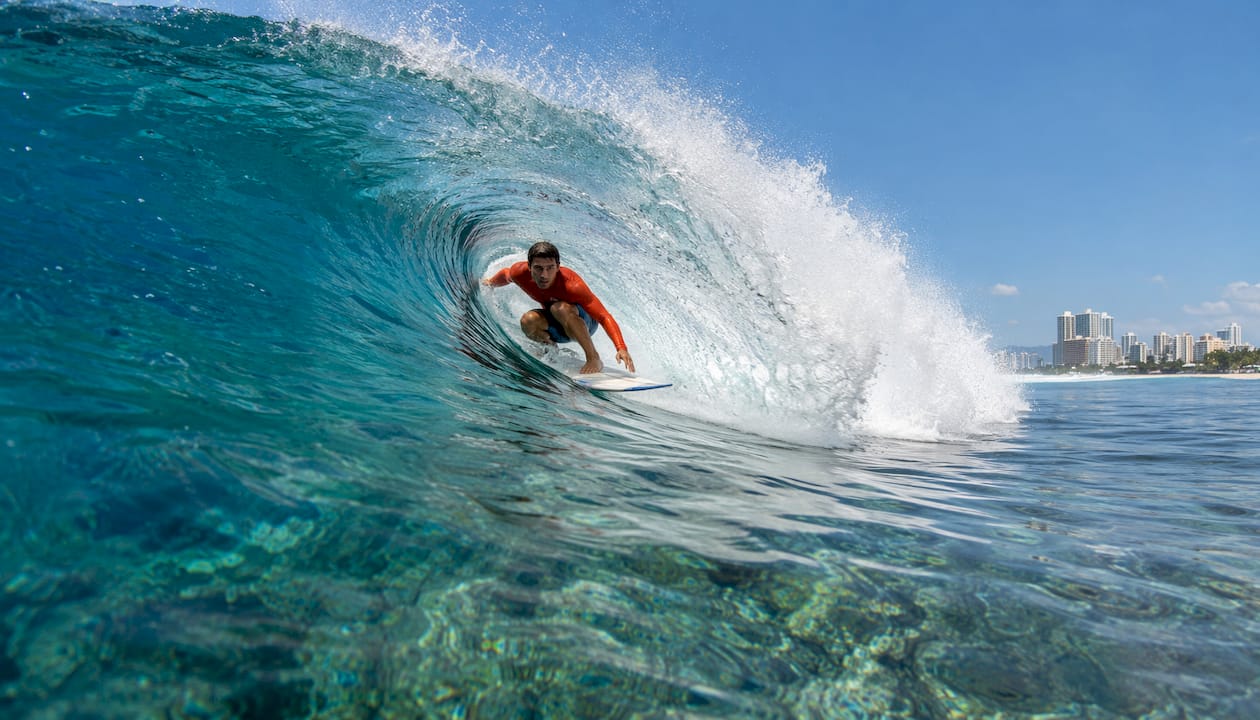
Reef breaks occur where waves roll over a hard seabed of coral or rock. That rigid, unchanging bottom produces waves with a consistent shape, often hollow and barreling, because the wave energy hits a fixed contour and pitches sharply. Reef breaks tend to be more powerful and more hazardous than beach breaks, and they are generally not suitable for beginners.
Safety considerations at reef breaks:
- Know your exit: Identify where you can safely get out of the water before you paddle in. Rocky shores have few obvious exits.
- Wear protection: Reef booties and a helmet are standard at shallow reef spots. Coral cuts get infected quickly.
- Get local knowledge: Ask someone who surfs the spot regularly about the specific hazards, submerged ledges, and currents.
Banzai Pipeline on Oahu’s North Shore is the world’s most famous reef break, a shallow coral ledge that produces thick, barreling tubes and injures even professional surfers regularly. Mavericks at Half Moon Bay, California, sits in a different category: a deep-water rocky reef environment that generates massive open-ocean swells, strictly for big-wave specialists.
River-mouth and standing-wave breaks
River-mouth breaks form where a river meets the ocean. The outflow of fresh water deposits sediment that builds sandbars at the river’s mouth, and incoming ocean swell interacts with those bars to produce surfable, peeling waves. The wave quality depends heavily on recent rainfall, river flow, and tidal stage, making these spots inconsistent but sometimes exceptional.
Standing waves are a different animal entirely. They form in rivers or engineered channels where fast-moving water flows over a submerged obstacle, creating a stationary wave face that surfers ride in place. You’ll find them in cities like Munich (the Eisbach river wave) and at engineered whitewater parks across the U.S.
Hazard notes for both:
- River currents add a downstream pull that ocean surfers aren’t used to.
- Water quality at river mouths can be poor after heavy rain.
- Standing waves in rivers often have fixed, hard obstacles nearby.
Jetties, piers, shipwrecks, and wave pools
Human structures create surf breaks more often than most people realize. Jetties and piers interrupt the natural flow of sand and water along a coastline, often building up sandbars on one side that produce consistent, predictable waves. Some of the most reliable beach-break peaks in the U.S. sit right next to a jetty.
Shipwrecks on the seabed can function like artificial reefs, concentrating wave energy and producing breaks where none existed before. The quality varies wildly depending on depth, orientation, and local swell patterns.
Artificial wave pools are a different category altogether. Facilities like those using the Wavegarden or Kelly Slater Wave Co. technology generate mechanically produced waves in a controlled lagoon. The waves are perfectly consistent, with no rip currents, no rocks, and no crowd jostling for position. They’re an excellent learning environment, though the experience differs from reading and reacting to a natural ocean break.
Pro Tip: If you’ve never surfed before, a wave pool or a calm beach break on a small-swell day gives you the cleanest possible introduction. Save the jetty peaks and reef setups for once you can reliably paddle, pop up, and steer.
How to choose the right break for your skill level
The single most important rule: match the break to your ability, not your ambition. Instructors consistently recommend that beginners seek beach breaks with small swell, because the sandy bottom reduces collision risk compared with reef or rock. Once you can read a lineup, control your board, and handle a wipeout calmly, you can start exploring point and reef breaks.
Before entering any break, run through this checklist:
- Observe from shore for at least 15 minutes. Watch where the waves break, where rip currents run, and where other surfers exit.
- Check the tide. Many breaks change dramatically between low and high tide. Local surf reports (Surfline, Magic Seaweed) include tide charts.
- Identify your exit point. Know exactly where you’ll get out before you paddle in.
- Ask a local or a lifeguard. Knowing the personality of a local break, where the peak forms, how the lineup funnels, where rips appear, is as important for safety as it is for performance.
- Respect the lineup. The surfer closest to the peak has right of way. Don’t drop in.
| Break type | Best for | Wave shape / ride | Consistency | Hazards | Tide sensitivity |
|---|---|---|---|---|---|
| Beach break | Beginners | Variable, often crumbly to punchy | Low to moderate (shifts with sandbars) | Rip currents, shorebreak, closeouts | Moderate |
| Point break | Intermediate to advanced | Long, peeling, clean | High | Crowds, rocks near headland | Low to moderate |
| Reef break | Advanced only | Hollow, barreling, powerful | High | Shallow reef, coral cuts, strong currents | High |
| River mouth | Intermediate | Peeling, variable | Low (rain/flow dependent) | River current, water quality | High |
| Wave pool | All levels | Consistent, controlled | Perfect | Minimal | None |
Pro Tip: Before paddling out anywhere new, check a local surf report and, if possible, ask an instructor or lifeguard on the beach. They know which sandbars are active, where the rips are running today, and whether the spot is appropriate for your level.
Why surf breaks matter beyond the lineup
Every surf break has what researchers call a hydrodynamic character, a unique combination of swell, currents, water level, wind, and seabed shape that makes it unlike any other spot on the coast. Coastal managers and surfers increasingly treat high-quality breaks as finite assets, because subtle changes to bathymetry or nearby coastal construction can reduce wave quality or eliminate a break entirely.
Coastal development, dredging, and poorly placed seawalls have degraded or destroyed surf breaks around the world. That’s why organizations in New Zealand, Australia, and California have pushed for legal protections for surf breaks as part of coastal management frameworks.
For readers who want in-water instruction, Hans Hedemann Surf School brings decades of teaching experience to Waikiki’s waves. Hhsurf’s teaching approach emphasizes safety, proper technique, and a high beginner success rate, with professional surfers guiding students through their first rides on one of the world’s most welcoming beach breaks.
Pro Tip: For reef areas, NOAA nautical charts (available free at charts.noaa.gov) show water depths and seabed features. Cross-referencing a chart with a surf report gives you a clearer picture of what’s under the water before you paddle out.
Key Takeaways
A surf break is the zone where seabed shape forces a wave to break in a rideable form, and choosing the right type for your skill level is the single most important safety decision you make before paddling out.
| Point | Details |
|---|---|
| Core definition | A surf break is any seabed feature (sand, reef, rock, headland) that causes a wave to break in a surfable form. |
| Three primary types | Beach, point, and reef breaks each produce distinct wave shapes and carry different hazard levels. |
| Beginner recommendation | Beach breaks with sandy bottoms and small swell are the safest starting point for new surfers. |
| Safety first | Always observe from shore, identify your exit, check the tide, and ask a local before paddling out at any unfamiliar break. |
| Hhsurf for beginners | Hhsurf teaches beginners on Waikiki’s forgiving beach break with professional instruction and a high first-lesson success rate. |
What instructors actually show beginners first
The first thing worth teaching a new surfer isn’t how to pop up. It’s how to read the water from the beach. Before anyone touches a board, understanding where the waves are breaking, where the white water is pushing, and where the calm channel sits tells you almost everything you need to stay safe.
At a beach break, that means watching for the peak, the spot where the wave first pitches. At a point break, it means understanding which direction the wave peels and where the crowd is sitting. At a reef break, it means knowing the exit before you even think about paddling in. The break type shapes every decision you make in the water, from where you sit to how you fall.
If you’re new to surfing, take at least one lesson at a beach break before you try to figure this out alone. The water teaches fast, but a good instructor teaches faster.
Ready to learn on a real wave?
Reading about surf breaks gets you halfway there. The other half happens in the water, and that’s where Hhsurf comes in. Hans Hedemann Surf School runs beginner surf lessons in Waikiki, one of the most forgiving beach breaks in the world, with professional instructors who get most students standing on their board within the first session. Equipment is provided, safety is built into every step, and the small-group format means you get real feedback, not just a board pointed at the shore.
Whether you’re visiting Oahu for a week or looking for a structured introduction to the ocean, book your first lesson and learn to read the lineup with someone who surfs it every day.
Useful sources and further reading
- Surf break — Wikipedia: Covers the full definition, break types, and named U.S. examples including Pipeline, Mavericks, Huntington Beach, Rincon, Malibu, and Trestles.
- The different types of surf breaks — Surfer Today: Clear breakdown of beach, point, reef, river, and artificial breaks with practical descriptions.
- Surf lingo for beginners — Surf School: Beginner-focused glossary explaining beach breaks, sandbars, and instructor-recommended safety guidance.
- Surf breaks — Environment Guide (New Zealand): Explains the hydrodynamic character of breaks and why coastal development can damage wave quality.
- Surf terms glossary — Salty Souls Experience: Practical glossary covering point breaks, reef breaks, lineup positioning, and wave terminology.
- Break — PlayTerms: Short, precise definition of a surf break and the lineup concept, useful as a quick reference.
0 Comments