
Consistent wave riding comes down to five things: smart positioning at the peak, a steady accelerating paddle that matches wave speed, decisive commitment paddles at takeoff, a practiced pop-up, and a compressed bottom turn. Get those right and your wave count climbs fast. Miss one and you’ll spend most of your session watching waves roll under you. Surfers typically reach the instinctive riding threshold after about 50–100 practice waves, and waves travel at speeds that require your paddle to accelerate with the wave, not just match it at the start. The fastest path to consistency isn’t more time in the water. It’s more focused time.
Your immediate action plan:
- Pick a nearby beach break with a defined peak and watch three to five sets before paddling out
- Run the commitment paddle drill: build speed, then add two to three hard strokes the moment the board lifts
- Do 20–30 pop-ups on dry land before your next session
- Schedule three two-hour sessions this week, not one long one
Table of Contents
- How do you position yourself and paddle efficiently for consistent takeoffs?
- How do you read waves and time your takeoff consistently?
- What does a reliable pop-up look like, and how do you build one?
- How do you commit on takeoff and maintain an accelerating paddle rhythm?
- Why does the bottom turn matter, and how do you execute one?
- What does a research-backed weekly practice plan look like?
- What common mistakes break consistency, and how do you fix them?
- Which board setup makes catching waves easier and more repeatable?
- What safety basics and lineup etiquette should every surfer know?
- How does hands-on coaching at Hhsurf shorten the learning curve?
- How do you handle wipeouts safely to build confidence and resilience?
- Key Takeaways
- What coaches actually see in surfers who improve fast
- A private lesson with Hhsurf gets you to consistent rides faster
- Useful sources and further reading
How do you position yourself and paddle efficiently for consistent takeoffs?
Sit slightly inside the breaking peak. That single positioning choice puts you where the wave’s energy is steepest and most catchable, rather than chasing it from behind.
Positioning checklist:
- Watch the first three to five waves in a set before paddling into position
- Pick two shore landmarks (a lifeguard tower, a tree) and use them as a grid to mark your takeoff zone
- Count waves per set so you know when the lull is coming and can reposition without fighting whitewater
- Use small corrective paddles during lulls to drift back to your zone, not big sprint efforts that drain you
Positioning is an active skill, not a passive one. Failing to manage your spot during lulls is one of the most common reasons surfers catch fewer waves than they should. Active position management beats waiting for the perfect set every time.
On the board, your chest should sit slightly forward of the midpoint. Too far back and you create drag that kills your paddle speed. Too far forward and the nose dips under the water on takeoff, a mistake called pearling. Correct board trim is the difference between a clean entry and a face full of water.
For paddle mechanics, reach fully forward with each stroke, pull through past your hip, and keep your elbow high on the entry. The most common error is the start-stop paddle: a few strokes, a pause to look at the wave, a few more strokes. That hesitation bleeds speed exactly when you need it most. Build a rhythm and hold it.
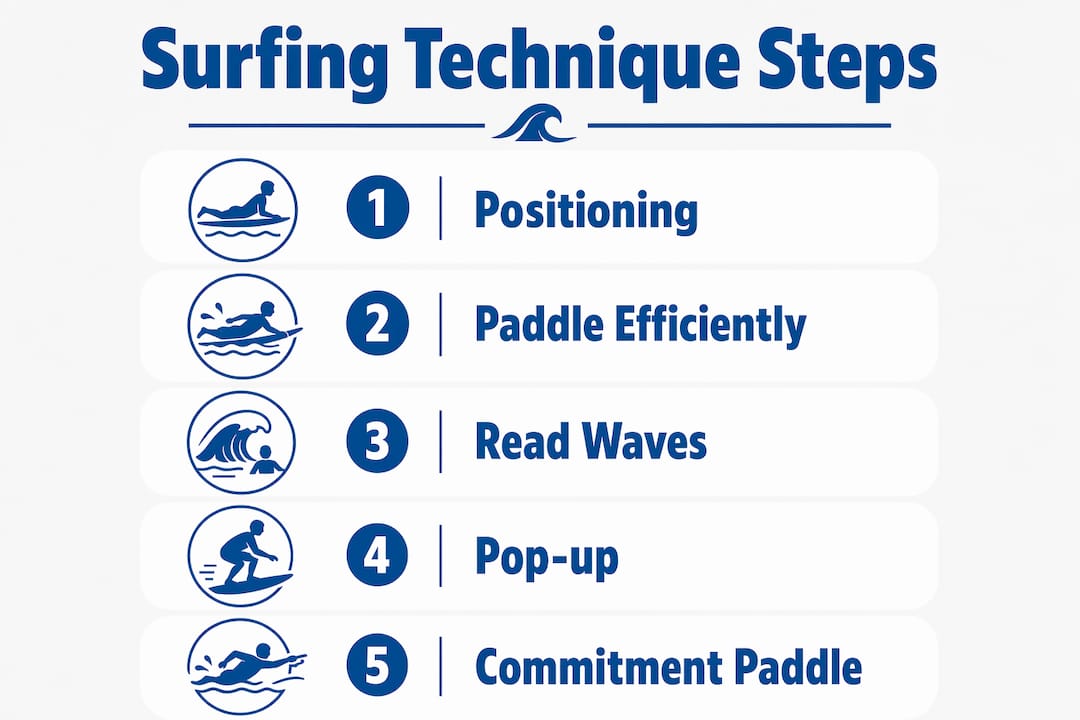
Pro Tip: When you feel yourself drifting off your landmark, use two or three short corrective strokes rather than a full sprint. Small adjustments preserve energy for the waves that matter.
Waves move at 10–20 mph. Your paddle speed needs to approach that range at the moment of commitment, which is why acceleration through the final strokes matters more than raw paddle power at the start.
How do you read waves and time your takeoff consistently?
Select waves that peel cleanly from a defined peak across a shoulder. A wave that closes out all at once gives you nowhere to go. A peeling wave gives you a wall to work with.
How to read a set:
- Watch three to five waves before committing to a position
- Identify where the peak breaks first, then trace the shoulder direction
- Count how many waves are in each set so you can predict the lull
- Mark a shore reference point for your takeoff zone and check it every few minutes
Timing the paddle is where most beginners lose waves. The goal is to be moving at close to wave speed before the peak reaches you, not after. Think of it as a runway: you need to be at speed before the wave arrives, not scrambling to catch up once it does.
The 12-second rule is a situational heuristic worth knowing. When you spot a set wave on the horizon, count a short interval before it reaches your position. Use that window to turn your board toward shore, take two to three positioning strokes, and begin building paddle speed. It won’t be exactly 12 seconds every time, but the habit of counting forces you to start early instead of reacting late.
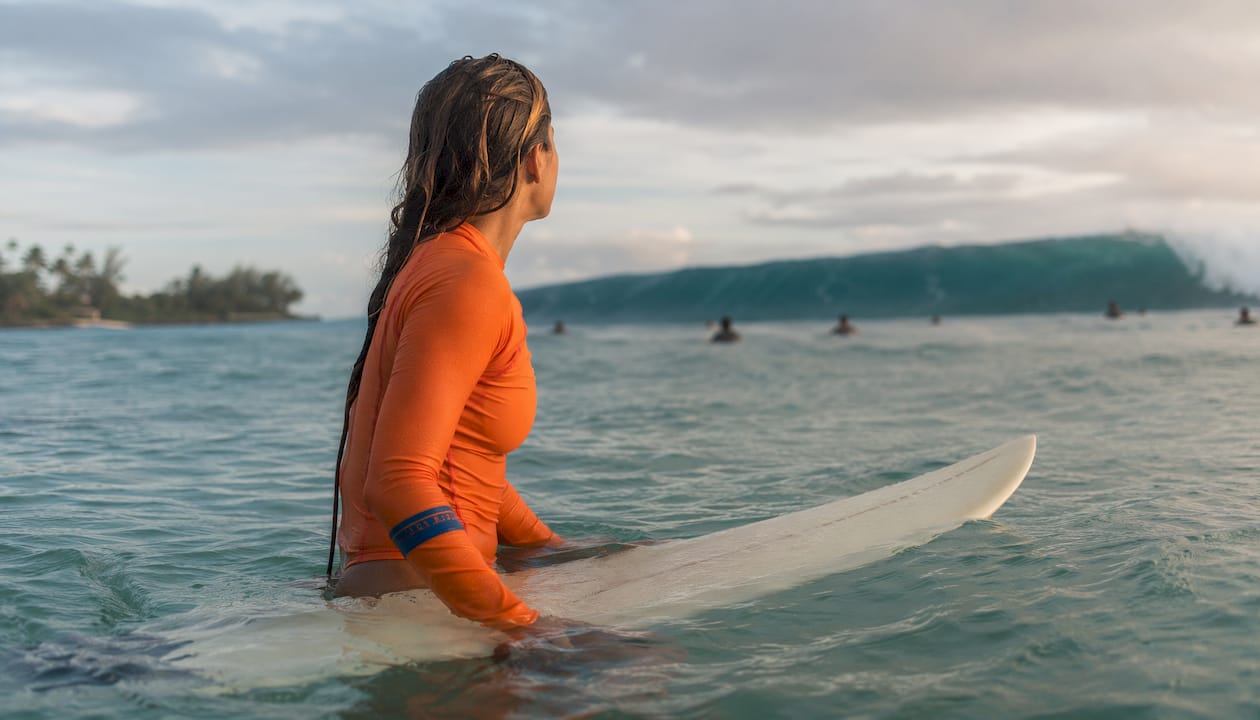
Steep, hollow waves require earlier commitment; slow, rolling waves allow a later paddle. Adjust your timing based on what the wave is doing, not what you wish it would do.
Pro Tip: When the lineup is crowded, target secondary peaks or smaller waves that other surfers ignore. You’ll catch more waves with less conflict, and those extra reps build consistency faster than waiting for the set wave.
What does a reliable pop-up look like, and how do you build one?
A fast, practiced pop-up plus a low, neutral stance is what turns a takeoff into a stable ride. The pop-up isn’t a push-up. It’s a single explosive movement from chest-down to feet-planted.
Step-by-step pop-up mechanics:
- Hands flat on the board beside your lower chest, not your shoulders
- Push up and slide your feet forward in one motion, don’t step one foot at a time
- Land with your front foot over the board’s midpoint and your back foot over the fins
- Keep your knees bent, weight centered, and eyes looking down the wave, not at your feet
- Arms out wide for balance, front arm pointing toward the wave’s shoulder
Land drills matter more than most surfers realize. 20–30 pop-ups on sand before each session builds the muscle memory that makes the motion automatic in the water. Do them on a board outline drawn in the sand so your foot placement becomes instinctive.
The pop-up is a skill built on land before it works in the water. Surfers who skip dry-land practice spend their first 20 minutes in the ocean relearning a movement they could have grooved in 10 minutes on the beach.
Film your pop-ups. A phone propped against a bag on the sand gives you instant feedback on timing and foot placement. Most surfers are surprised to see how slow their pop-up actually is compared to how fast it feels.
For small, rolling waves, a slightly more upright stance works fine. On steeper, faster waves, drop your weight lower and lean into the front foot earlier to prevent the board from shooting out behind you.
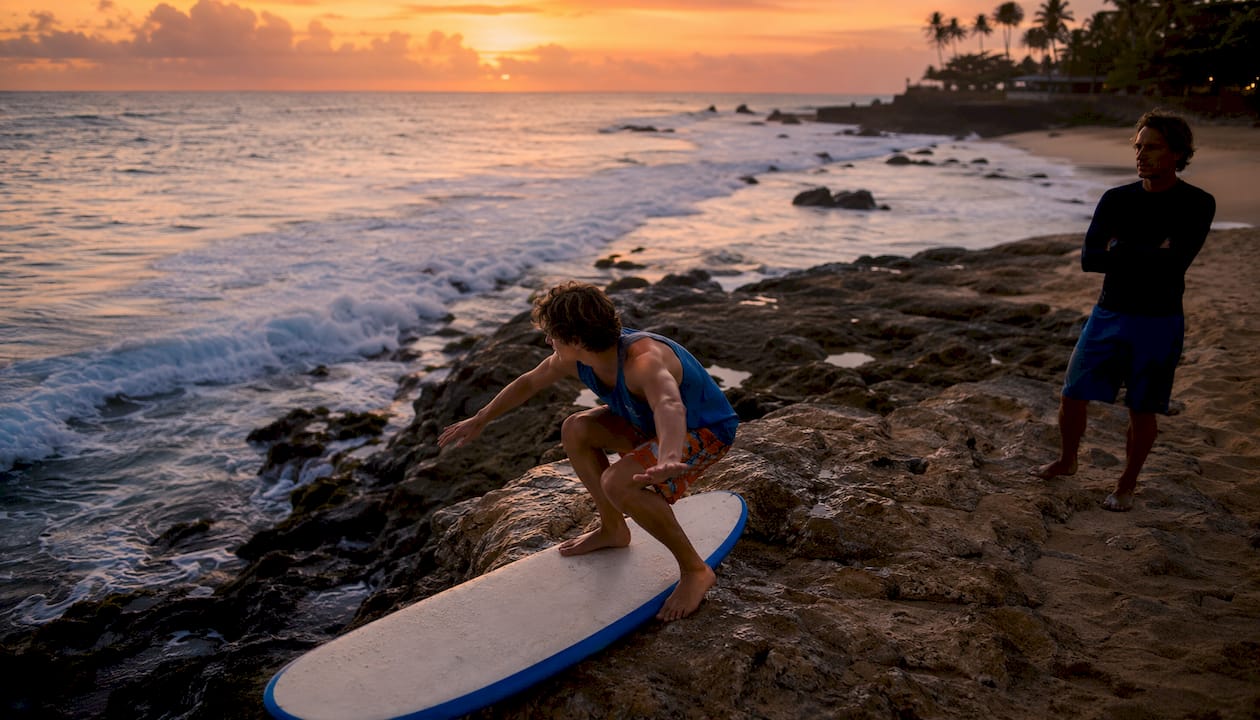
Pro Tip: Practice single-leg balance holds (30 seconds per leg) at home to build the ankle and hip stability that keeps your stance solid when the board moves under you.
How do you commit on takeoff and maintain an accelerating paddle rhythm?
The commitment paddle is the single biggest fix for missed takeoffs. When the wave lifts the board, most learners stop paddling. That pause kills all momentum and leaves the board stalling on the face. The fix is two to five extra hard strokes timed exactly to the moment of lift.
Progressive paddling drill:
- Paddle at a steady rhythm toward the peak
- As the wave begins to lift the tail, increase stroke power by 50%
- Add two to three hard commitment strokes, keeping chest pressure on the board
- Hold that pressure until you feel the wave fully grab the board
- Pop up only after the board is clearly moving with the wave
The start-stop paddle is the primary cause of missed waves. A steady accelerating rhythm replaces hesitation and improves takeoff success. Think of your paddle cadence as a ramp, not a series of bursts.
Troubleshooting common feelings:
- Board stalls: Add two extra commitment strokes and keep your chest pressed to the deck
- Pearling (nose dives): Shift your body slightly back on the board and reduce the delay between the wave lifting and your pop-up
- Being left behind: Start your paddle earlier, before the wave reaches you, not as it arrives
- Board shoots forward without you: You’re popping up too early; wait for the wave to fully engage the board
Pro Tip: Count your commitment strokes out loud during practice. “One, two, three” forces you to complete the full sequence instead of cutting it short when the wave feels fast.
Why does the bottom turn matter, and how do you execute one?
The bottom turn is the engine of consistent rides. Without it, you stall on the wave face and the ride ends in two seconds. With it, you generate speed and set up every maneuver that follows.
A compressed, driven bottom turn converts the potential energy of the drop into usable speed along the face. It’s not a casual lean. It’s a deliberate weight transfer.
Step-by-step bottom turn:
- As you drop down the wave face, compress your knees and lower your center of gravity
- Drive your back foot into the tail to engage the fins
- Point your front arm in the direction you want to go, toward the open shoulder
- Keep your eyes on the section ahead, not at your feet
- Extend out of the compression as you come off the bottom, letting that energy push you up the face
Bottom turns are more than maneuver mechanics. They are how surfers convert potential energy on the face into usable speed for linking sections. Every maneuver you want to do later depends on how well you set it up here.
Start practicing on small, forgiving waves where the consequence of a bad turn is just a slow ride. Add speed as your confidence builds, then link the bottom turn to a single top turn. That two-move combination is the foundation of every longer ride you’ll ever do.
Pro Tip: If you keep stalling after the bottom turn, you’re probably standing too upright. Drop your hips lower during the compression phase and you’ll feel the difference immediately.
What does a research-backed weekly practice plan look like?
Frequency beats duration. Three two-hour sessions per week produce faster skill gains than one long session, because shorter sessions reduce fatigue and prevent the bad habits that form when you’re tired. Here’s a four-week plan built around that principle.
| Week | Session Goal | Key Drills | Success Criteria |
|---|---|---|---|
| 1 | Positioning and paddle rhythm | Shore landmark drill, 20 paddle sets, 20 land pop-ups | Hold takeoff zone for 30 minutes without drifting |
| 2 | Commitment paddle and takeoff | Commitment paddle drill (5 reps per wave), pop-up timing | Complete 15–20 successful takeoffs per session |
| 3 | Pop-up and stance stability | 30 land pop-ups, single-leg balance holds, film review | Consistent foot placement over fins on most rides |
| 4 | Bottom turn and ride linking | Bottom turn reps on small waves, two-move combinations | Complete a bottom turn plus one direction change per ride |
Drill checklist for each session:
- 20–30 land pop-ups before entering the water
- Landmark check every 10 minutes to confirm positioning
- Commitment paddle drill on every catchable wave
- One bottom turn attempt on every ride, even a small one
- Film at least one session per week for form review
Reaching 50 practice waves is a meaningful milestone. At that point, the movements start to feel less deliberate and more automatic. At 50–100 waves, most surfers describe the pop-up as something that just happens, rather than something they have to think through. That’s the neural learning threshold you’re building toward.
For surfers who want to support their paddle endurance between sessions, cross-training for surfers covers the conditioning work that translates directly to the water.
What common mistakes break consistency, and how do you fix them?
Most consistency problems trace back to three fixable errors: positioning drift, start-stop paddling, and late commitment. Diagnose which one is costing you waves and you can fix it in a single session.
| Symptom | Likely Cause | Quick Fix |
|---|---|---|
| Board stalls at takeoff | Stopped paddling when wave lifted | Add 2–3 commitment strokes; keep chest on deck |
| Pearling (nose dive) | Too far forward on board, or popped up too late | Shift body slightly back; pop up faster |
| Wave passes under you | Started paddle too late | Begin paddling before the wave reaches you |
| Ride ends immediately | No bottom turn, board stalls on face | Compress and drive off the bottom on every wave |
| Drifting out of takeoff zone | Not checking landmarks | Set two shore references; correct with small strokes during lulls |
Pre-paddle checklist:
- Board trim confirmed (chest slightly forward of midpoint)
- Leash attached and clear of feet
- Shore landmarks identified
- First three waves of the set observed
On wipeouts: fall flat, not headfirst. Cover your head with your arms as you surface, and always come up slowly to check for the board above you. A safe wipeout is one you recover from quickly and paddle back out from with confidence. Treating wipeouts as data, not failures, is what keeps training continuity intact.
Pro Tip: After a wipeout, take 10 seconds before paddling back. Breathe, check your position relative to your landmarks, and reset your mental checklist. Rushing back out without resetting is how bad habits compound.
Which board setup makes catching waves easier and more repeatable?
More volume means more stability and easier paddling, which directly supports consistent practice. For beginners moving toward intermediate, the board choice matters more than most people admit.
Quick gear recommendations:
- Beginners: A foam longboard or funboard in the 8–10 foot range gives the volume and stability to catch waves easily and practice pop-ups without fighting the board
- Intermediate surfers: A funboard or mid-length (7–8 feet) lets you apply the techniques in this guide while still offering enough paddle speed to catch a wide range of waves
- Avoid shortboards early: A board under 6’6" requires precise technique to catch waves at all, which makes it a poor learning tool when you’re still building consistency
- Fin setup: A three-fin (thruster) setup is the most forgiving for beginners and intermediates; it provides drive and control without the twitchiness of a twin fin
- Leash length: Match your leash to your board length. An 8-foot board takes an 8-foot leash. A leash that’s too short pulls the board back into you on wipeouts
Board trim, where you lie on the board, affects everything. Chest slightly forward of the midpoint is the baseline. Adjust slightly back in bigger surf to prevent pearling, slightly forward in small, slow waves to generate enough paddle speed to catch them.
What safety basics and lineup etiquette should every surfer know?
Safe, respectful sessions lead to more practice time and better outcomes. A surfer who understands the lineup gets more waves and fewer close calls.
Safety checklist before every session:
- Check the surf report and observe conditions for five minutes before paddling out
- Warm up on the beach: hip rotations, shoulder circles, and 20 pop-ups
- Confirm your leash is attached and the cord is clear of your feet
- Identify your exit point before you paddle in, not after
- Know the basic rip current response: don’t fight it directly, paddle parallel to shore until you’re clear, then angle back in
Lineup etiquette:
- The surfer closest to the peak has priority. Don’t drop in on a wave someone else is already riding
- Keep a board-length of distance from other surfers when paddling out; go around the break, not through it
- Call your wave if you’re going right or left so nearby surfers know your direction
- Don’t sit directly on top of the pack in a crowded lineup. Targeting secondary peaks gives you more waves and fewer conflicts
- Respect the surfing etiquette rules that keep lineups functional for everyone
Etiquette isn’t just politeness. It’s how you protect your wave count. A surfer who drops in on others gets called out and loses priority. A surfer who reads the lineup and communicates gets more waves.
How does hands-on coaching at Hhsurf shorten the learning curve?
Instructor-led lessons cut the time to consistent rides by providing immediate feedback, tailored drills, and safe progression. The difference between figuring it out alone and having a coach watch your pop-up in real time is measured in weeks, not days.
At Hans Hedemann Surf School in Waikiki, lessons are structured around the same techniques in this guide: positioning, paddle rhythm, commitment, pop-up, and bottom turn. Instructors watch your takeoff from the water and correct positioning errors before they become habits. That real-time feedback loop is what accelerates progress.
What to expect in a typical Waikiki lesson:
- Individual positioning guidance in the water, not just on the beach
- Real-time correction of paddle timing and commitment stroke errors
- Targeted pop-up drills matched to your current level
- Safety briefing and wipeout practice before you paddle out
- Most students stand up and ride their first wave within the first lesson
The fastest path to consistent wave riding is a coach who can see what you can’t. A student watching their own pop-up on video learns in minutes what might take months of solo trial and error to figure out.
Hhsurf’s teaching methodology is built around individual attention and rapid progression. The school’s instructors are professional surfers who understand both the technique and the psychology of learning in the water. For readers who want to know what makes a great instructor, the traits of a good beginner surf instructor are worth reading before you book.
How do you handle wipeouts safely to build confidence and resilience?
Wipeouts are not failures. They are the mechanism by which your body learns what not to do next time. Every surfer wipes out, including the ones who make it look effortless.
The key to a safe wipeout is protecting your head and surfacing slowly. When you fall, push away from the board and fall flat, like a starfish, to distribute impact across the surface rather than driving deep. Cover your head with both arms as you come up. The board is on a leash and it will be somewhere above you.
Once you surface, take a breath before you look for the board. Then locate it, check for incoming waves, and decide whether to paddle back out or let a wave push you in. Rushing the recovery is how surfers get hit by their own boards.
Confidence in the water grows directly from knowing how to fall well. Surfers who practice wipeout technique, actually practicing falling in shallow water, recover faster and paddle back out with less hesitation. That shorter recovery time means more waves per session, which is exactly what builds consistency.
The mental side matters too. Treat each wipeout as a data point: what happened, what caused it, what you’ll adjust. That habit turns a frustrating moment into a coaching session with yourself.
Key Takeaways
Consistent wave riding is built on five repeatable skills practiced frequently enough to become instinctive, with many practice waves as the measurable threshold for automated movement.
| Point | Details |
|---|---|
| Positioning is active | Use two shore landmarks and small corrective strokes during lulls to stay in the takeoff zone. |
| Commitment paddle is the fix | Add 2–5 hard strokes the moment the wave lifts the board; stopping early is the top cause of missed waves. |
| Land pop-ups build water skills | Do 20–30 pop-ups on sand before each session to ingrain foot placement and timing. |
| Three sessions per week beats one long one | Three two-hour sessions per week produce faster skill gains than a single marathon session. |
| Hhsurf accelerates the process | Hans Hedemann Surf School’s in-water coaching corrects positioning and pop-up errors in real time, compressing weeks of solo practice. |
Next-session plan:
- Warm up with 20–30 land pop-ups and shoulder circles
- Spend the first 30 minutes on paddle positioning: landmark drills and corrective stroke practice
- Spend 45 minutes on wave-focused reps: commitment paddle, pop-up, and one bottom turn per ride
- Spend the final 15 minutes reviewing filmed footage or mentally noting what worked
Aim for 50 practice waves across your first week of focused sessions. That’s your first real milestone.
What coaches actually see in surfers who improve fast
The surfers who progress fastest aren’t the most athletic ones. They’re the ones who show up three times a week instead of once, who do their land pop-ups even when it feels silly, and who treat a missed wave as information rather than embarrassment.
What coaches notice most is the moment a student stops thinking about the pop-up and just does it. That shift, from deliberate to automatic, happens somewhere in the 50–100 wave range for most people. Before that threshold, every takeoff is a mental checklist. After it, the body just responds. The goal of every drill in this guide is to get you to that threshold faster.
The plateau is real and it’s predictable. Around week three or four, progress feels slower because the obvious errors are gone and the subtler ones take longer to see. The fix coaches give at that stage is always the same: go back to basics. Run the commitment paddle drill again. Film the pop-up again. The answer is almost always in the fundamentals, not in some advanced technique the student hasn’t learned yet.
Small wins compound. Catching one more wave per session than last week is a meaningful improvement. Don’t wait for a breakthrough session. Build the habit of consistent, focused practice and the breakthrough sessions take care of themselves.
A private lesson with Hhsurf gets you to consistent rides faster
One targeted private lesson with Hans Hedemann Surf School compresses weeks of trial-and-error into a few hours. The reason is simple: an instructor watching your takeoff from the water catches the errors you can’t see yourself, and corrects them before they become habits.
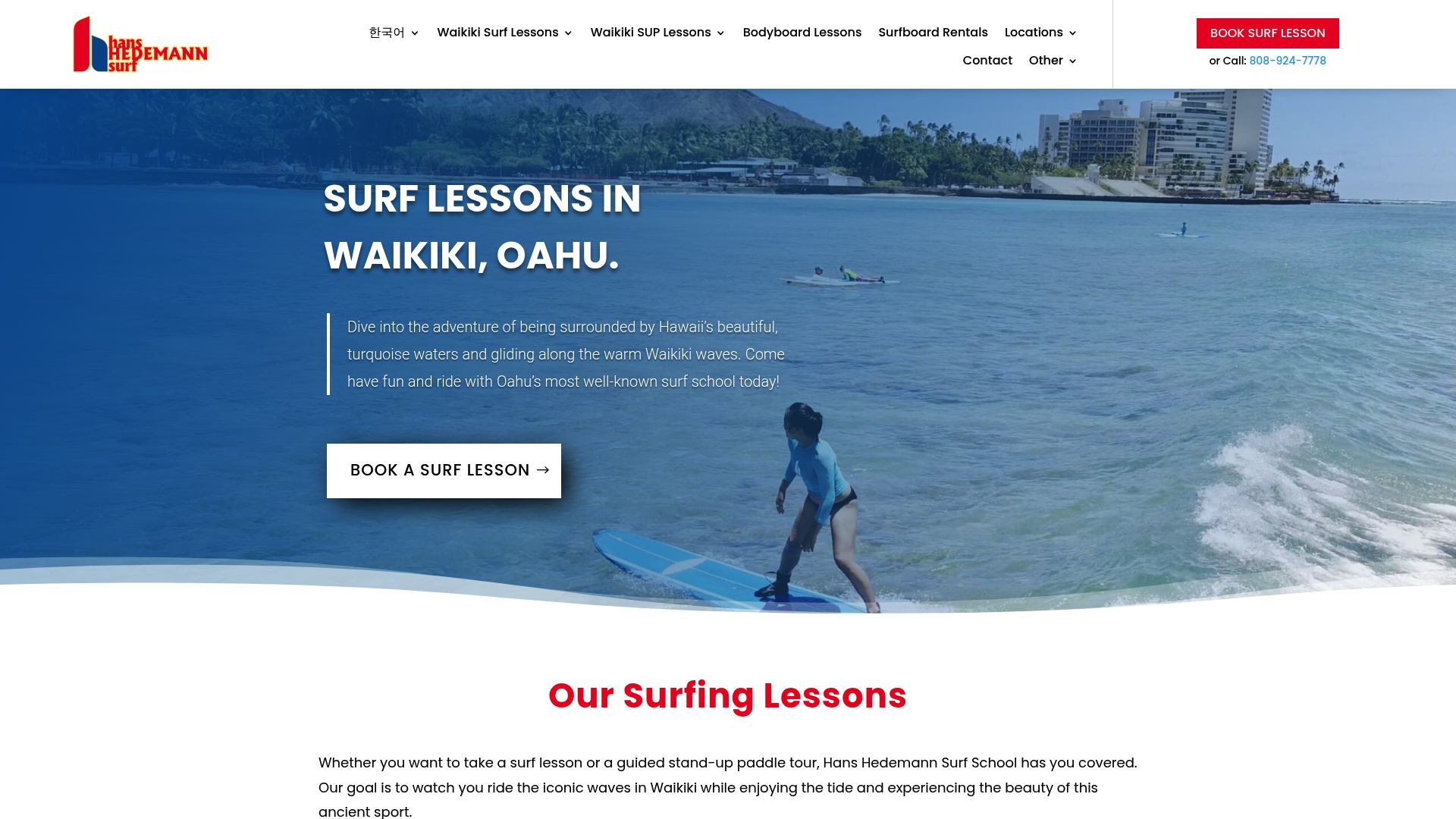
Private surf lessons in Waikiki are structured around the techniques in this guide: positioning, commitment paddle, pop-up, and bottom turn. You get one-on-one attention in the water, real-time feedback on every wave, and a progression plan matched to your current level. Most students stand up and ride in their first lesson. The school’s professional instructors have taught surfers of every level, from first-timers to intermediate riders looking to link maneuvers.
Ready to put these techniques into practice with a coach beside you? Book a surf lesson with Hhsurf and get in the water with a plan that works.
Useful sources and further reading
The following sources informed the techniques, drills, and practice thresholds in this guide. Each is worth reading for deeper study of specific areas.
-
How to Catch Green Waves — Surf Spot Guide. The primary source for the 50–100 practice-wave threshold and the 10–20 mph wave speed data. Best for understanding the physics of wave catching and why paddle timing matters.
-
How to Paddle for Any Wave — Surf Technique. Detailed breakdown of the commitment paddle, start-stop errors, and board trim. The most practical single resource on paddle mechanics available online.
-
Surfing Strategies: Essential Techniques to Improve Your Wave Riding — Provision Sports. Covers positioning tactics, landmark use, crowded-lineup strategy, and land pop-up drills. Strong on the active position management concept.
-
Top Surfing: A Complete Guide to Riding the Waves — Provision Sports. Source for the three two-hour sessions per week frequency recommendation and the skill acquisition science behind shorter, frequent practice.
-
Surf Tips and Theory for the Advanced Surfer — Soul & Surf Journal. Best resource for bottom-turn theory and how compression converts potential energy into speed. Useful once you’re ready to link maneuvers.
-
Understanding Advanced Surfing Techniques — Ika Ika Surf School. Covers condition-specific paddle timing adjustments for steep versus rolling waves. Relevant for intermediate surfers reading different wave types.
-
Hhsurf: How to Surf — Hans Hedemann Surf School. The school’s own methodology page, explaining what students learn and the progression framework used in Waikiki lessons.
0 Comments