
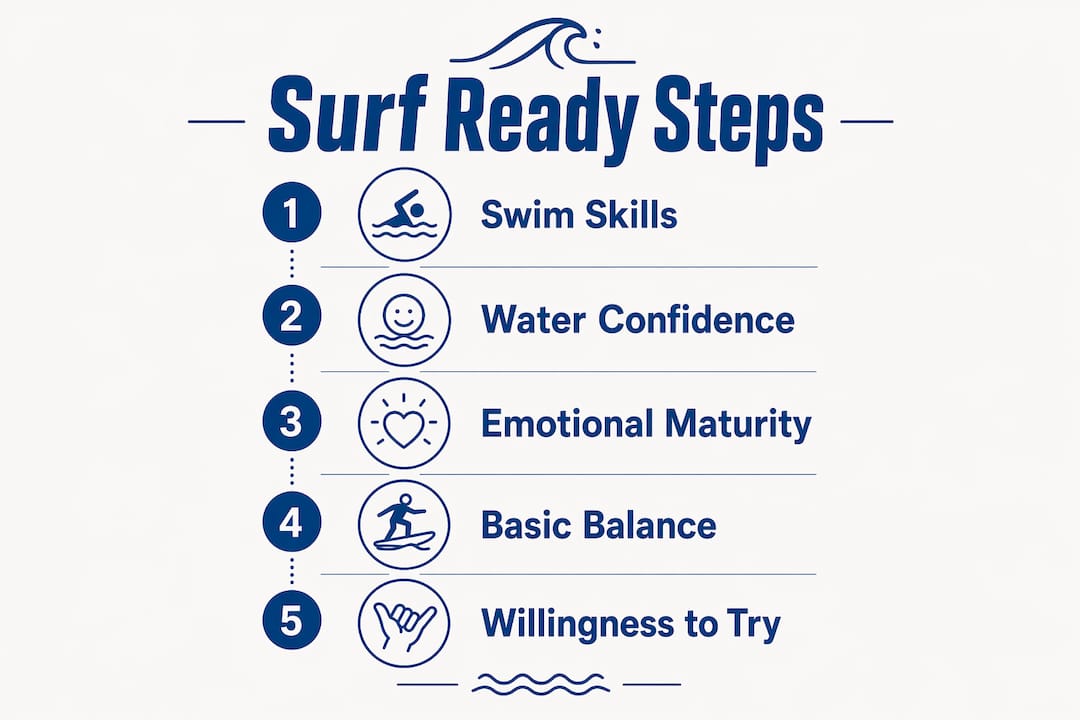
A child is “surf ready” when they can swim a short distance unassisted, stay calm when a wave washes over their face, follow simple one-step instructions, and show up genuinely excited to try. That combination of ocean comfort, basic swim ability, and positive attitude is what instructors actually look for before a first lesson — not athletic talent, not age, and definitely not the ability to stand up on day one.
Quick checklist for parents:
- Can your child swim a short distance without help?
- Do they stay calm (not panicked) when water splashes their face?
- Can they follow a short, simple instruction and repeat it?
- Are they willing to try, even if nervous?
- Do they have enough energy to play in shallow water for 45–60 minutes?
Surf schools consistently advise that enjoyment and confidence come before technical progress. A child who has fun in the water on day one will come back. A child who feels pressured to perform often won’t.
Table of Contents
- What specific skills make a child surf ready?
- How to build surf ready skills before the first lesson
- Minimum safety requirements parents must confirm before lessons
- What actually happens in a first kids’ surf lesson
- How many lessons does it take, and what does it cost in the U.S.?
- What parents should do before, during, and after lessons
- How Hans Hedemann Surf School judges surf readiness and teaches beginners
- Ready to book a kids’ surf lesson in Waikiki?
- Key Takeaways
- The mindset that actually makes lessons work
What specific skills make a child surf ready?
Understanding surf readiness means looking at four concrete areas, not a general sense of “water person.”
- Basic swim ability. Your child doesn’t need to be a competitive swimmer. Unassisted movement through water for a short stretch — roughly 25 meters — is the practical floor. This matters because if a child falls off the board, they need to stay calm and get back to it without panicking.
- Ocean comfort. This is the one parents most often underestimate. Ocean comfort means a child can open their eyes underwater, tolerate water washing over their head, and recover quickly when a small wave knocks them sideways. Pool swimming builds fitness; ocean comfort builds the reflexes that keep kids safe.
- Listening and focus. Instructors give short, clear instructions in real time. A child who can hear “lie flat, now paddle, now pop up” and execute each step in sequence is ready to learn. Kids who tune out mid-instruction slow their own progress and create safety gaps.
- Basic balance and shoulder endurance. Paddling uses muscles most kids haven’t isolated before. A child who can hold a plank position for 20–30 seconds and do a few push-ups has the baseline strength to paddle out and hold the board steady.
Research shows that emotional maturity and water confidence predict faster progress than raw age. A motivated 6-year-old with strong pool skills will often outpace an older child who’s reluctant or anxious.
Pro Tip: Run a quick “wave wash” test at the pool: pour a cup of water over your child’s face and watch the reaction. Calm and laughing? Surf ready. Screaming? Two more weeks of pool games first.
Kids who already love the water tend to learn surfing faster than adults for exactly this reason — lower fear, more flexibility, and a lower center of gravity all work in their favor.
How to build surf ready skills before the first lesson
You don’t need a beach to prepare. A pool, a backyard, and 15 minutes three times a week is enough.
Pool and water drills (2–3 sessions per week, 15–20 minutes each):
- Underwater eye-openers. Have your child submerge and open their eyes to find a toy on the pool floor. Start with goggles, then try without. This builds the reflex to stay calm and oriented when a wave pushes them under.
- Rolly-wave games. Stand in waist-deep water and gently push small waves toward your child’s face. The goal is to laugh, not flinch. Repeat until the reaction is relaxed.
- Boogie-board push practice. In shallow water, have your child lie on a boogie board while you push them toward shore. They practice keeping their chest up, arms forward, and eyes ahead — the exact body position they’ll use on a surfboard.
- Flutter kick practice. Hold the pool wall and kick for 30 seconds. This builds the hip-flexor and leg endurance that powers paddling.
Dry-land prep (2–3 times per week, 10 minutes):
Scaled-down bodyweight exercises done consistently over 2–4 weeks make a real difference in lesson stamina. For kids, keep sets short: a 20-second plank, 10 squats, and 5 push-ups is plenty. The goal is building the habit, not exhausting them.
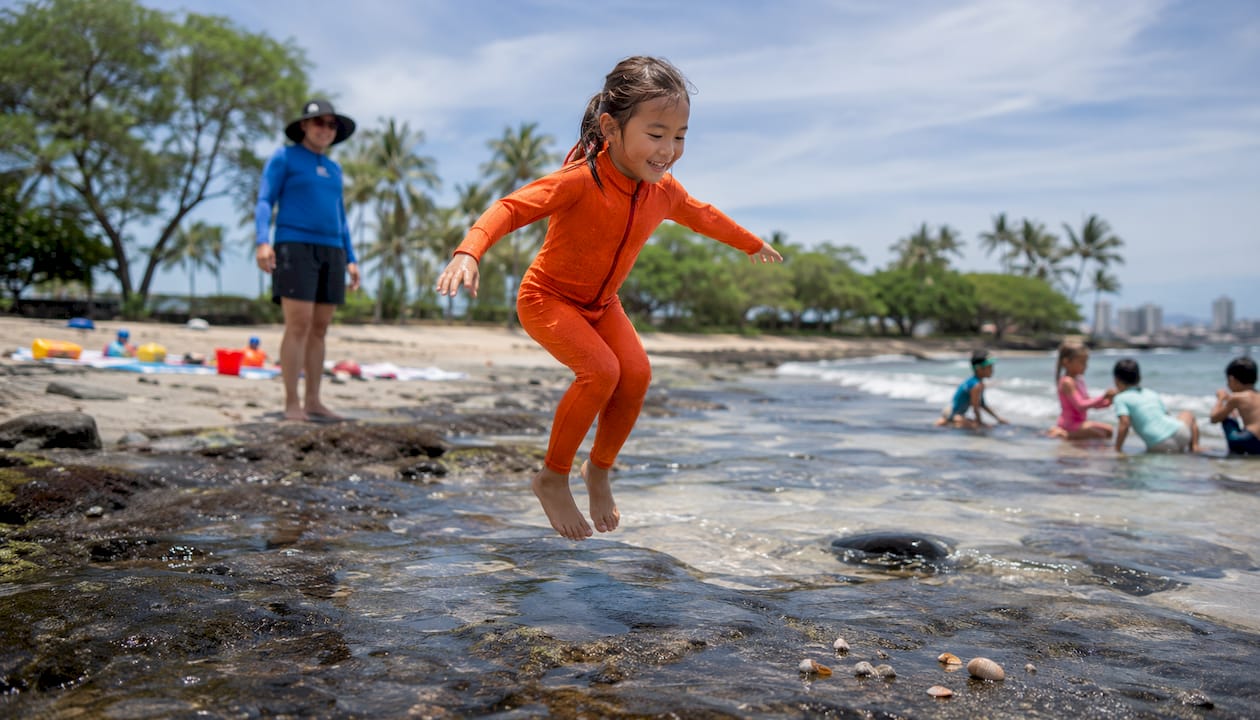
Pro Tip: Frame every drill as a game with a silly name. “Shark attack” for the wave-wash drill, “rocket launch” for the pop-up practice. Kids who are laughing are learning.
Minimum safety requirements parents must confirm before lessons
Before booking any lesson, run through this checklist. These aren’t suggestions — they’re the baseline that keeps kids safe in the water.
- Swim test passed. Your child can swim 25 meters unassisted in a pool. If they can’t, swim lessons come first.
- Calm under water. They can submerge their face without panicking and recover quickly when water washes over their head.
- Age and readiness. Most surf schools accept kids from early school age; some programs take younger children who already show strong water confidence. Age matters less than readiness.
- Proper equipment. A soft-top foam board (not a hard fiberglass board), a properly fitted surf leash, and a rash guard or UV-protective shirt. For younger or less confident swimmers, a properly fitted personal flotation device may be appropriate — confirm with the school.
- Instructor-to-student ratio. For kids, a ratio of 1:4 or better is the standard to ask for. Anything higher than 1:6 in beginner kids’ lessons is a red flag.
Before booking, ask the school directly: “What is your instructor-to-student ratio for kids’ lessons, and what is your safety protocol if a child panics in the water?” A school that answers confidently and specifically is one worth trusting.
Check board types and sizing before the lesson day — the right board size makes a significant difference in how quickly a child finds their balance.
What actually happens in a first kids’ surf lesson
Parents often picture their child shredding waves on day one. The reality is better: it’s structured, safe, and usually ends with a huge grin.
A typical 60-minute beginner lesson follows this sequence:
- Warm-up and introductions (5–10 min). The instructor meets the kids, checks comfort levels, and runs a quick stretch. This is also when the instructor quietly assesses each child’s confidence and energy.
- Dry-land pop-up practice (10–15 min). Kids practice the “pop-up” move on the sand: lying flat, then jumping to a standing position in one smooth motion. Most kids nail the basic shape within a few tries.
- Whitewater wading and board feel (10 min). Kids get in the shallow water with the board, feel how it moves, and practice lying flat while small waves push them toward shore.
- Assisted rides in whitewater (20–25 min). The instructor holds the board, selects a small broken wave, and gives the child a push at the right moment. Instructors commonly use this hands-on support until the child gains enough balance and confidence to try independently.
- Cool-down and debrief (5 min). High-fives, feedback, and a quick chat about what to practice before the next session.
Realistic outcomes: Many kids ride a whitewater wave in their first lesson. Standing up fully is possible, but not guaranteed — and that’s fine. Confidence, comfort, and a positive memory are the real wins on day one. Instructors adjust activities mid-lesson based on how each child responds, so a nervous child might spend more time on the board-feel stage while a confident one moves faster to assisted rides.
How many lessons does it take, and what does it cost in the U.S.?
Progress varies more than most parents expect, and that’s not a bad thing.
- Lessons 1–2: Most kids get comfortable lying on the board and riding whitewater with assistance. Standing up happens for some, not all.
- Lessons 3–4: Kids who practice between sessions and have good ocean comfort usually start popping up independently on small waves.
- Lessons 5–6: Consistent standing, basic steering, and the ability to select their own wave with guidance.
Factors that change the timeline: age (younger kids sometimes progress faster due to lower fear and a lower center of gravity), prior ocean comfort, lesson frequency, and instructor ratio. A child taking weekly group lessons will progress more slowly than one doing a 3-day camp with daily sessions.
Typical U.S. price ranges:
- Group lessons (4–6 students): $75–$120 per session
- Private lessons: $150–$250 per session
- Multi-day kids’ camps: $300–$600 for a 3–5 day program
Private lessons or multi-lesson packages increase instructor attention and tend to accelerate progress compared with one-off group sessions.
Pro Tip: Book a 3-lesson package rather than a single session. The second lesson is where most kids make their biggest jump — they arrive knowing what to expect, and that confidence alone changes everything.
What parents should do before, during, and after lessons
Do:
- Arrive 15 minutes early so your child isn’t rushed or anxious at the water’s edge
- Apply reef-safe sunscreen 30 minutes before the lesson, not in the parking lot
- Pack a snack, water, and a dry change of clothes
- Praise effort and persistence, not just standing up
- Confirm the instructor’s qualifications and safety protocols before the first session
Don’t:
- Stand at the water’s edge coaching technique — it splits your child’s attention between you and the instructor
- Ask “Did you stand up?” as the first question after the lesson
- Compare your child’s progress to other kids in the group
- Book a lesson when your child is tired, hungry, or already anxious about the ocean
After the lesson, let your child lead the debrief. Ask “What was the coolest part?” instead of “What did you learn?” Kids who feel ownership over the experience want to come back.
Pro Tip: Use “I noticed you kept trying even when the wave knocked you over” instead of “Good job.” Specific encouragement tied to effort builds the persistence that actually drives surf progress.
How Hans Hedemann Surf School judges surf readiness and teaches beginners
Hans Hedemann Surf School in Waikiki is one of the clearest examples of instructor-backed methodology done right. The school’s teaching approach centers on hands-on support in whitewater, stepwise progression from play to assisted rides, and safety checks before any child enters the water.
Trust signals parents should look for in any surf school — and that Hhsurf demonstrates:
- Professional surfer coaches. Instructors are experienced surfers, not just lifeguards with a whistle. That distinction matters when a child needs real-time technique correction.
- Low student-to-instructor ratio. Hhsurf’s structure keeps ratios tight so each child gets individual attention, not just a group demo.
- Structured safety protocol. Swim checks, equipment fitting, and a clear plan for what happens if a child panics are all part of the pre-lesson routine.
- Whitewater-first progression. Kids start in broken, shallow waves — not out the back — so the learning environment matches their skill level at every stage.
When evaluating any school, ask specifically how they handle a child who becomes frightened mid-lesson. The answer tells you more about their safety culture than any marketing copy.
Ready to book a kids’ surf lesson in Waikiki?
Hhsurf’s kids surf lessons in Waikiki put your child in the water with professional surfer coaches who know exactly how to read a beginner’s confidence level and adjust in real time. That’s the concrete difference from a generic beach lesson: your child gets hands-on support, a soft-top board sized for their body, and a structured progression that makes standing up feel like a natural next step, not a performance test.
Booking options to match your family’s needs:
- Group kids’ lessons — great for social kids who feed off group energy and want to share the experience with peers
- Private lessons — ideal when your child needs more one-on-one attention or has specific anxiety about the ocean
- Family surf lessons — parents and kids learn together, which often reduces a nervous child’s hesitation faster than anything else
Check safety policies and age requirements directly on the booking page, then reserve your lesson before spots fill — Waikiki lessons book out quickly, especially during summer and school breaks.
Key Takeaways
A child is surf ready when they combine basic swim ability, ocean comfort, and a willingness to try — those three qualities predict a safe, enjoyable first lesson more reliably than age or athletic background.
| Point | Details |
|---|---|
| Swim baseline first | Your child should swim 25 meters unassisted before booking any surf lesson. |
| Ocean comfort beats pool fitness | Calm reactions to face-washing waves matter more than lap speed — practice this in a pool first. |
| Progress takes 1–6 lessons | Most kids ride whitewater with assistance in lesson one; consistent standing usually develops by lessons 3–4. |
| Enjoyment drives return | Instructors and surf schools agree: confidence and fun on day one predict long-term progress better than immediate standing. |
| Hhsurf for Waikiki beginners | Hhsurf’s kids lessons in Waikiki use professional surfer coaches, low ratios, and hands-on whitewater progression to get children riding waves safely. |
The mindset that actually makes lessons work
Most parents walk up to the beach focused on the wrong metric. They want to see their kid stand up. Instructors want to see their kid laugh.
That gap is where most first-lesson disappointments come from. A child who falls six times and gets up laughing every time is having a perfect lesson. A child who stands up once but looks terrified the whole time is not surf ready yet — regardless of what their feet did.
The parents who see the fastest progress are the ones who treat the first few lessons as ocean playtime with structure, not a performance evaluation. They cheer for paddle attempts, not just pop-ups. They let the instructor be the authority in the water and save their own enthusiasm for the walk back to the car.
Patience isn’t passive here. It’s the most active thing a parent can bring to the beach.
0 Comments