
For long surf sessions, the most effective approach is a layered system: UPF 50+ clothing, a broad-spectrum water-resistant SPF 50 mineral sunscreen applied 15–20 minutes before paddling out, and a zinc stick targeted to your face, ears, nose, and lips. The American Academy of Dermatology recommends SPF 30 as a minimum for outdoor activity and SPF 50 for extended sessions; Hawaii’s Act 104 adds a reef-safety dimension by restricting oxybenzone and octinoxate. Hhsurf instructors reinforce this routine with every lesson in Waikiki.
Your surf session checklist:
- UPF 50+ rash guard or wetsuit
- Mineral zinc stick (face, ears, nose, lips)
- Water-resistant broad-spectrum SPF 50 lotion (body)
- SPF lip balm
- Surf hat or hooded rash guard for paddle-outs
- Sunglasses for off-water time
Table of Contents
- Why does surfing create higher UV exposure than a day at the beach?
- Which sunscreen type actually works for surfing?
- What UPF clothing should surfers actually wear?
- How do you apply sunscreen correctly before and during a surf session?
- What does “water-resistant” actually mean for surfers?
- Why reef-safe sunscreen matters and what Hawaii’s rules require
- What does a dermatologist-backed routine look like for a long session?
- What should you do for your skin after a surf session?
- Key Takeaways
- Why Hhsurf takes sun protection seriously
- Hhsurf surf lessons in Waikiki: learn to surf with safety built in
- Useful sources and further reading
Why does surfing create higher UV exposure than a day at the beach?
Surfers face a compounding UV problem that a casual beachgoer simply doesn’t. You’re out there for one to three hours with no shade, no umbrella, and no escape from direct overhead sun. Your face, neck, shoulders, and the backs of your hands are exposed the entire time.
Water makes it significantly worse. Sea foam reflects a significant portion of UV rays, and dry sand also contributes additional UV reflection. That means UV hits you from above and bounces back from below simultaneously. Add in the fact that sweating and repeated immersion wash sunscreen off faster than normal, and the exposure compounds quickly.
Statistic: A study of competitive surfers found that 76.7% reported sunburn and 22.5% never used sunscreen at all, despite training multiple hours outdoors.
The weather-myth problem is real too. Thin cloud cover does almost nothing to block UV radiation. Surfers who skip protection on overcast days are taking the same risk as a clear-sky session. Tropical locations like Hawaii, high-altitude breaks, and low-latitude destinations all intensify UV further. Checking the UV index before a session is as practical as checking the swell report.
Key exposure amplifiers for surfers:
- Water and sand reflection (double-exposure effect)
- No shade during sessions lasting 1–3+ hours
- Sweat and salt water washing off sunscreen
- Physical exertion increasing skin photosensitivity
- Overcast conditions that feel safe but aren’t
Which sunscreen type actually works for surfing?
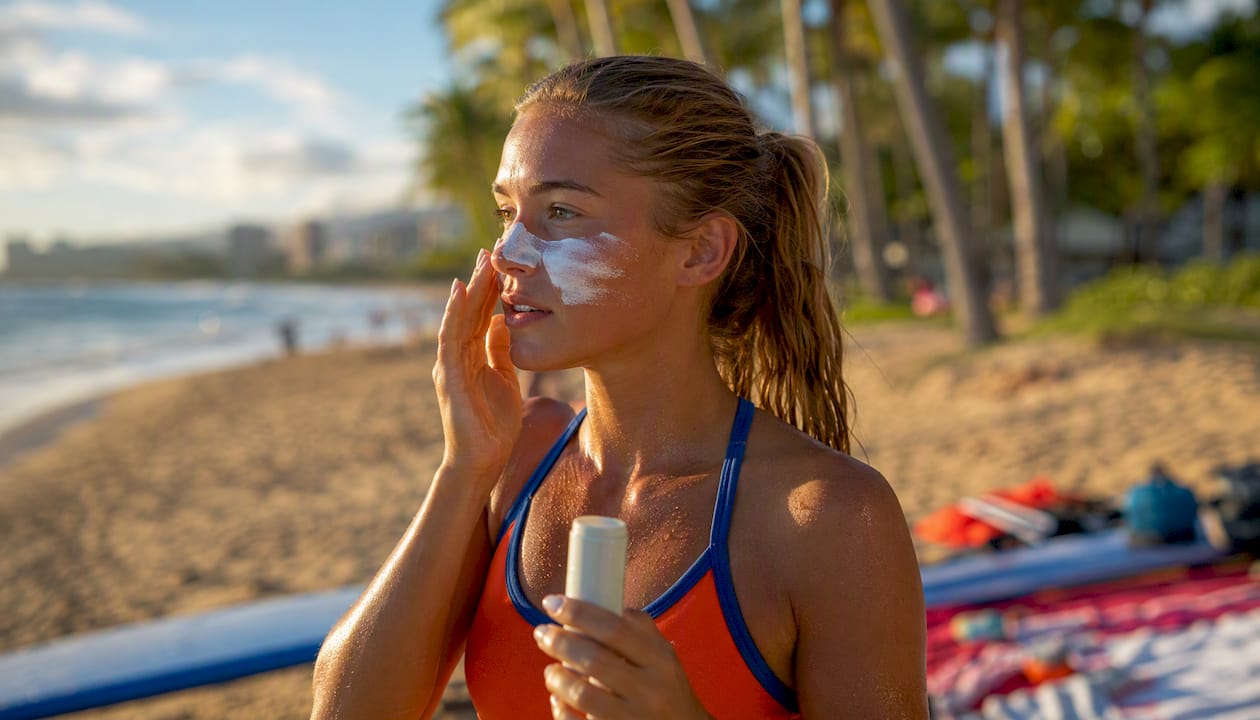
Mineral sunscreens using zinc oxide or titanium dioxide are the preferred choice for surfers. They sit on top of the skin rather than absorbing into it, they tend to stay put better in water, and they’re far less likely to sting your eyes when sweat and saltwater mix. The AAD recommends SPF 30 as a minimum for outdoor activity; SPF 50 is the practical choice for anyone spending extended time in the water.
Format matters as much as SPF:
- Zinc sticks: Non-run, easy to reapply solo, visible layer for confidence. Best for nose, cheeks, ears, and lips. Mineral zinc sticks are standard practice among frequent surfers precisely because they don’t migrate into the eyes.
- Mineral lotions: Good for body coverage before suiting up. Apply generously 15–20 minutes before entering the water.
- Chemical water-resistant lotions: Broader availability, often lighter feel, but more likely to run and sting eyes. Not reef-safe in many formulations.
- Sprays: Convenient on land, but wind and uneven coverage make them unreliable for surfers. Use only as a supplement, never as the primary layer.
Project Reef Sunscreen and Meadow and Bark compared
| Product | Type | SPF / Broad-Spectrum | Water Resistance | Comfort / Run-off | Coverage | Reef Safety |
|---|---|---|---|---|---|---|
| Project Reef Sunscreen | Mineral | SPF 50, broad-spectrum | Water-resistant | Non-greasy lotion; low run-off | Face and body | Reef-safe mineral formula; ocean-friendly filters |
| Meadow and Bark Mineral Zinc Sunscreen | Mineral zinc | SPF 30+, broad-spectrum | Water-resistant | Thick zinc stick; non-run | Face, nose, ears, lips | Non-nano zinc oxide; reef-safe |
| Mineral zinc stick (category) | Mineral | SPF 30–50, broad-spectrum | Water-resistant | Non-run visible layer | Targeted: nose, ears, lips | Non-nano zinc; reef-safe |
| Water-resistant SPF 50 lotion (category) | Mineral or chemical | SPF 50, broad-spectrum | 40–80 min label claim | Spreadable; varies by formula | Body coverage | Mineral versions reef-safe; check label |
Project Reef Sunscreen is built around an ocean-friendly ingredient profile. It works as a full-face and body lotion for surfers who want one product that covers both bases without compromising reef safety. Apply it to all exposed skin before suiting up.
Meadow and Bark Mineral Zinc Sunscreen earns its place specifically as a facial stick. The thick zinc oxide formula doesn’t migrate when you’re paddling hard or duck-diving, and the stick format means you can reapply between sets without needing dry hands. It’s the product you keep in your board shorts pocket.
For body coverage where UPF clothing isn’t present, a water-resistant broad-spectrum SPF 50 lotion gives you the surface area you need. Apply generously. Most surfers use roughly half the recommended amount, which cuts effective protection significantly.
Pro Tip: Use the double-layer method: apply your SPF 50 mineral lotion to all exposed skin 15–20 minutes before leaving home, then add a zinc stick to your face, ears, and lips right before paddling out. The lotion bonds to skin; the stick handles the high-exposure zones that take the most direct sun.
What UPF clothing should surfers actually wear?

Clothing is the most reliable protection layer you have. It doesn’t wash off, doesn’t need reapplication, and a UPF 50+ rated garment blocks over 98% of UV radiation. That’s a level no sunscreen can consistently match across a two-hour session in the water.
When shopping for UPF swimwear, look for a certified UPF 50+ rating (not just “UV protective”), tight fiber density, and a snug but comfortable fit. Loose weaves lose UPF performance when wet and stretched. Long-sleeve rash guards cover your torso, arms, and part of your neck, dramatically cutting the skin area that needs sunscreen.
Garment selection by condition:
- Warm water, high UV: Long-sleeve UPF 50+ rash guard. Covers torso and arms; pair with zinc stick for face and neck.
- Cool water: 2–3mm wetsuit top or full suit. Neoprene provides physical UV blocking in addition to warmth.
- Extended paddle-outs or flat spells: Hooded rash guard or a surf hat with a chin strap. Your ears and neck take serious sun when you’re sitting upright waiting for a set.
- Kids: Full-coverage suits with hoods are the most practical option; kids surf lessons at Hhsurf always recommend full-sleeve coverage for younger surfers.
Pro Tip: For sessions over two hours, layer a rash guard under a thin wetsuit top. The rash guard reduces friction and adds a second UV barrier; the wetsuit top handles water temperature and adds coverage for your neck and upper chest.
For more on UV protection clothing and how fabric construction affects real-world performance, the L’ANIMAL CO guide covers fiber density and wet-state UPF in practical detail.
How do you apply sunscreen correctly before and during a surf session?
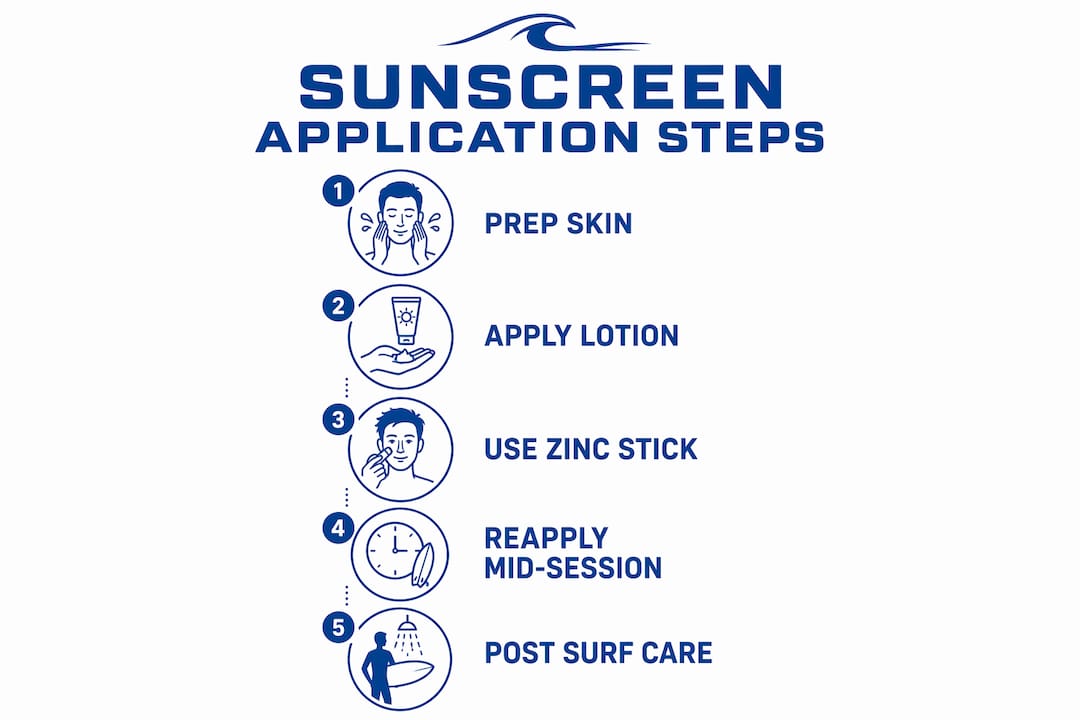
Apply your lotion at home, not in the parking lot. Mineral sunscreens need 15–20 minutes to bond with skin before water contact; chemical formulas need the same window. Rushing this step cuts your protection from the first wave.
Step-by-step application sequence:
- At home (15–20 min before leaving): Apply water-resistant SPF 50 mineral lotion to all exposed skin: face, neck, ears, backs of hands, and any body areas not covered by your rash guard. Use a generous amount.
- In the parking lot or on the beach: Add a second pass to any areas you missed. Check your neck and ears specifically.
- Right before paddling out: Apply your zinc stick to nose, cheekbones, ears, and lips. This is your targeted high-exposure layer.
- In the lineup: Keep your zinc stick in a board shorts pocket or tucked in your wetsuit. Between sets, a quick wipe-and-reapply takes 15 seconds.
- Reapplication triggers: Every 80 minutes minimum, after towel-drying, and after any heavy session segment involving repeated duck-dives or wipeouts.
Solo reapplication is the real challenge. A stick format solves it: you don’t need dry hands, a mirror, or a second person. Wipe the back of your hand across your face to check if the zinc layer has worn thin, then reapply directly.
What does “water-resistant” actually mean for surfers?
“Water-resistant” is a laboratory claim, not a field guarantee. The FDA allows the label for products that maintain their SPF after either 40 or 80 minutes of water immersion under controlled test conditions. Real surfing involves continuous immersion, board friction, sweating, and repeated wipeouts. That combination degrades protection faster than any lab test replicates.
| Label Claim | Lab Test Condition | Realistic Surf Expectation | Reapply Guidance |
|---|---|---|---|
| Water-resistant (40 min) | 40 min immersion, controlled | 20–30 min in active surfing | Every 40 min or after towel dry |
| Water-resistant (80 min) | 80 min immersion, controlled | 40 min in active surfing | Every 80 min minimum; sooner after heavy sets |
| No water-resistance claim | None | Washes off almost immediately | Not suitable for surfing |
Reapplication after towel drying and at least every 80 minutes is the standard guidance for water sports. Treat that as a ceiling, not a target.
Practical reapplication triggers:
- Every 80 minutes on the clock, regardless of how the product feels
- After any towel dry, even a quick one
- After a long wipeout sequence or heavy duck-dive session
- When you can see the zinc layer has visibly worn off your nose or cheeks
If you can’t reapply mid-session, at minimum keep the zinc stick on your face refreshed. That’s your highest-exposure zone and the easiest area to touch up without leaving the water.
Why reef-safe sunscreen matters and what Hawaii’s rules require
The most ocean-friendly choice is a mineral sunscreen containing non-nano zinc oxide or titanium dioxide. These particles sit on the skin surface and don’t penetrate coral tissue the way chemical filters do. The Surfrider Foundation’s reef-safe guidance is direct: if the active ingredient list includes anything beyond zinc oxide and/or titanium dioxide, it’s not reef-safe, regardless of what the label claims.
Regulatory note: Hawaii Act 104, effective January 2021, banned the sale of sunscreens containing oxybenzone and octinoxate without a prescription. If you’re surfing in Hawaii, check your product’s ingredient list before you pack it.
Ingredients to avoid:
- Oxybenzone (linked to coral bleaching and hormonal disruption in marine life)
- Octinoxate (banned in Hawaii and several other jurisdictions)
- Octocrylene (emerging concern; avoid where possible)
- Nano-particle zinc or titanium (smaller particles are more bioavailable to marine organisms)
The “reef-safe” marketing label is not regulated by the FDA. A product can carry that claim while still containing chemical filters. Reading the active ingredients list is the only reliable check. Look for “non-nano zinc oxide” or “non-nano titanium dioxide” as the sole active ingredients. Products labeled “Hawaii Act 104 Compliant” give you a clearer signal.
Chemical sunscreens aren’t always a dealbreaker if you’re surfing in non-reef environments and mineral options aren’t available. But for Hawaii, the Caribbean, and any coral-adjacent break, the mineral choice protects both your skin and the ecosystem you’re surfing in.
What does a dermatologist-backed routine look like for a long session?
The full protocol for a multi-hour session runs across three phases: pre-surf, in-surf, and post-surf. Each phase has a specific job.
Pre-surf (at home, 15–20 min before leaving):
- Apply water-resistant SPF 50 mineral lotion to all exposed skin
- Dress in UPF 50+ rash guard or wetsuit
- Pack zinc stick and lip SPF in your bag or board shorts pocket
In-surf:
- Apply zinc stick to face, ears, nose, and lips right before paddling out
- Reapply zinc stick every 80 minutes and after towel dry
- Wear a surf hat during paddle-outs and flat spells
Post-surf:
- Rinse salt and sunscreen off within 30 minutes of exiting the water
- Apply a gentle moisturizer or aloe vera to rehydrate the skin barrier
- Check high-exposure areas (nose, ears, lips, shoulders) for any unusual changes
“For multi-hour sessions, sunscreen alone is rarely sufficient. Top practitioners use a layered system — UPF clothing, lotion, and zinc stick — time sessions to avoid 10 a.m.–4 p.m. peak UV hours, and plan reapplication tied to towel-drying or every 80 minutes.” — American Academy of Dermatology
If you have sensitive skin, test new products on a small area before a full session. Reactions to zinc oxide are rare but possible. And if you’re getting recurrent burns despite protection, or noticing any changing moles or spots that don’t heal, that’s a dermatologist visit, not a sunscreen upgrade.
What should you do for your skin after a surf session?
Rinse off salt and sunscreen residue as soon as you can after exiting the water. Salt left on skin pulls moisture out; sunscreen residue, especially chemical formulas, can cause irritation if it sits for hours. A gentle, fragrance-free cleanser works better than a harsh scrub, which strips the skin barrier further after UV exposure.
Post-surf skin care steps:
- Rinse with fresh water within 30 minutes of your session
- Use a gentle cleanser on your face; avoid anything with exfoliating acids right after sun exposure
- Apply a hydrating moisturizer or pure aloe vera gel while skin is still slightly damp
- Drink water. Dehydration and UV exposure compound each other.
- Avoid retinoids and AHAs for at least 24 hours after heavy sun exposure; they increase photosensitivity and can worsen irritation on already-stressed skin
See a dermatologist if you notice:
- A mole or spot that changes shape, color, or size
- A sore around the lips or ears that doesn’t heal within a few weeks
- Blistering sunburns occurring despite protection
- Rough, scaly patches on frequently exposed areas (nose, ears, scalp)
Skin cancer caught early is highly treatable. Surfers who spend years in the water without consistent protection carry a meaningfully elevated risk, and annual skin checks are a reasonable habit for anyone logging serious time in the ocean.
Key Takeaways
Effective sun protection for surfing requires a layered system of UPF clothing, SPF 50 mineral sunscreen, and a zinc stick, reapplied every 80 minutes and after towel-drying.
| Point | Details |
|---|---|
| Layer your protection | Combine UPF 50+ clothing, SPF 50 mineral lotion, and a zinc stick for face and ears every session. |
| Reapply on a schedule | Reapply every 80 minutes minimum and immediately after towel-drying or heavy wipeout sequences. |
| Choose reef-safe formulas | Use non-nano zinc oxide or titanium dioxide as the sole active ingredients; check labels, not marketing claims. |
| Post-surf care matters | Rinse salt off within 30 minutes, moisturize, and avoid retinoids or AHAs for 24 hours after heavy exposure. |
| Hhsurf reinforces the routine | Hhsurf instructors in Waikiki build sun-safe habits into every surf lesson, from gear prep to in-water reapplication tactics. |
Why Hhsurf takes sun protection seriously
Most surf schools hand you a board and point you toward the water. The instructors at Hhsurf in Waikiki treat sun protection as part of the lesson, not an afterthought. When you’re learning to surf, you’re spending more time sitting on your board, paddling, and waiting than an experienced surfer would. That means more cumulative UV exposure per session, not less.
The layered approach described in this guide reflects what works in the real conditions of Waikiki: intense tropical UV, reflective water, and sessions that run longer than planned. Knowing how to protect your skin is as much a part of learning to surf safely as learning to read a wave.
Hhsurf surf lessons in Waikiki: learn to surf with safety built in
Spending hours in the Hawaiian sun without a solid protection routine is the fastest way to cut a surf trip short. Hhsurf’s Waikiki surf lessons are structured so that safety, including sun protection habits, is part of what you learn from your first session. Professional instructors cover gear, positioning, and in-water routines that keep you comfortable and protected across a full lesson.
Whether you’re booking a group lesson, a private session, or bringing the family for kids surf lessons, Hhsurf’s approach means you leave with technique and the practical habits that make long sessions sustainable. Book your lesson at hhsurf.com/surf-lesson and show up ready to surf.
Useful sources and further reading
- American Academy of Dermatology (AAD) — Authoritative guidance on SPF recommendations, broad-spectrum protection, and skin cancer risk for outdoor athletes.
- Surfrider Foundation Reef-Friendly Sunscreen Guide — Detailed breakdown of which ingredients harm coral reefs and how to read sunscreen labels accurately.
- NOAA Ocean Service: Sunscreen and Corals — Federal research on how chemical sunscreen filters affect coral reef ecosystems.
- EPA Sun Safety Tips — UV index guidance and practical sun-safety recommendations from the U.S. Environmental Protection Agency.
- PMC Study: Sun Exposure in Elite Water-Sport Athletes — Peer-reviewed research on sunburn rates and sunscreen use among competitive surfers.
- Surfline: A Surfer’s Guide to Avoiding Skin Cancer — Practical surf-specific guidance on product selection and application from a surf-focused publication.
- Vampire Surf Club: A Dermatologist’s Guide to Sun Protection for Surfers — Dermatologist-reviewed protocol covering water-resistance labels, reapplication timing, and post-surf care.
- DermLA: Sun Safe on the Water — Dermatology practice guidance on reapplication schedules and protection strategies for surfers and boaters.
Product labels and local regulations, including Hawaii’s sunscreen restrictions, can change. Check official sources and ingredient lists before purchasing, and consult a dermatologist for personalized skin health advice.
0 Comments