
A shared wave is when two or more surfers ride the same wave at the same time, with each rider respecting right-of-way rules and communicating clearly to avoid collision. According to the Cambridge Dictionary, “shared” simply means used or experienced by more than one person — and in surfing, that cooperative spirit is exactly the point. A party wave is the friendliest version: a group of friends all drop in together, same direction, same energy. A peaked wave offers a different scenario, where the wave breaks both left and right from its crest, letting two riders split off in opposite directions simultaneously. A third version is the mid-session yield, where a surfer already riding gives the inside position to someone who has clearly earned priority. None of these is a drop-in. A drop-in means taking off on a wave someone else already has priority on, without permission — the opposite of sharing.
Key Takeaways
Sharing a wave is a cooperative, communicated act governed by right-of-way rules — and learning those rules early makes every session safer and more enjoyable for everyone in the lineup.
| Point | Details |
|---|---|
| Shared wave definition | Two or more riders on the same wave by mutual agreement, respecting right-of-way and communicating direction. |
| Core priority rule | The surfer closest to the breaking peak has right-of-way; always yield when unsure. |
| Call your direction | Shout “Left!” or “Right!” early and loudly on dual-peak waves to prevent collisions. |
| When to yield as a beginner | Wait until you can control your board reliably before attempting to share in open lineups. |
| Hhsurf lessons | Hhsurf teaches right-of-way, calling lines, and safe spacing from the first session in Waikiki. |
Table of Contents
- What does a shared wave look like in practice?
- Core right-of-way rules that govern sharing
- When sharing a wave is acceptable and when it isn’t
- How to share a wave safely
- Common conflicts and how to de-escalate them
- How board type changes the sharing equation
- Why surfers share waves at all
- How surf schools teach sharing and etiquette
- Where the term “shared wave” comes from
- How to read the wave and understand others’ intentions
- When beginners should attempt sharing versus waiting
- What to do when a shared wave goes wrong
- The social awkwardness of sharing is real
- Hhsurf lessons put etiquette into practice
- Sources
What does a shared wave look like in practice?
Picture three distinct moments. First, a party wave at a mellow beach break: four friends paddle together, someone calls “Go!”, and they all pop up, spreading across the shoulder. Nobody cuts across anyone else’s line. Second, a peaking A-frame at a reef break. Wave physics tells us a wave’s crest can break in two directions from a single peak, creating a natural left and a natural right. Two surfers position themselves on either side, one calls “Left!”, the other goes right, and they ride away from each other cleanly. Third, a solo surfer already on a wave spots a friend paddling for the same section. She shifts her weight toward the shoulder, opening up the inside. That’s a yield, and it’s a gift.
Nonverbal cues carry a lot of weight before anyone says a word. Two paddlers lining up shoulder-to-shoulder near the peak usually signals they’re preparing to share. A surfer who makes eye contact and nods while paddling is checking in. Someone who looks away and paddles hard toward the peak is claiming priority.

| Visual sign | Likely meaning |
|---|---|
| Two paddlers side by side at the peak | Preparing to share or split directions |
| Eye contact plus a nod from a paddler | Checking in, open to sharing |
| Hard paddle toward peak, no eye contact | Claiming priority, not inviting a share |
| Rider shifts toward shoulder mid-wave | Yielding the inside line |
Core right-of-way rules that govern sharing
The right-of-way framework is simple once you know it. Follow these six rules and most lineup conflicts disappear before they start.
- Furthest out or closest to the peak has priority. The surfer sitting deepest, nearest the breaking part of the wave, goes first. Everyone else waits.
- First to their feet is a valid exception. If the priority surfer hesitates and someone else pops up cleanly, that person may have earned the wave. Context matters.
- On a dual peak, call your direction. Shout “Left!” or “Right!” loud enough to be heard over the water. Do it early, before you’re already dropping.
- Never snake. Paddling around someone to get inside position — called snaking — is a direct violation of the queue. It poisons the lineup faster than almost anything else.
- Yield when you’re unsure. If you genuinely cannot tell who has priority, let the wave go. There will be another one.
- Sharing is not the same as burning. A drop-in (burning someone) means taking off in front of a surfer who already has right-of-way. A shared wave is a mutual, communicated agreement.
Pro Tip: Call your direction the moment you commit to the wave, not after you’re already on your feet. A clear, early “Left!” gives the other rider time to respond. If they don’t acknowledge it, hold your line and give them space rather than assuming they heard you.
When sharing a wave is acceptable and when it isn’t
Some situations are built for sharing. Others are not.
Sharing works well when:
- The wave has a wide, defined peak with clear left and right shoulders
- Everyone involved has made eye contact and there’s mutual agreement
- The lineup is crowded and taking turns is genuinely impractical
- It’s a mellow, slow-rolling wave with plenty of room to spread out
Sharing is a bad idea when:
- The wave is fast, hollow, or closing out quickly — there’s no room for two riders
- One surfer already holds a clear inside position and hasn’t invited anyone else
- A beginner is attempting a maneuver that requires the full face of the wave
- The other rider hasn’t acknowledged you and doesn’t know you’re there
The one-line rule that covers everything else: if you’re not sure, yield. A wave you didn’t catch costs you nothing. A collision costs everyone.
How to share a wave safely
Sharing safely is mostly about spacing and timing. Beginner etiquette guides consistently stress communication first, positioning second.
- Make eye contact before you paddle. A quick look and nod confirms the other rider sees you.
- Call your direction early and loudly. “Left!” or “Right!” before you’re on your feet.
- Keep rail-to-rail spacing. Give the other rider enough room that a stumble won’t send boards into each other.
- Control your leash. Know where your board will go if you wipe out. A flying board is the biggest injury risk in a shared-wave scenario.
- Avoid aggressive turns toward the other rider. Ride your section of the wave; don’t cut across theirs.
Pro Tip: At bigger, faster breaks, the spacing you’d use on a mellow wave isn’t enough. Swell size and break speed directly affect how much room two riders need. At Oahu surf spots like Sunset or Pipeline, sharing is rare for exactly this reason — the wave moves too fast and the consequences of a mistake are too serious.
Common conflicts and how to de-escalate them
Most lineup conflicts trace back to four situations: a drop-in, a back-paddle (paddling in front of someone to steal priority), snaking, and heated verbal exchanges after one of the first three. The wave commons research frames the lineup as a shared resource governed by informal rules, and violations trigger social sanctions — sometimes just a cold stare, sometimes a direct confrontation.
If you drop in on someone by accident, the response is straightforward: paddle over, make eye contact, and say “My bad, that was yours.” Offer to yield the next wave. Most surfers respect a genuine apology. What they don’t respect is silence or a shrug. As The Inertia documents, sharing ideals break down fastest at crowded, high-demand breaks where waves are scarce and patience runs thin. If a confrontation escalates past words, the cleanest move is to paddle in, take a break on the beach, and return when the tension has settled. Involving an instructor or a more experienced local can help defuse a situation that’s getting out of hand.
How board type changes the sharing equation
Different craft behave very differently in a lineup, and that affects how sharing plays out.
- Longboards need more lead time to turn and more space to stop. A longboarder sharing a wave needs to commit to their line early and hold it.
- SUPs (stand-up paddleboards) have a larger turning radius and more speed on the paddle-in. They can catch waves earlier than shortboarders, which sometimes creates unintentional priority conflicts.
- Shortboards are maneuverable but fast. A shortboarder sharing with a longboarder should expect the longboard to hold a straighter, wider line.
- Bodyboarders often ride deeper in the barrel and take a lower line than stand-up surfers, which can create a natural split on the right wave.
A classic scenario: a longboarder catches a long, peeling right early and rides the shoulder. A shortboarder drops in behind them on the same wave, further down the line. If both riders stay on their respective sections and neither cuts across the other’s path, that’s a clean share. The longboard’s wider arc and the shortboard’s tighter turns naturally keep them apart — as long as both riders are paying attention.
Why surfers share waves at all
Sharing isn’t just courtesy. Surf-sociology research describes the lineup as a “wave commons” — a shared resource where informal rules allocate access and reciprocity keeps the system functional. Surfers yield priority as a social investment: you give a wave today, you’re more likely to receive one tomorrow. That reciprocal logic is what makes the lineup work, especially at crowded spots where waves are genuinely scarce.
Localism strains these norms. When a break is dominated by a tight local crew, the commons logic can collapse into hierarchy — visitors yield not out of reciprocity but out of social pressure. Knowing the local dynamic and adjusting your behavior accordingly (yielding more often as a visitor, reading the room before attempting a share) is a practical skill, not a compromise of principle. The aloha spirit that defines Hawaiian surf culture is, at its core, a formalization of that reciprocal ethic.
How surf schools teach sharing and etiquette
Instructors don’t just tell students the rules — they drill them. At Hhsurf, lessons begin in the whitewater, where the stakes are low and the focus is on fundamentals: calling lanes, reading other riders, and practicing the spacing decisions that matter in a real lineup. Common instructor cues include:
- “Call your line before you paddle, not after.”
- “Look left, look right before you pop up.”
- “Give the person inside you the wave — always.”
Practicing these habits in controlled conditions builds the muscle memory that makes etiquette automatic in open water. Students who go through structured instruction tend to reach a functional understanding of right-of-way far faster than those who learn by trial and error in a crowded lineup. Your first lesson at a school like Hhsurf covers these basics directly, so you’re not figuring out the social rules of the lineup alone.
Where the term “shared wave” comes from
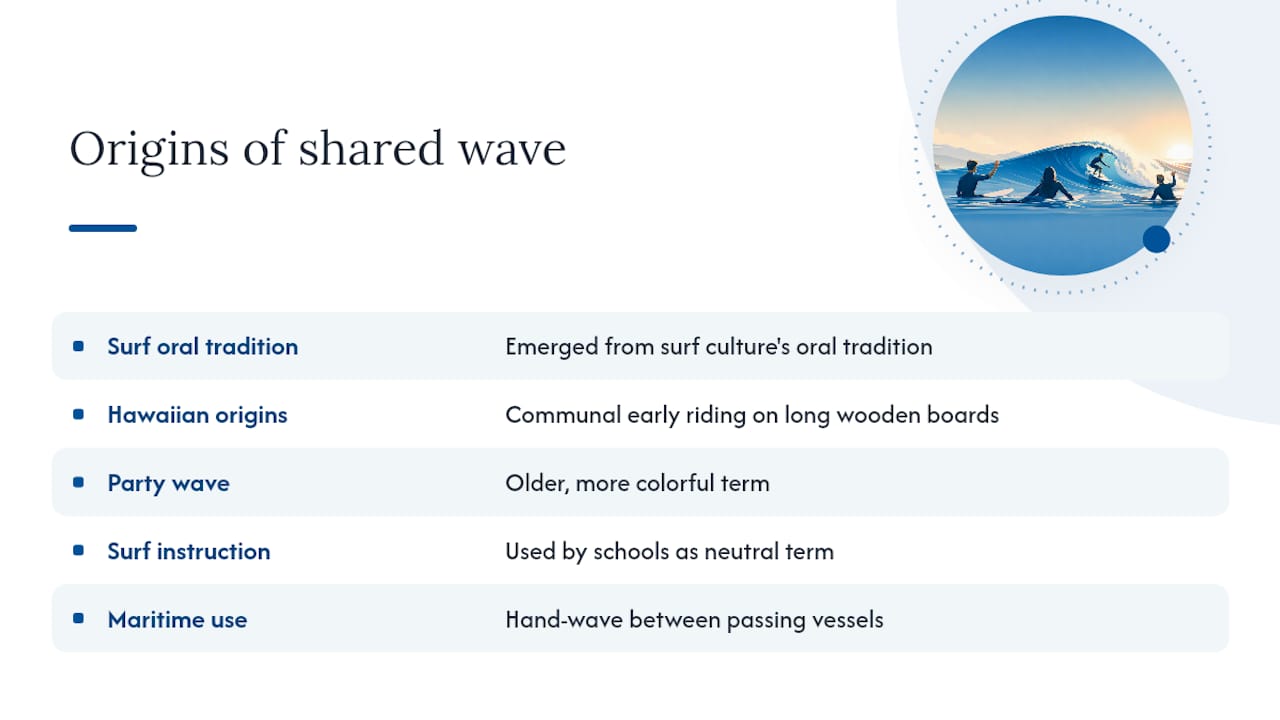
The phrase doesn’t have a single origin point. “Shared wave” is a descriptive compound that emerged naturally from surf culture’s oral tradition, where most etiquette was passed down through lineups rather than written guides. The history of surfing in Hawaii traces back centuries, and the communal nature of early wave riding — where multiple riders on long wooden boards shared the same surf together — is arguably the original form of wave sharing. The term “party wave” is the older, more colorful version of the same concept. “Shared wave” as a formal phrase gained traction as surf instruction became more structured and schools needed neutral, teachable language for what was previously just an informal practice.
Interestingly, “share a wave” also appears in maritime culture as a boating goodwill gesture — a wave of the hand between passing vessels as a signal of mutual awareness and safety. The two uses share the same spirit: acknowledgment, respect, and a brief moment of connection on the water. For collision-avoidance specifics in boating contexts, Safe Boating America covers the parallel principles in detail.
How to read the wave and understand others’ intentions
Reading a wave before you paddle means looking at where it’s going to break, how fast, and where other surfers are positioned relative to the peak. A wave that’s peaking cleanly in the middle with two surfers on either side is almost certainly going to split — that’s a natural share. A wave that’s closing out fast across the whole break has no room for two riders.
Reading other surfers is just as important. Watch their paddle direction, their eye line, and their body position on the board. Someone paddling hard and looking down the line has committed. Someone paddling casually and looking around is still deciding. That distinction tells you whether there’s room for a conversation or whether you need to yield immediately.
When beginners should attempt sharing versus waiting
The honest answer: most beginners should wait. Sharing a wave requires reading both the wave and another rider simultaneously, making quick spatial decisions, and communicating clearly under pressure. Those skills take time to develop.
A reasonable threshold: if you can consistently catch waves on your own, control your board’s direction, and stop reliably, you’re ready to start practicing sharing in low-stakes conditions. Mellow, slow waves with a friend who knows what they’re doing is the right starting point. A crowded reef break with strangers is not. The beginner surf zone exists partly for this reason — it’s a space where the stakes are lower and the learning curve is gentler.
What to do when a shared wave goes wrong
Sometimes it doesn’t work out. Boards collide, lines cross, someone gets spooked and pulls back. The immediate priority is always safety: check that everyone is okay before anything else. If there’s contact, stop surfing and assess.
After the physical situation is clear, the social one follows the same script as any lineup conflict: acknowledge what happened, take responsibility for your part, and offer a genuine apology. If the other rider is shaken or angry, give them space. Paddling back out immediately and acting like nothing happened is the fastest way to make a bad situation worse. If the wave-share was genuinely a miscommunication rather than a violation of right-of-way, say so clearly — most surfers can tell the difference between an honest mistake and a deliberate drop-in.
The social awkwardness of sharing is real
Calling a line out loud in a crowded lineup feels strange the first time. You’re essentially announcing your intention to a group of strangers, and there’s always a moment of uncertainty about whether anyone heard you or whether you read the situation correctly. That discomfort is normal.
The surfers who handle sharing best aren’t the ones who never feel awkward — they’re the ones who’ve practiced the call enough times that it becomes automatic. Etiquette is a skill, not a personality trait. You get better at it by doing it, and the best place to start is on a slow, forgiving wave where a mistake costs you nothing but a laugh.
Pro Tip: Start with mellow, wide-shouldered waves and a friend who already knows the etiquette. Call your line out loud even when it feels unnecessary. The habit of communicating early is what separates a clean shared wave from a near-miss.
Hhsurf lessons put etiquette into practice
Knowing the rules is one thing. Applying them in real water, with real people, is another. Hhsurf’s surf lessons in Waikiki give you both: professional instructors who teach right-of-way, calling lines, and safe spacing from your very first session, in a structured environment where you can make mistakes without consequence.

For focused, one-on-one coaching on etiquette and technique, private surf lessons in Waikiki let you work through sharing scenarios at your own pace with an instructor who can correct your positioning in real time. Book a session and practice sharing the right way from the start.
Sources
- Wave Priority – Who’s Turn to Go in the Surfing Lineup?
- The wave commons: toward a (Rousseauvian) theory of entitlement and its rationalization
- Share a Wave, Save a Life
- Sharing Waves: Is It Too Much to Ask?
- shared | Definition of shared in English by Cambridge Dictionary
- Surfing Etiquette: How to Share Waves and Respect Other Surfers – Hollow Tree Resorts
- Wave | physics | Britannica
0 Comments