
Small group lessons accelerate targeted skill growth while building social confidence and peer relationships at the same time. A meta-analytic summary from Harvard Kennedy School found that compared with individual or competitive learning, small-group instruction consistently improves academic achievement, peer relationships, and psychological well-being. The Education Endowment Foundation puts a number on it: well-targeted small-group tuition with 2–5 pupils yields roughly four months of additional progress over a year.
Two things parents can expect to see:
- Learning: Faster skill acquisition on targeted content, more willingness to ask questions, and measurable progress when groups are matched to the child’s level.
- Behavior: Greater confidence speaking up, stronger peer relationships, and better self-regulation during group tasks.
Key Takeaways
Small-group lessons for kids improve academic outcomes, social skills, and confidence simultaneously when groups stay at 3–6 students, instruction is assessment-driven, and feedback is specific and consistent.
| Point | Details |
|---|---|
| Optimal group size | 3–6 students per instructor; above 6 without an assistant, individual feedback drops sharply. |
| Measurable academic gain | EEF research shows well-targeted small-group tuition yields roughly four months’ additional progress per year. |
| Frequency matters | Around 90% of elementary teachers meet small groups 3–5 days per week; once a week rarely produces the same gains. |
| Top program signals | Flexible grouping, specific corrective feedback, explicit roles, and progress reporting after each session. |
| Hhsurf kids’ lessons | Small groups of 4–6 in Waikiki with professional coaches, individual feedback, and clear skill progression each session. |
Table of Contents
- What is the role of small group lessons for kids?
- What does the research say about benefits for children?
- What small-group activities should your child’s program include?
- How are effective small-group lessons actually run?
- How often and how long should small-group sessions run?
- How to choose a quality small-group program for your child
- How can you support small-group learning at home?
- When small-group lessons may not be the right fit
- What a well-run small-group lesson looks like in practice
- Hhsurf’s small-group kids’ surf lessons in Waikiki
- Sources
What is the role of small group lessons for kids?
Small-group learning places 3–6 students together with a teacher or coach for focused, interactive instruction. That range matters. Below three, it starts to feel like tutoring. Above six, the instructor loses the ability to give each child meaningful feedback in a single session.
The format sits between one-on-one tutoring and whole-class instruction. One-on-one tutoring maximizes individual attention but removes peer interaction entirely. Whole-class lessons reach everyone at once but rarely allow a teacher to address individual gaps. Small groups hit a practical middle ground: targeted instruction with the social dynamics that help children learn from each other.
Parents will recognize three common setups. A guided teacher table pulls a small group aside while the rest of the class works independently, common in reading and math. Breakout groups divide a class for collaborative tasks, often used for projects or problem-solving. Rotating stations cycle students through different activities, each with a specific skill focus. Each format serves a different purpose, and a quality program uses more than one.
What does the research say about benefits for children?
The evidence base here is stronger than most parents realize. The Harvard meta-analytic summary covers academic, social, and psychological outcomes together, which is unusual. Most education research isolates one dimension. The finding that all three improve simultaneously is the key insight for parents: you are not trading social development for academic gains.
A large-scale classroom field experiment in junior-high language arts found small-group techniques produced greater achievement on treatment-specific measures and a modest positive effect on peer-relationship self-concept compared with individualized instruction. More recently, a randomized trial of tailored small-group math interventions found meaningful gains for low-achieving pupils, particularly in younger grades, and noted that group variants sometimes matched or exceeded one-on-one results while being more scalable.
| Evidence source | Key finding | What it means for your child |
|---|---|---|
| Harvard meta-analysis | Improves achievement, peer relationships, and well-being | All three outcomes improve together |
| EEF small-group tuition | ~4 months’ additional progress per year | Measurable academic gain when well-targeted |
| npj randomized trial | Strong gains for low achievers, especially younger grades | Younger children benefit most from early intervention |
| Scholastic teacher survey | ~90% of elementary teachers meet small groups 3–5 days/week | Frequent, consistent sessions drive results |
Pro Tip: Ask any program how they measure progress between sessions. A provider who cannot answer that question specifically is likely not using assessment to guide their groupings.
What small-group activities should your child’s program include?
Stanford Teaching Commons documents several activity formats that work across in-person and online settings. Here is what parents should look for, with age guidance:
- Think-Pair-Share (ages 6+): One child thinks alone, shares with a partner, then the pair reports to the group. Builds articulation and listening simultaneously.
- Jigsaw (ages 8–12): Each child becomes an “expert” on one piece of content and teaches the others. Strong for reading comprehension and retention.
- Turn-and-Talk (ages 5–7): A quick partner exchange during instruction. Low stakes, high frequency, and ideal for younger children who need practice verbalizing ideas.
- Two-stage tasks (ages 9–12): Children complete a task individually, then revisit it as a group. The gap between the two attempts shows exactly where understanding breaks down.
- Reciprocal teaching (ages 8–12): Students take turns leading comprehension strategies: summarizing, questioning, clarifying, predicting. Works well in both classroom and online breakout rooms.
- Role-based drills (ages 7+): Assigned roles (facilitator, note-taker, reporter) keep every child accountable. Curriculum Associates highlights explicit role assignments as one of the strongest equity levers in small-group work.
- Fishbowl discussions (ages 10–12): A small inner group discusses while others observe, then groups swap. Excellent for modeling academic conversation.
- Buzz groups (ages 6+): Short, timed pair or trio discussions on a single question. Works in any setting and takes under five minutes.
For at-home use, Turn-and-Talk and reciprocal teaching translate easily. Ask your child to explain a concept to you as if you have never heard it. That five-minute exercise mirrors what the best small-group sessions do in class.
How are effective small-group lessons actually run?
The operational details separate a well-run program from one that just calls itself small-group. HMH’s guidance on small-group instruction frames it clearly: the format pairs targeted skill work with peer interaction and emotional safety, a balance that supports both cognitive and social outcomes.
In practice, a lead instructor manages the group’s skill focus while an assistant or “float” supports students who need extra help without pulling the instructor off task. In activity-based programs like surf or sport, a coach plays both roles simultaneously, which is why group size control matters even more.
Grouping strategy is where many programs fall short. Flexible grouping means children move between groups based on current performance data, not a fixed label. Homogeneous groups (similar skill level) work well for targeted remediation. Heterogeneous groups (mixed levels) work better for social tasks and collaborative projects. A program that never changes its groups is not using assessment to drive instruction.
Pro Tip: During any observation, watch whether the instructor gives specific corrective feedback or only general praise. “Good job” tells a child nothing. “You shifted your weight too early — try holding it until the wave catches you” is the kind of feedback that drives progress.
What to watch for in a session:
- Clear roles for each child before the activity starts
- Instructor circulating and adjusting, not just observing
- A defined start and end routine (not just “go”)
- At least one moment where a child explains something to a peer
How often and how long should small-group sessions run?
The Scholastic teacher survey found roughly 90% of elementary teachers meet with small groups 3–5 days per week. That frequency is not arbitrary. Skill acquisition in children requires spaced repetition, and once-a-week sessions rarely produce the same gains.
Practical guidance by goal:
- Skill catch-up / remediation: 30–60 minutes per session, 3–5 days per week. Consistent, frequent contact with targeted content is what drives the EEF’s four-month gain figure.
- Enrichment / extension: 20–30 minutes, 2–3 days per week. Less intensity, more exploration.
- Social skills or activity-based programs (sports, arts, surf): 45–60 minutes per session, 1–3 times per week. Longer sessions allow for warm-up, practice cycles, and cool-down reflection.
Younger children (ages 5–7) benefit from shorter, more frequent sessions. Older children (ages 10–12) can sustain longer focused work but still need structured breaks within a session.
How to choose a quality small-group program for your child
Use this checklist before you commit. Check the age requirements and safety considerations for any activity-based program as a starting point.
- Instructor qualifications: Ask for certifications, training background, and experience with your child’s age group.
- Group size and ratio: No more than 5–6 students per instructor for skill-focused work. Above that, individual feedback drops sharply.
- Curriculum alignment: Is the content tied to a clear progression? Can the instructor show you what comes next?
- Progress measures: How does the program track each child’s development? Written reports, verbal updates, or nothing?
- Safety procedures: Especially for physical programs. Ask about emergency protocols, insurance, and waiver terms.
- Cancellation and makeup policy: A program confident in its quality offers reasonable flexibility.
Red flags: groups of 8+ with one instructor and no assistant, no progress reporting after multiple sessions, lesson plans that never change regardless of how children perform, and high instructor turnover.
Questions to ask directly: “How do you decide which group my child is in?” “What happens if my child is ahead of or behind the group?” “Can I observe a session before committing?”
How can you support small-group learning at home?
You do not need materials or a lesson plan. Short, low-prep activities extend what happens in class:
- “Teach it back” prompt (5 min): Ask your child to explain one thing they learned today as if teaching a younger sibling. This mirrors reciprocal teaching and strengthens retention.
- Think-Pair-Share at dinner (5 min): Pose a question, give everyone 30 seconds to think silently, then share. Even two people can run this.
- Role replay (10 min): Assign your child the “facilitator” role for a short family decision or game. Builds the same skills as classroom role assignments.
- Metacognition prompts (2 min): “What did you teach your group today?” or “What surprised you?” These questions build self-awareness about learning, not just recall.
- Mini practice rounds (10–15 min): For skill-based programs, short at-home repetition between sessions reinforces muscle memory. Cross-training activities can support physical skill programs specifically.
- Step-back moments: Once your child knows a routine, let them run it without your input. Self-management in group settings is a skill that needs practice without a parent as a safety net.
When small-group lessons may not be the right fit
Small-group instruction has real limits. A child who needs intensive remediation on a foundational skill may progress faster with one-on-one tutoring before joining a group. The npj randomized trial noted that gains sometimes fade in older grades, suggesting the format works best as an early intervention rather than a permanent substitute for individualized support.
Common limitations to watch for:
- Poorly matched groups: A child placed significantly above or below the group’s level gets little from the session.
- Inconsistent routines: Groups that restart from scratch each session lose the cumulative benefit of structured repetition.
- Passive grouping: Sitting children together is not small-group instruction. Without explicit roles, tasks, and feedback, it is just proximity.
- No progress data: If a program cannot show you how your child is developing after 4–6 weeks, the instruction is not assessment-driven.
Action steps: request assessment data after the first month, ask to observe a session unannounced, and if your child’s group has not changed composition in three months despite clear skill growth, ask why. If the answer is vague, consider requesting a group change or a more individualized option.
What a well-run small-group lesson looks like in practice
Hans Hedemann Surf School runs kids’ surf lessons in Waikiki in groups of 4–6 students with one lead instructor and a water-safety assistant. A typical session runs about 60 minutes and follows a clear three-part structure: a land-based warm-up with explicit role assignments (who watches the instructor, who counts repetitions, who calls out the wave), a water practice cycle with individual corrective feedback from the coach, and a brief group debrief on shore.
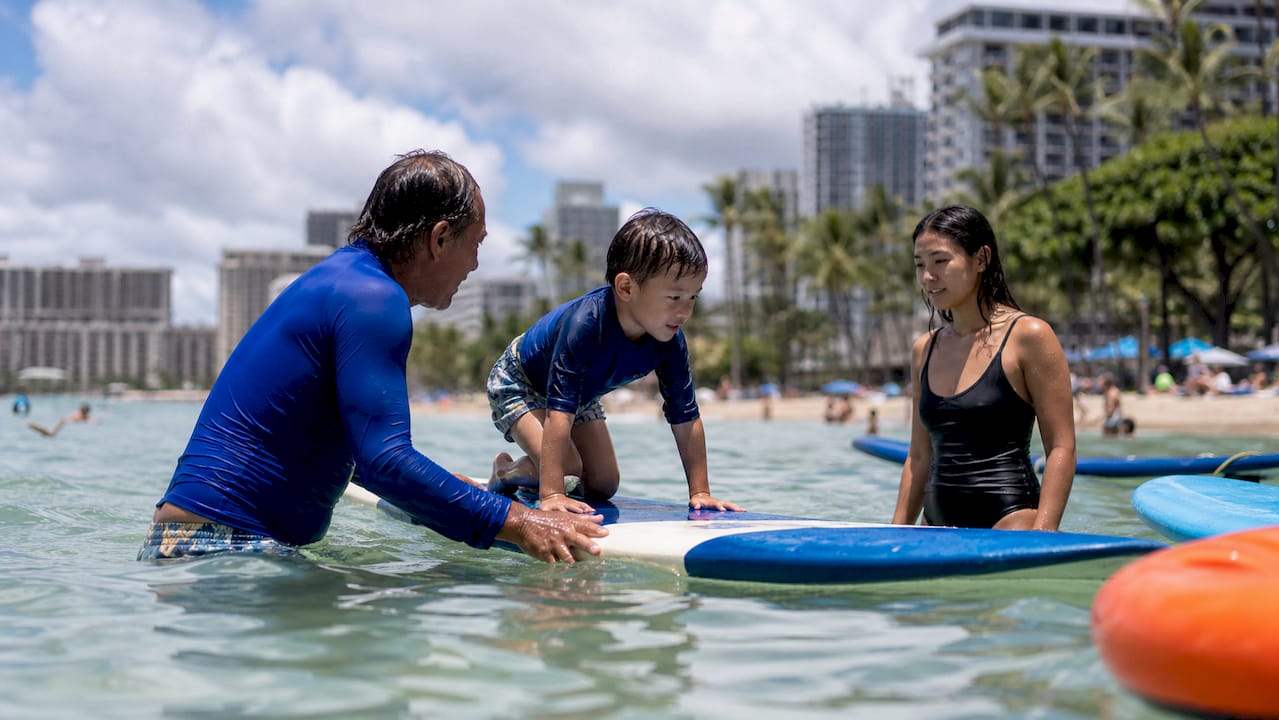
Skill focus is set before each session based on where each child left off. A child who popped up cleanly in the last lesson moves to weight distribution and direction. A child still working on the pop-up stays on that skill with modified coaching cues. The groups are small enough that the instructor can give each child at least two specific feedback moments per session.
What to watch for during a kids’ surf session:
- Does the instructor use each child’s name and reference their previous session?
- Is corrective feedback specific and immediate, not just after the fact on shore?
- Do children have a defined role during the waiting period (not just floating)?
- Is the group size consistent, or does it balloon when the session is busy?
What parents often overlook about small-group instruction
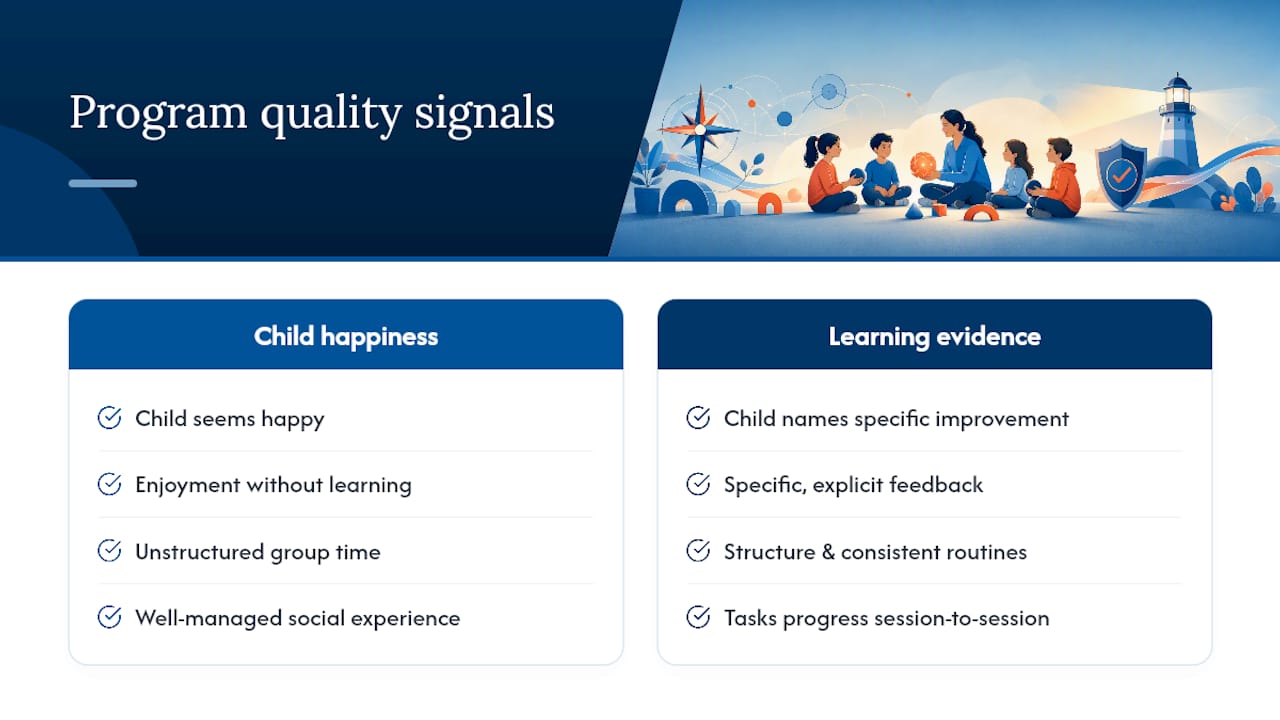
Most parents evaluate a program by how happy their child seems after a session. That is a reasonable starting point, but it misses the more predictive signal: whether the child can tell you something specific they learned or improved. Enjoyment and learning are not the same thing, and the best small-group programs produce both.
The research on structured surf instruction mirrors what classroom studies show: structure, explicit feedback, and consistent routines drive faster skill gains than unstructured time in a group setting. A child who loves their class but cannot articulate any progress after four weeks is probably in a well-managed social experience, not a well-designed instructional one.
The distinction matters most when you are paying for skill development. Watch for specificity in feedback, progression in tasks from session to session, and a coach who adjusts based on what they observe, not just what they planned.
Hhsurf’s small-group kids’ surf lessons in Waikiki
If you are looking for a kids’ program that puts the principles above into practice, Hhsurf’s kids’ surf lessons in Waikiki offer small-group instruction with a direct focus on skill progression, safety, and individual feedback in every session.

Groups stay at 4–6 students, instructors are professional surfers with hands-on teaching experience, and every lesson includes on-water coaching with specific corrective feedback, not just encouragement. The program covers all ages and skill levels, from first-timers to kids building on previous sessions. You can also book Waikiki surf lessons for the whole family or check availability for North Shore sessions if you prefer a different setting. Ready to see it in action? Book a kids’ surf lesson and watch the first session yourself.
Sources
- Guide to Small-Group Learning (Harvard Kennedy School)
- Small-group activities (Stanford Teaching Commons)
0 Comments