
In a surf-lesson lineup, the single most important thing you can do is follow your instructor’s directions exactly, respect the wave priority of whoever is closest to the peak, keep both hands on your board at all times, and paddle wide around the takeoff zone after every ride. That’s the whole game. Everything else in this guide is just detail on those four moves.
- Follow your instructor first. Their call overrides everything else in the lesson zone.
- Respect peak priority. The student positioned closest to the breaking part of the wave has the right to go.
- Keep board control. Never let go of your board in the lineup.
- Paddle wide after a ride. Return outside by going around the breaking waves, not through them.
Pro Tip: In Waikiki, a simple nod or a raised hand toward another surfer before you paddle signals awareness and respect. You don’t need words. That small gesture shows you see them.
Key Takeaways
Following your instructor’s directions is the single most effective etiquette behavior a beginner can practice in a Waikiki lesson lineup.
| Point | Details |
|---|---|
| Follow instructor first | Your instructor’s signal overrides all other cues in the lesson zone. |
| Paddle wide after every ride | Use the channel to return outside, never through the takeoff zone. |
| Hold your board always | Never release your board in the lineup; a loose board is a hazard to everyone nearby. |
| Respect local surfers | Stay in your designated lesson area and yield to experienced surfers outside it. |
| Hhsurf lesson structure | Hhsurf’s supervised methodology manages takeoff order so beginners can focus on technique, not traffic. |
Table of Contents
- What should you do before your surf lesson in Waikiki?
- How does a typical beginner surf lesson actually run?
- What are the basic lineup rules for a surf lesson group?
- How do you catch and ride a wave safely during a lesson?
- What should you do after a wipeout or collision?
- What are the most common beginner mistakes in a lesson lineup?
- How should lesson groups behave when local surfers are nearby?
- Etiquette and safety notes for kids and family lessons
- What questions should you ask a surf school before booking?
- Why Hans Hedemann Surf School is a strong fit for beginners
- How should you handle and position your board in the lineup?
- What does Waikiki surf culture actually expect from visitors?
- How do you communicate non-verbally in the lineup during a lesson?
- How do you share waves with advanced surfers in crowded conditions?
- How do you stay patient while waiting your turn in the lineup?
- What this guide taught me about beginner etiquette
- Hhsurf’s lesson formats make etiquette easy to follow
- Sources
What should you do before your surf lesson in Waikiki?
Arriving prepared makes the difference between a smooth first session and a stressful one. Most schools recommend showing up well before morning lessons, since those slots fill fast and instructors need time to fit you with equipment and run through waivers.
What to pack:
- Reef-safe mineral sunscreen (zinc oxide or titanium dioxide). Hawaii law bans the retail sale of sunscreens containing oxybenzone and octinoxate, so bring the right kind and apply it 20 minutes before you hit the water.
- Secure swimwear that won’t shift during a wipeout
- A rash guard (most schools provide one, but confirm)
- Water bottle and a small towel
- Photo ID and any signed waiver documents
Swim readiness: You should be comfortable swimming in water over your head and able to cover roughly 50 yards without stopping. Tell your school upfront if you have any concerns. Hiding a weak swim background doesn’t help anyone.
Booking format: Group lessons typically run with around 3–8 students per instructor and are the most affordable option. Semi-private and private sessions cost more but give you faster feedback and less time waiting for your turn. If this is your first time in the ocean, private or semi-private is worth considering.
How does a typical beginner surf lesson actually run?
Understanding the structure before you arrive removes a lot of anxiety. Here’s the standard flow:
- Sand demo (10–20 minutes). Your instructor covers paddling position, the pop-up, and basic stance on the beach. Practicing the pop-up on sand before you ever touch water increases your chances of standing on the first wave.
- Paddle to the beginner zone. Expect a short paddle of a moderate distance to a designated area away from the main crowd.
- In-water coaching. Your instructor positions you on the board, reads incoming waves, and gives you a push timed to match the wave’s speed. That timing is the key: instructor push assists let you feel forward momentum without needing raw paddle power.
- Ride and return. You ride toward shore, step off in shallow water, and paddle back wide.
Total time in the water is generally a significant part of a longer session lasting about an hour and a half to two hours. Your instructor controls the takeoff order. If they haven’t called your name or signaled you, you wait. That single rule prevents most collisions in a lesson zone.
Pro Tip: Watch how your instructor positions themselves relative to the wave before each push. They’re reading the ocean for you. Trust that read.
Hans Hedemann Surf School’s methodology is built around exactly this supervised structure, with professional instructors managing every takeoff so students can focus on the pop-up rather than traffic.
What are the basic lineup rules for a surf lesson group?
The lesson zone is a designated area, usually inside the main break, where your instructor has positioned the group. Think of it as a controlled classroom with moving walls.
Do:
- Stay in the zone your instructor assigned
- Wait at the shoulder of the peak until your instructor signals you
- Paddle wide and use the channel (the calmer water beside the breaking waves) to return outside
Don’t:
- Paddle through the takeoff zone when returning out
- Drop in on another student who is already riding
- Drift toward the main local peak without your instructor’s direction
The student closest to the breaking part of the wave has priority for that wave. In a lesson, your instructor assigns that position, so following their verbal and physical cues is the simplest way to stay both safe and polite. Spacing matters too: keep at least one board-length between yourself and the next student while waiting.
How do you catch and ride a wave safely during a lesson?
The sequence is short and repeatable:
- Spot the wave. Your instructor will point it out or call your name.
- Paddle hard. Lie flat, arms pulling in long strokes, chin up.
- Feel the push. Your instructor will give you a timed assist. Keep paddling through it.
- Pop up. Hands flat near your chest, push up, back foot plants first, front foot follows. Land in a wide stance.
- Ride toward shore. Look where you’re going, not at your feet.
If you feel the wave slip away, lie back down and wait for the next one. Don’t try to force a late pop-up.
Falling safely: Aim to fall flat and wide, away from your board. Cover your head with your arms as you surface. A soft-top longboard with a leash is forgiving, but a board edge can still sting. Soft-top longboards and leashes are standard in Waikiki beginner lessons for exactly this reason.
What should you do after a wipeout or collision?
Stay calm. The sequence is fast:
- Cover your head with both arms as you come up.
- Locate your board immediately. Pull the leash hand-over-hand to bring it back to you.
- Signal your instructor with a raised arm if you’re hurt or disoriented.
- Clear the zone. Paddle to the shoulder, not back through the peak.
If your instructor isn’t visible, raise both arms above your head. That’s the universal distress signal. Waikiki Beach has lifeguard towers staffed throughout the day.
Pro Tip: The fastest way to clear the lineup after a wipeout is to go sideways, not straight back out. Paddle to the channel first, then return outside from there.
What are the most common beginner mistakes in a lesson lineup?
Most errors come down to three habits:
- Dropping in. Paddling for a wave another student is already riding. Fix: wait for your instructor’s signal, not the wave itself.
- Paddling through the takeoff zone. Observing the lineup before entering and using the channel on the way back prevents this almost entirely.
A short sand drill before paddling out helps. Run through the pop-up three times on the beach. It locks in the muscle memory so you’re not thinking about your feet when a wave arrives.
One sentence to repeat to yourself before paddling out: “Wait for the signal, paddle wide, hold my board.”
How should lesson groups behave when local surfers are nearby?
Stay in your designated lesson area. Local surfers at spots like Canoes or Queens in Waikiki have been riding those breaks for years, and they have priority outside the lesson zone. Your instructor knows where the boundaries are.
- Yield to experienced surfers without hesitation if you drift toward their peak.
- Give extra space when a local signals they’re going for a wave.
- A shaka (thumb and pinky extended, hand relaxed), a nod, or a smile goes a long way. It signals you’re aware and respectful, not oblivious.
Your instructor usually has an existing relationship with the local lineup. Follow their lead on positioning and timing. They’ll handle any negotiation; your job is to stay in your zone and be friendly.
Etiquette and safety notes for kids and family lessons
Young children, roughly ages 4–8, do best in private or semi-private lessons where the instructor can give undivided attention and adjust pacing on the fly.
For parents:
- Stay on the sand or at the waterline. Don’t wade in to help unless the instructor asks.
- Follow the instructor’s directions as closely as your child does.
- Communicate any medical conditions, swim ability, or fears before the lesson starts.
Kids’ packing list:
- Secure swimwear with a drawstring or snap
- Rash guard (long-sleeve for sun protection)
- Extra reef-safe sunscreen
- Strap or band for glasses if needed
Brief your child on the beach before the lesson: listen to the instructor, don’t let go of the board, and come back to the instructor after every wave.
What questions should you ask a surf school before booking?
- What is the maximum group size and instructor ratio?
- How long is the lesson and how much time is spent in the water?
- What are the swim ability requirements?
- What equipment is provided, and are soft-top boards and leashes standard?
- What is the cancellation and rescheduling policy?
- Is there lifeguard coverage at the lesson site?
- Are photo or video packages available?
Pro Tip: Book a morning slot. Morning sessions have calmer winds, smoother water, and fewer crowds. They fill up fast, so reserve at least a few days ahead.
Why Hans Hedemann Surf School is a strong fit for beginners
Hans Hedemann Surf School’s approach is built around one goal: getting first-timers standing on a wave within their first session. The school’s supervised, instructor-led methodology prioritizes safety and respectful interaction with local surf culture from the first paddle out.
- Professional instructors manage takeoff order and push timing so students focus on technique, not traffic.
- Equipment includes soft-top longboards and leashes standard for all beginner lessons.
- Lesson formats cover group, semi-private, private, and kids’ options.
- Optional on-water photography and video packages let you capture the moment.
Many first-time students stand up during their first lesson and ride multiple waves to shore with instructor-guided push assists. That outcome is the direct result of structured supervision, not luck.
Johann has published guides on surf etiquette and lesson planning for Waikiki and Oahu. Questions? Ask at the Hhsurf desk or through the booking page.
How should you handle and position your board in the lineup?
In a crowded beginner zone, your board is the biggest safety variable you control. Point the nose into incoming waves when you’re sitting in the lineup; this keeps the board from getting swept sideways and hitting someone. Hold the rail, not the nose, when a wave passes over you.
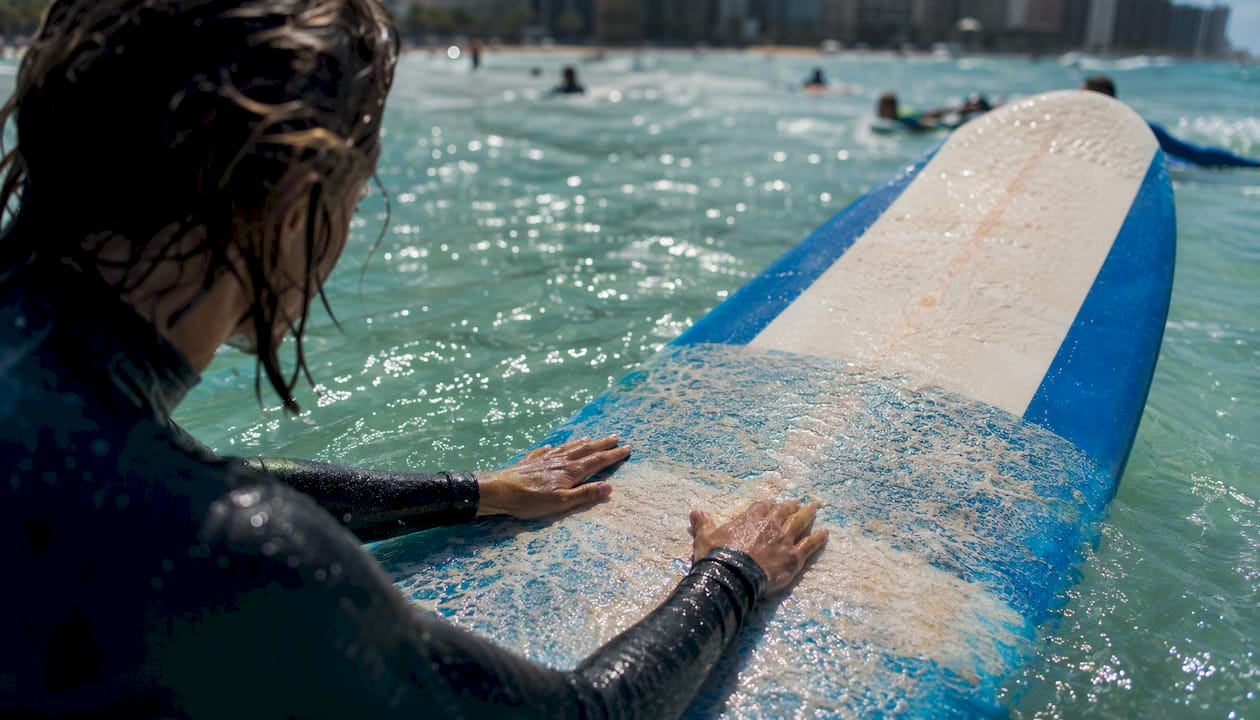
Never let the board drift between you and another surfer. If you lose your grip, call out “board!” so nearby students can protect themselves. Efficient board handling in a crowded zone, keeping the nose pointed into waves and holding the rail, reduces runaway-board incidents significantly.
What does Waikiki surf culture actually expect from visitors?
Waikiki has been a surfing destination since the early 1900s, and the culture here carries real weight. The concept of aloha in the water isn’t a slogan; it’s a practical standard. Experienced local surfers expect visitors to be aware, humble, and patient.
A few things that matter beyond basic lesson etiquette: don’t paddle straight to the peak on your first session at any break. Sit on the shoulder, watch the rhythm of the sets, and earn your position gradually. Locals notice who observes and who charges in. The former gets welcomed; the latter gets cold shoulders.
Waikiki’s main breaks like Canoes and Queens are unusually welcoming compared to most surf spots in the world, partly because the culture here has always included teaching visitors. Respect that history by being a student of it.
How do you communicate non-verbally in the lineup during a lesson?
Words get lost in wind and whitewater. Your instructor will use a short set of signals, and you should know them before you paddle out.
- Pointed finger toward a wave: your wave, start paddling.
- Flat palm facing you: stop, hold position.
- Circular arm motion: paddle back out, return to the group.
- Raised fist: something is wrong, come to the instructor immediately.
From your side, eye contact is the most important tool. Before you paddle for any wave, make eye contact with your instructor. A nod from them means go. No eye contact means wait. That single habit eliminates most confusion in a busy lesson zone.
How do you share waves with advanced surfers in crowded conditions?
Outside the lesson zone, the rule is simple: you don’t. As a beginner in a lesson, your instructor keeps you in the designated area for a reason. Advanced surfers at the main peak are moving faster, reading waves earlier, and operating on a different priority system.
If conditions push you toward the main break, paddle back to your zone immediately. Don’t attempt to compete for waves with experienced surfers. They have right of way, they know it, and they’ll take the wave regardless of your position.
When a lesson ends and you’re surfing on your own, the core etiquette rules still apply: observe before entering, respect priority, paddle wide, and never drop in. Those rules don’t change with experience level.
How do you stay patient while waiting your turn in the lineup?
Waiting is most of surfing. In a lesson group, you might wait several minutes between waves. That time is useful if you treat it right.
Watch the waves breaking. Notice where they peak, how fast they move, and where they close out. This is how you build wave-reading instincts without paddling anywhere. Watch your instructor’s positioning relative to each incoming set.
If frustration builds, take a breath and count the waves in a set. Most Waikiki sets run 3–5 waves. Knowing a new set is coming in a minute or two reframes the wait as a rhythm rather than a delay. Patience in the lineup is a skill, and like the pop-up, you get better at it with repetition.
What this guide taught me about beginner etiquette
The gap between a beginner who struggles and one who thrives in a lesson lineup almost never comes down to athletic ability. It comes down to awareness. Students who watch before they paddle, listen before they move, and hold their board before they let go have a fundamentally safer and more enjoyable first session.
Etiquette isn’t a set of rules imposed on you from outside. In Waikiki, it’s the shared agreement that makes it possible for dozens of people to share the same break without chaos. When you follow your instructor, respect the peak, and stay in your zone, you’re not just being polite. You’re contributing to a system that works for everyone in the water.
Hhsurf’s lesson formats make etiquette easy to follow
Hhsurf gives first-timers the fastest path from sand to standing wave in Waikiki, with professional instructors who manage every takeoff, handle the crowd navigation, and keep students in the safest part of the break. You focus on the pop-up. They handle everything else.
Lesson options include group sessions for budget-conscious travelers, semi-private and private lessons for faster progress and more instructor time, kids’ lessons designed for young beginners, and North Shore sessions for those who want a different break. Optional photo and video packages mean you leave with proof.
Book your Waikiki surf lesson and reserve a morning slot before they fill up.
Sources
- Surf Lessons in Waikīkī: Prices, Tips, and What to Expect (2026)
- Waikiki Surf Lessons (2026): Best Schools, Prices, And What To Expect – Waikiki Beach
- Surfing in Waikiki: A Beginner’s Guide (2026)
- Essential Surf Etiquette Rules Every Beginner Needs to Know
0 Comments