
Most beginner surf lessons in Waikiki run 60 to 120 minutes, with 80 to 90 minutes being the sweet spot most operators book by default. A typical split puts 15 to 30 minutes into land safety and technique instruction, with the rest spent paddling out and catching waves under an instructor’s guidance.
- Group lessons: usually 80 to 90 minutes total
- Private or semi-private lessons: often 90 to 120 minutes, weighted toward water time
- Kids lessons: typically 60 to 75 minutes to match shorter attention spans
Private sessions tend to shift more of the clock into actual coached wave-riding rather than shared instruction time, since one instructor isn’t splitting attention across a group.
Key Takeaways
Most Waikiki beginner surf lessons run 80 to 90 minutes, splitting time between a land safety briefing and instructor-assisted water coaching, with format and group size determining how much of that time you actually spend riding waves.
| Point | Details |
|---|---|
| Standard lesson length | Plan for 80 to 90 minutes total, with 15 to 30 minutes on land before entering the water. |
| Format changes your water time | Private and semi-private lessons pack more coached wave time into the same overall length as group lessons. |
| Kids need shorter sessions | Book 60 to 75 minute lessons for children to match attention span and energy levels. |
| Progress takes repetition | Expect 3 to 5 lessons for a consistent pop-up and several more for independent paddling and positioning. |
| Arrive early and confirm details | Check in 15 to 30 minutes before start time and confirm cancellation policies through the booking platform. |
| Hhsurf matches format to your schedule | Hans Hedemann Surf School offers 2-hour group, private, and kids lesson formats built around the safety-then-water structure covered above. |
Table of Contents
- Surf Lesson Duration in Waikiki: A Minute-by-Minute Breakdown
- Group, Semi-Private, or Private: How Format Changes Your Time in the Water
- What Happens During a Waikiki Beginner Surf Lesson
- How Many Lessons Does It Take to Actually Learn to Surf?
- Booking Your Lesson: Check-In, Cost, and What to Bring
- Why Hans Hedemann Structures Lessons Around These Timeframes
- Book a Lesson Built Around These Exact Timeframes
- Sources
Surf Lesson Duration in Waikiki: A Minute-by-Minute Breakdown
Why do lesson lengths vary so much between 60 and 120 minutes? It comes down to who’s paddling out. A 60-minute slot suits a quick add-on for kids or travelers squeezing surfing between other plans. The 80 to 90 minute window is the default for standard beginner groups. Ninety minutes to two hours shows up for private lessons or intensive sessions where someone wants real repetition, not just one or two assisted stands.
Faith Surf School’s booking page lists an 80-minute lesson as its standard offering, while Hans Hedemann Surf School advertises a 2-hour format that includes a safety slideshow, land lesson, warm-up, and extended on-water instruction. Both are common in Waikiki. Neither is wrong. They’re built for different goals.
Here’s what a 90-minute lesson typically looks like in practice:
- Check-in: time for paperwork, gear fitting, and meeting your instructor.
- Safety briefing and land demo: covering ocean conditions, currents, hand signals, and pop-up technique practiced on sand.
- Warm-up: light stretching and preparation before paddling out.
- Paddle-out and assisted wave time: the main portion where the instructor helps you catch and ride waves.
- Cool-down and debrief: wrapping up with feedback, photos, and recommendations.
That 45-minute water window is where the real learning happens, and it’s also why most schools stop well short of the 3-hour mark. Beginners tire fast. Paddling against Waikiki’s gentle but persistent swell works muscles most people don’t use often, and surf instructors outside Hawaii report the same fatigue pattern: past 90 to 120 minutes, focus and form drop off, and the risk of a sloppy fall or minor injury climbs. Capping lessons around 2 hours isn’t a marketing decision. It’s a fatigue-management decision.
Tripadvisor’s listing for a Waikiki private group lesson describes the same rhythm guests report elsewhere: 15 to 30 minutes on the sand, then roughly an hour in the water. That consistency across operators tells you something. This structure isn’t arbitrary. It’s what actually works for someone standing on a board for the first time.
Group, Semi-Private, or Private: How Format Changes Your Time in the Water
The lesson length on a booking page only tells half the story. What matters more is how that time gets divided among the people in the water with you.
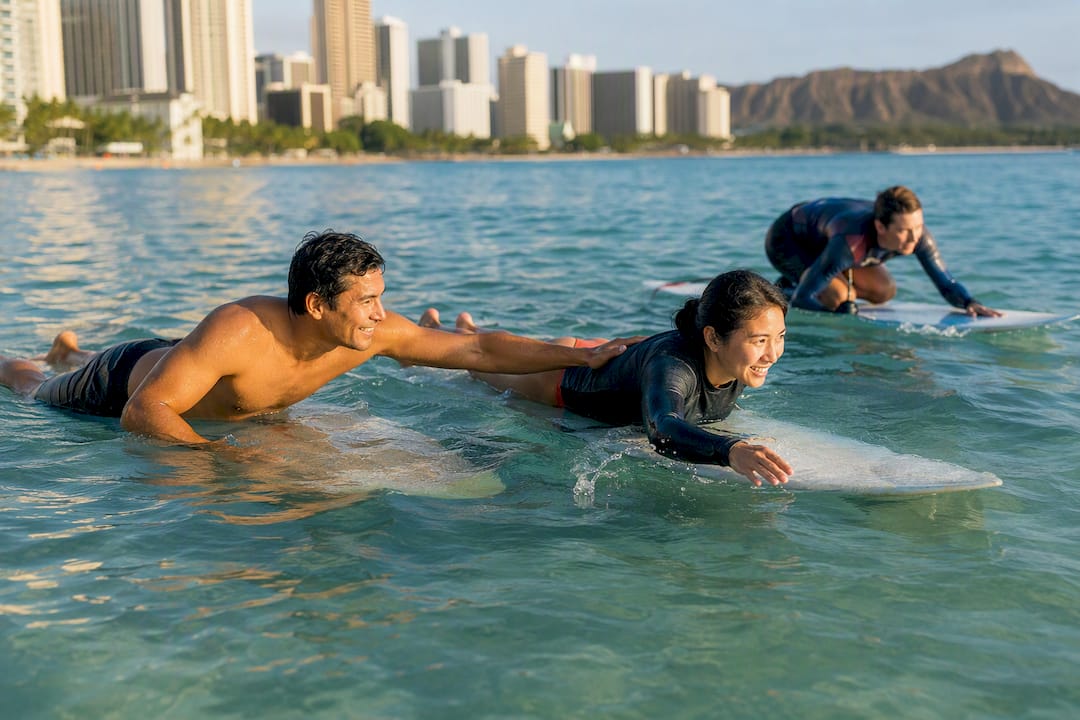
Group lessons usually run 4 to 8 students per instructor, and they stick to fixed start and end times because the whole group moves together. Water time per student in an 80 to 90 minute group lesson often works out to somewhere between 10 and 20 minutes of direct, hands-on coaching, split across the session as the instructor rotates attention.
Semi-private and private lessons flip that math. Same 80 to 120 minute window, but nearly the entire water portion is focused on one or two people. More waves caught, more corrections made in real time, faster adjustments to your stance.
Kids lessons run shorter, usually 60 to 75 minutes, because young attention spans and sun exposure both cap out faster than an adult’s. Instructors also build in more frequent breaks and simpler safety explanations.
Pro Tip: If you only have one shot at a lesson during your trip and want to actually stand up more than once, book a private or semi-private slot. The total time on your itinerary barely changes, but the number of waves you actually ride goes up significantly.
What Happens During a Waikiki Beginner Surf Lesson
Every reputable Waikiki lesson follows a similar arc, even when the total length differs. Knowing what’s coming helps you show up mentally ready instead of just physically ready.
The safety briefing usually eats up 10 to 30 minutes and covers ocean conditions, rip currents, right-of-way rules in the lineup, and hand signals for communicating with your instructor from a distance. The International Surfing Association treats this briefing as a non-negotiable part of instructor training, not an optional add-on, and it’s why you shouldn’t be suspicious of a school that spends real time on land before letting you near the water.
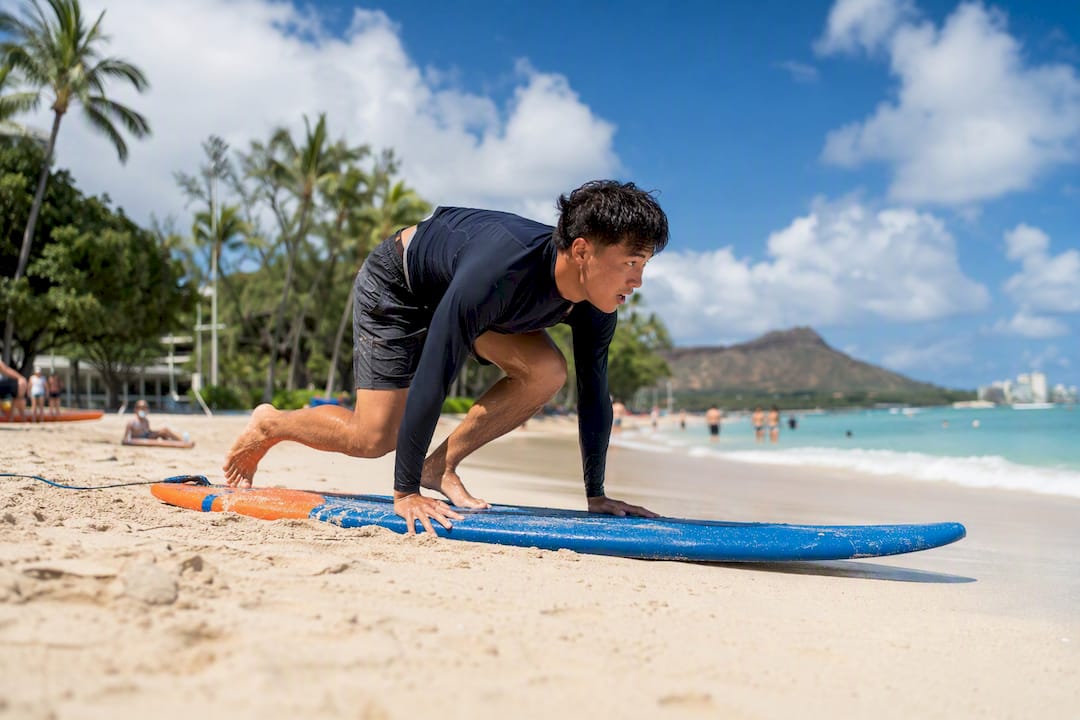
Land practice comes next: pop-up drills on the sand, where you practice going from lying flat to a standing stance without a wave underneath you. It looks a little silly. It also builds the muscle memory that makes your first real pop-up far less chaotic.
On-water coaching is the main event. Your instructor positions your board, watches for the right swell, and often gives your board a push at the exact right moment so you catch the wave instead of missing it entirely. This assisted-catch method is a big part of why so many first-timers stand up on their very first lesson.
Most lessons also include practical extras: a soft-top board and rashguard, sometimes photo or video packages of your session, and clear meeting-point instructions so you’re not wandering the beach looking for your instructor.
How Many Lessons Does It Take to Actually Learn to Surf?
One lesson gets you the basics: ocean safety awareness, a handful of assisted stand-up attempts, and the experience itself. That’s genuinely enough for a bucket-list traveler who wants the Waikiki surfing moment without a longer commitment.
- One lesson: you’ll likely stand up at least once with instructor help, but don’t expect independent wave-catching yet.
- Three to five lessons: this is where most beginners start developing a consistent pop-up and can begin reading which waves are worth paddling for.
- Six or more lessons, with practice in between: independent paddling, basic positioning in the lineup, and the start of real surfing instead of assisted surfing.
Fitness matters here more than people expect. Paddling is the actual bottleneck for most beginners, not balance. Someone who swims or does regular cardio tends to progress faster than someone who doesn’t, simply because their arms and shoulders hold up longer during the water portion of each lesson. Frequency matters too. Lessons spaced a year apart mean relearning fundamentals each time, while lessons booked a few days apart during one trip build on each other.
Booking Your Lesson: Check-In, Cost, and What to Bring
Arrive 15 to 30 minutes before your scheduled start. Quick-details panels on Waikiki booking pages consistently list this window for paperwork, gear fitting, and a short pre-briefing conversation with your instructor. Showing up right at start time usually means you’re cutting into your own lesson.
Most Waikiki operators, including Hans Hedemann’s own booking system, run bookings through fixed time-slot platforms. That means cancellation windows are real and worth checking before you book, especially if your trip has weather uncertainty baked in.
What to bring:
- Reef-safe sunscreen (regular sunscreen is often restricted near Hawaii’s reefs)
- Swimwear you’re comfortable moving in, plus a rashguard if you have one
- Water and a light snack for after
- Your booking confirmation and a photo ID
Group lesson pricing in Waikiki generally sits in a lower bracket than private instruction, given the shared instructor cost. Private lessons cost more per person but deliver more individual water coaching per dollar spent. Tipping your instructor isn’t mandatory, but it’s customary in Hawaii’s tourism industry, with most guests tipping in the range that reflects standard US service tipping norms.
Why Hans Hedemann Structures Lessons Around These Timeframes
Hans Hedemann Surf School builds its 2-hour lesson format around exactly the sequence that works best for beginners: a safety slideshow and land lesson, a proper warm-up, then real on-water instruction where the goal is getting you standing during your very first session.
- The school’s method focuses on individual attention during both the land and water segments, not just a quick group demo followed by open water time.
- Guest reviews describe the same structure outlined above: safety first, technique second, then instructor-assisted wave riding as the main event.
- Instructors are professional surfers who understand Waikiki’s specific breaks, which matters more than generic surf knowledge when you’re timing a wave for a first-timer.
Booking a lesson built around this proven sequence means your time on land isn’t wasted and your time in the water is spent catching waves, not figuring things out from scratch.
A Traveler’s Guide to Picking Your Lesson Length
If your vacation time is tight and you want visible progress, book a private or semi-private 80 to 90 minute slot. It’s the fastest way to go from zero to consistently standing. If this is a one-time bucket-list moment, a standard 80 to 90 minute group lesson delivers the full experience without overcomplicating your day. Book mornings when you can. Waikiki’s surf tends to be gentler and schedules run more predictably before the wind picks up.
— Johann
Book a Lesson Built Around These Exact Timeframes
Hhsurf runs the same land-then-water structure covered throughout this guide, but built by instructors who’ve spent years reading Waikiki’s specific breaks. Group, semi-private, private, or a shorter kids’ session: the lesson length and coaching intensity get matched to what you actually need out of your time in the water, not a one-size-fits-all slot.

If your trip only allows for one lesson, book a private lesson for maximum coached water time, or grab a spot in a group lesson if you’re looking for the classic Waikiki experience at a lower cost. Check current availability and reserve your surf lesson directly online, and pick the time slot that fits the rest of your day in Waikiki.
0 Comments