
Yes, most beginners stand up on their first stand up lesson in Waikiki, often within the first 30 to 60 minutes in the water. That success rate holds because Waikiki’s waves are gentle and predictable, and it climbs even higher with a private or small-group lesson taught by an experienced instructor. If you’re booking your first session, check availability for a small-group or private lesson before you lock in a date.
TL;DR:
- Small group and private lessons in Waikiki increase your chances of standing up within the first hour by providing more personalized instruction.
- Booking early morning during calm tides and minimal crowds creates ideal conditions for beginners to learn safely and confidently.
- Instructor-to-student ratios are the most crucial factor, with private lessons offering the highest level of individual assistance and corrections.
- Most lessons last 60 to 90 minutes, including safety briefing, sand drills, and multiple assisted attempts, with costs generally ranging from $50 to $150.
- Watching your own first attempts on video can significantly speed up learning, and choosing lessons with smaller ratios yields quicker progress.
Table of Contents
- Why Waikiki Is Such a Good Place to Learn Stand-Up Surfing
- What Happens During Your First Stand-Up Surf Lesson
- What to Pack for Your First Surf Lesson
- How to Pick the Right Beginner Lesson in Waikiki
- What a Waikiki Surf Lesson Costs and How Long It Runs
- Best Time to Book: Season, Time of Day, and Basic Safety
- How Hans Hedemann Surf School Backs Up Its First-Lesson Promise
- Why the “Anyone Can Learn to Surf” Marketing Undersells What Actually Works
- Book Your First Stand-Up Lesson With Hans Hedemann Surf School
- Sources
Why Waikiki Is Such a Good Place to Learn Stand-Up Surfing
Waikiki didn’t become the world’s best-known beginner break by accident. The reef sits far enough offshore to break the ocean’s energy before it reaches the sand, so waves arrive slow, rolling, and spaced out instead of dumping all at once. That matters more than most first-timers realize: a wave that gives you two extra seconds to find your feet is the difference between a wobble and a wideout.
The seafloor helps too. Much of Waikiki’s beginner zone has a sandy bottom rather than a rocky reef, so falls are forgiving and the water stays shallow enough to stand in in most spots. Local guides consistently describe Waikiki’s breaks as gentle, predictable, and built for beginners because of that combination of sand and slow, rolling swell.
Waikiki also has infrastructure most beginner breaks lack. Lifeguard towers dot the shoreline, the water stays busy with instructors and other learners, and the beach itself is set up for tourism rather than hardcore local surf culture. That doesn’t mean etiquette disappears (more on that later), but it does mean help is close and the learning curve is shorter than it would be at a more exposed, current-heavy beach.
A few things do shift throughout the day, and they affect how your lesson feels:
- Tide changes wave shape and how far you have to paddle out.
- Wind picks up by late morning most days, chopping the surface and making balance harder.
- Crowds build fast once cruise groups and other schools arrive.
- Swell direction occasionally sends slightly bigger sets through, which is why booking with a school that checks conditions daily matters.
None of this makes Waikiki unpredictable exactly. It just means the same beach can feel noticeably different at 7 a.m. versus 1 p.m., which is worth knowing before you pick a lesson time.
What Happens During Your First Stand-Up Surf Lesson
A typical first lesson in Waikiki runs 60 to 90 minutes, and it follows a pattern that’s been refined by decades of teaching total beginners. Here’s the walkthrough.
- Check-in and gear fitting. You’ll sign a waiver, get matched with a soft-top beginner board sized for your weight and skill level, and meet your instructor.
- Safety briefing. Your instructor covers ocean conditions for that specific day, hand signals, and where the lesson zone sits relative to other surfers.
- On-sand demo and drills. Before you touch water, you’ll practice the pop-up (the motion of going from lying down to standing) on the sand, usually five to ten repetitions, along with proper paddling posture and how to position your body on the board.
- Paddling out. Your instructor walks or paddles you into position, keeping the first waves close to shore and manageable.
- Assisted first rides. This is the core of the lesson. The instructor times the wave, gives your board a push, and calls out “up!” at the exact right moment. Most schools give each student several of these assisted attempts.
- Independent attempts. As your timing improves, the instructor backs off the push and lets you paddle and pop up with just verbal cues.
- Wrap-up. A short debrief on what worked, what to work on, and often a photo or video review if your package included one.
Publisher lesson-flow guidance breaks this process down in more detail, but the sequence above holds across most reputable Waikiki schools.
What should you actually expect for results? Most complete beginners land at least one standing ride by the midpoint of the lesson. Some pop up on the very first attempt; others need six or seven pushes before the timing clicks. Both outcomes are normal, and a good instructor adjusts pacing rather than rushing you toward a wave you’re not ready for.
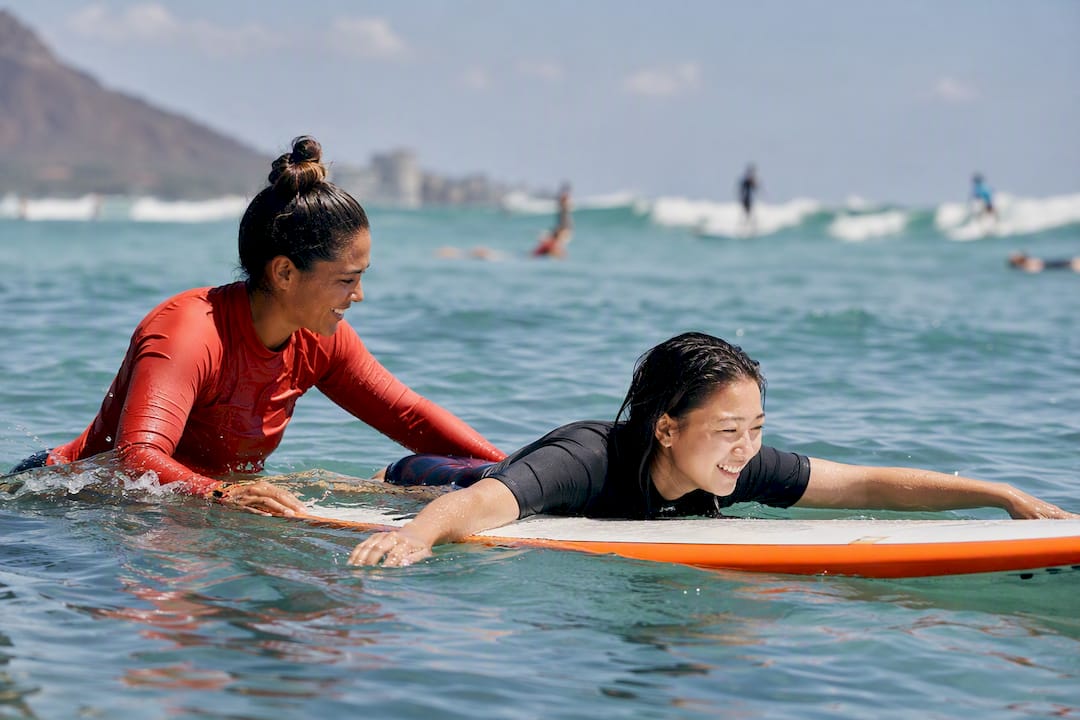
Pro Tip: Ask your instructor to film your first three attempts on your phone or theirs. Watching your own pop-up timing back, even for thirty seconds, teaches your brain the rhythm faster than another verbal correction ever will.
Structured, instructor-led lessons following ISA guidance consistently produce better beginner outcomes and fewer safety incidents than unguided attempts, which is exactly why the sand-drill-then-assisted-push sequence exists in the first place. It’s not busywork. It’s the fastest route from standing on sand to standing on a moving board.
What to Pack for Your First Surf Lesson
Most of what you need either comes with the lesson or fits in a small beach bag. Here’s the actual list.
- A swimsuit or rash guard you can move in; board shorts work fine for men, and a one-piece or athletic top usually holds up better than a bikini during repeated paddling.
- Reef-safe sunscreen, applied before you leave your hotel, since regular sunscreen can wash off and harm the reef.
- A hat and sunglasses for the beach portion, though you’ll leave both on shore once you paddle out.
- A quick-dry towel and a change of clothes for after.
- A water bottle, since Hawaii sun and salt water dehydrate you faster than you’d expect.
- Reef shoes (optional) if your feet are sensitive to sand or shell fragments.
- A waterproof phone case or GoPro if you want your own footage beyond what the school provides.
- Cash or a card for instructor tips, which are appreciated but not required.
On the fitness side, you don’t need to be an athlete; however, it’s essential to understand water sports for beginners: activities, safety, and gear to ensure a safe and enjoyable experience. You do need basic water comfort: the ability to float, tread water briefly, and handle saltwater splashing your face without panicking. If you’re not a confident swimmer, mention that when you book. Most schools adjust the lesson zone and level of physical assistance accordingly, and some instructors will stay within arm’s reach the entire time.
How to Pick the Right Beginner Lesson in Waikiki
Not every “beginner lesson” delivers the same experience, and the differences show up fastest in group size and instructor attention.
Group lessons typically run six to eight students per instructor. They cost less, and they’re social, but you’ll spend more time waiting for your turn and less time getting individual timing corrections. Private and semi-private lessons flip that ratio, often pairing one instructor with one to three students, which means more assisted pushes per person and faster correction when your pop-up timing is off. If standing up on the first try matters to you, the ratio matters more than almost anything else on this list.
Before you book, ask a few direct questions:
- What’s the maximum number of students per instructor?
- Do instructors physically demonstrate and assist in the water, or just coach from the sand?
- What’s the equipment condition, and are boards sized for beginners specifically?
- Is a photo or video package available, and is it included or extra?
- What’s the cancellation and weather policy?
Watch for red flags too. A school that won’t state its instructor-to-student ratio, that rushes you into the water without a sand demo, or that hands you a board without checking your swimming comfort is cutting corners on exactly the steps that make Waikiki lessons work as well as they do.
Pro Tip: If two schools quote similar prices, ask about the ratio before you ask about anything else. A private lesson at a slightly higher price almost always beats a crowded group session when the goal is standing up on day one.
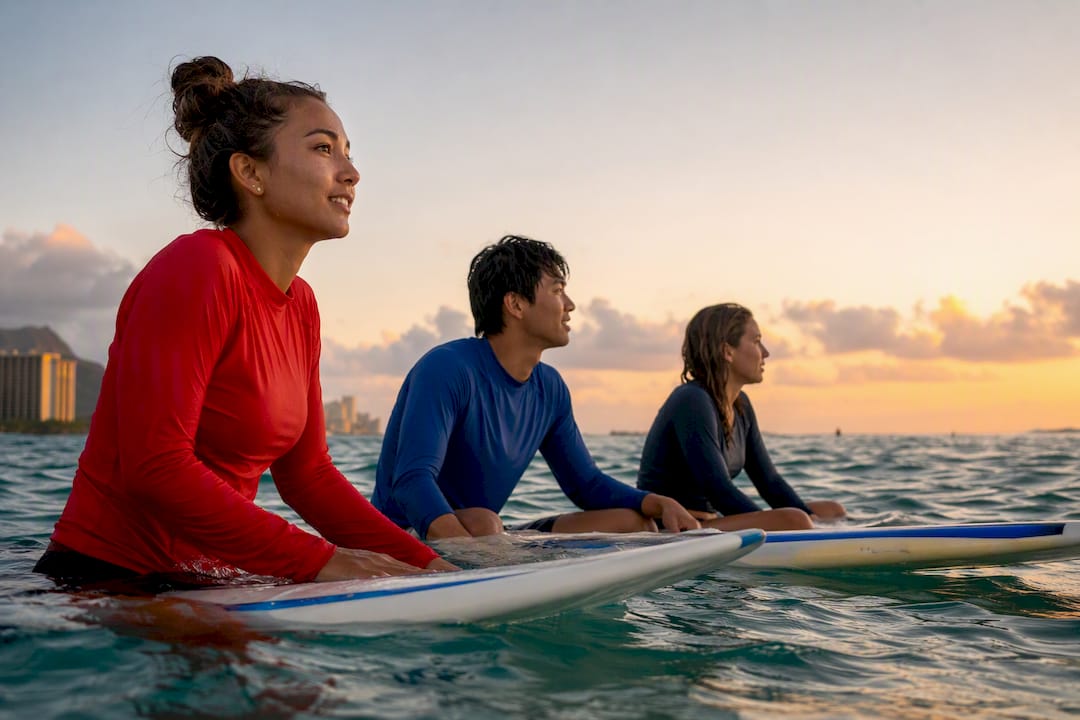
Private lessons built around smaller instructor-to-student ratios are designed specifically around this logic: more attempts, faster corrections, less waiting.
What a Waikiki Surf Lesson Costs and How Long It Runs
Budgeting for your first lesson is straightforward once you know the general ranges. Waikiki beginner lessons typically run 60 to 90 minutes, and that window covers everything from the safety briefing through your final in-water attempts.
Group lessons tend to sit at the lower end of the price range since the cost splits across more students. Private lessons cost more per person but buy you dramatically more instructor attention. Multi-session packages (two or three lessons booked together) often bring the per-lesson price down if you’re staying in Waikiki long enough to return for a second round.
A few line items catch first-timers off guard:
- Board rental is usually bundled into the lesson price, but confirm this before booking.
- Photo or video packages run as an add-on at many schools, capturing your first standing ride for a fee.
- Gratuity for instructors is customary and typically handled separately from the lesson price.
- Sales tax applies to most Hawaii service purchases and isn’t always shown in the advertised rate.
Industry pricing snapshot: Activity guides generally place Waikiki beginner surf lessons in the roughly $50 to $150 range, with group sessions at the lower end and private instruction, longer duration, or photo add-ons pushing costs toward the top of that band.
Best Time to Book: Season, Time of Day, and Basic Safety
Timing changes your experience more than most first-timers expect, and it’s an easy variable to control since you’re the one picking the slot.
Summer months bring smaller, calmer swells to Waikiki’s south-facing beaches, generally making it the more forgiving season for absolute beginners. Winter can bring bigger swells to other parts of Oahu, though Waikiki itself stays comparatively mild year-round compared to North Shore breaks. Either season works for a first lesson; summer just adds a slightly larger margin for error.
Within any given day, early morning sessions consistently offer the calmest conditions, before the trade winds pick up and before the beach fills with other lessons, swimmers, and boat traffic. An 8 a.m. lesson and a 1 p.m. lesson at the same beach can feel like two different environments.
A short safety checklist worth keeping in mind:
- Lifeguard towers are stationed along Waikiki; note the nearest one before you paddle out.
- Rip currents are less common in the beginner zones but not impossible, so listen to your instructor’s read of the day.
- Local and more experienced surfers use the same lineup; give them space and priority on waves they’re already riding.
How Hans Hedemann Surf School Backs Up Its First-Lesson Promise
A first-lesson stand-up isn’t luck. It’s the product of a method built and refined specifically to get complete beginners up and riding fast, and Hhsurf built its entire beginner program around that goal.
Lesson options cover the range of what a visiting family or solo traveler might need:
- Group and private surf lessons for teens and adults at every experience level.
- Kids-specific lessons with pacing built around younger students.
- Stand-up paddle lessons for those who want an easier entry point before standing on a shortboard.
- Bodyboard instruction as a lower-intensity alternative for the same beach sessions.
Many students arrive nervous about standing up at all and leave their first session having ridden multiple waves on their own, often faster than they expected. That gap between expectation and outcome is the entire point of the methodology.
Safety stays built into every step, from the sand briefing through the in-water assist, following the same instructor-led standards the ISA promotes across the sport.
Why the “Anyone Can Learn to Surf” Marketing Undersells What Actually Works
Most surf-lesson marketing tells you anyone can stand up on their first try, which is true but incomplete. What separates a beginner who stands up in ten minutes from one who’s still struggling after an hour usually isn’t athleticism. It’s instructor attention.
The conventional advice, “just book a lesson, any lesson,” glosses over the single biggest lever a first-timer controls: ratio. A group of eight splits an instructor’s attention eight ways, and on a 75-minute lesson, that math works against you no matter how gentle Waikiki’s waves are.
What I’d prioritize differently: pick your time slot before you pick your school, and pick your ratio before you pick your price. An early morning private or small-group lesson beats a discounted midday group session almost every time, because you’re stacking calmer water on top of more individual coaching. That combination, not raw talent or fitness, is what actually predicts whether you’re standing by the end of the hour.
— Johann
Book Your First Stand-Up Lesson With Hans Hedemann Surf School
Hans Hedemann Surf School turns “maybe I’ll stand up” into the expectation, not the hope, because the entire lesson structure is built around getting first-timers riding waves in a single session. The small instructor-to-student ratios in private lessons mean more assisted pushes and faster corrections than a crowded group class, and the instructors themselves are working surfers who teach the same sand-to-water sequence outlined earlier in this guide.
Lesson options cover group and private Waikiki sessions, kids-focused classes, and add-on photo packages that capture your first ride without you having to hold a camera. Arrive about 15 minutes before your scheduled start to complete a quick waiver and get fitted with a board; confirmation emails include the exact meeting point and what’s already included in your price. Check current availability and lock in a time slot on the main surf lesson booking page before your Waikiki dates fill up.
0 Comments