
Yes, bodyboard lessons on Oahu are safe for beginners and families when you stack three things in your favor: a lifeguarded beach, an instructor with real safety training, and proper gear including a leash and fins. Waikiki checks every one of those boxes better than almost anywhere else in the islands. Hans Hedemann Surf School builds its beginner lessons around exactly that formula, which is why it’s worth a look before you book anything else.
TL;DR:
- Waikiki offers the safest beginner bodyboarding environment, with sandy bottoms, calm reef breaks, and constant lifeguard supervision, making it ideal for learning.
- Lessons should include land-based safety briefings, small groups, and proper gear checks, with instructor certification being a key indicator of quality.
- Wearing a coil wrist leash, using a foam board suited for beginners, and following rip current safety guidelines significantly reduce injury and drowning risks.
- Booking lessons within designated lifeguarded zones, with verified small groups and experienced instructors, ensures a higher level of safety for children and novices.
- Most injuries are minor, but knowing basic first aid for cuts, jellyfish stings, and head impacts helps handle common incidents effectively.
Table of Contents
- Best Beginner Beaches And What Makes Them Safe On Oahu
- What A Safe Beginner Bodyboard Lesson Looks Like
- Essential Gear And Techniques For Bodyboarding Safely
- How To Pick A Safe Bodyboard Lesson Provider On Oahu
- How Hans Hedemann Surf School Runs Safe Beginner Lessons
- Child-Appropriate Age And Supervision Guidance
- Emergency Procedures And Who To Contact On Oahu Beaches
- Safe Entry And Exit Techniques For Oahu’s Shorelines
- How Crowd Density Affects Lesson Safety
- First Aid Basics For Common Bodyboarding Injuries
- An Instructor’s Take On What Actually Keeps Beginners Safe
- Book A Safety-First Bodyboard Lesson In Waikiki
- Sources
Best Beginner Beaches And What Makes Them Safe On Oahu
Not every stretch of sand on Oahu is built for a first-timer, and the difference isn’t subtle. A beach that’s perfect for an experienced bodyboarder chasing a north shore swell can be genuinely dangerous for a kid on a foam board.
Six features separate a beginner-safe beach from one that isn’t:
- A sandy bottom instead of reef or rock, which cuts down on scrapes and cuts during wipeouts
- A gentle, predictable shorebreak rather than a steep, dumping wave
- Consistent, moderate swell size rather than wildly variable conditions
- Active lifeguard towers with posted hours
- Manageable crowd density so instructors can actually see their students
- Fast emergency access, meaning a lifeguard or paramedic can reach the water quickly
Waikiki tops the list for a reason. A long protective reef offshore breaks up incoming swell before it ever reaches the beach, which is why the water inside stays comparatively calm even when the open ocean is churning. The bottom near shore is sandy, the lifeguard presence is constant, and the sheer number of lesson providers here means instructors know every sandbar and current shift by heart. Hawaii-focused visitor guides consistently point first-timers toward Waikiki for exactly these reasons.
If you’re staying outside of Waikiki, Ko Olina’s lagoon-style pockets on the west side offer another sheltered option, particularly for younger kids who need calmer water than open beach breaks provide. On the windward side, Kailua and Waimanalo tend to run calmer than south shore spots during summer months, though wind conditions there can pick up in the afternoon, so morning sessions are usually the better bet.
Seasonality matters more than most visitors realize. South shore beaches like Waikiki see their biggest, most powerful swells from roughly May through September, while the north shore’s famous winter swells (November through February) push size and power that has nothing to do with beginner bodyboarding. That’s part of why Waikiki’s lesson season stays busy nearly year round: the reef keeps things manageable even during the bigger south swell months, and it’s mellow enough the rest of the year that timing is rarely a dealbreaker.
Before you get in the water anywhere on Oahu, look for the flags. Red and yellow flags mark a lifeguard-supervised zone, and that strip of sand is where you want your lesson happening, full stop. Lifeguard towers post their hours on a sign at the tower itself, and it’s worth a quick check before you commit to a lesson time, since coverage can shift seasonally at some beaches.
What A Safe Beginner Bodyboard Lesson Looks Like
A well-run lesson doesn’t start in the water. It starts with a conversation, and if your instructor skips straight to handing you a board, that’s worth noticing.
- Screening first. A good instructor asks about swim ability before anything else. Can you tread water? Have you swum in ocean conditions before? Kids’ lessons should also cover basic medical questions (asthma, ear issues, allergies) and any age or weight guidelines the provider uses for board sizing.
- Land briefing and warm-up. This is where technique gets taught before waves get faced. Instructors demonstrate the wipeout position (arms up, chin tucked, never headfirst), explain how shorebreak behaves at that specific beach, and walk through hand signals for when the water gets loud.
- Staged water entry. Students enter behind the breaking waves, not through them, with the instructor leading the way. Groups stay small, often broken into pairs or trios for the first waves, and true beginners frequently start one-on-one until the instructor sees they’ve got the basic paddle and pop-up down.
- Wave-by-wave coaching. Each attempt gets immediate feedback. Instructors watch body position, timing, and how a student handles the whitewater, adjusting instructions wave to wave rather than lecturing from shore.
- Debrief and next steps. A solid lesson ends with a short conversation about what worked, what to practice, and where it’s safe to keep bodyboarding solo afterward. Equipment gets checked back in, and any rental gear should be inspected for leash integrity before it goes out with the next group.
Most beginner lessons on Oahu run long enough to work through the full progression without wearing out a young rider’s arms. Standard inclusions are the board, fins if the lesson uses them, and a rashguard loan in most cases. If a provider’s lesson skips the land briefing entirely and just points you at the water, that’s a shortcut that costs you the exact instruction that keeps beginners safe.
Essential Gear And Techniques For Bodyboarding Safely
Gear choices sound minor until you’re the one dealing with a lost board or a leash that snapped at the wrong moment. Here’s what actually matters:
- Foam board sized for beginners. Softer rails and more volume mean easier paddling and a forgiving nose if it hits you.
- Bodyboard fins, not swim fins. They’re shorter and built for the kick pattern bodyboarding actually uses.
- A coil wrist leash, never an ankle leash. Ankle leashes let the board swing up and hit you; a wrist leash keeps it close and controllable.
- A rashguard with UPF 50+ coverage. Oahu sun is relentless even on overcast days, and a long-sleeve rashguard solves sunburn and board rash at once.
- Reef-safe sunscreen on any exposed skin the rashguard doesn’t cover.
- A watersports helmet, worth considering specifically at reef-bottom or rocky beaches, though it’s optional at sandy-bottom spots like Waikiki.
Technique matters as much as gear, and the single most important skill is knowing how to lose. Wipeouts are guaranteed, so the goal is falling correctly. Never point yourself headfirst toward the bottom. Tuck your chin, keep your arms up near your face, and roll with the wave instead of fighting to stand up in it. The RNLI’s core bodyboarding checklist boils this down to staying between the lifeguard flags, wearing your leash, bodyboarding with a partner, and checking your equipment and the forecast before you go in, and every one of those habits applies directly to Oahu conditions. Injury data from Hawaii-focused safety guides backs this up too: most bodyboarding injuries happen in the impact zone, right where breaking waves meet shallow water, and riders who fight the wave instead of tumbling with it take the brunt of it in the neck and shoulders.
Pro Tip: If you feel yourself getting pulled sideways faster than you’re moving toward shore, you’re probably in a rip current, not just a strong wave push. Stop trying to swim straight back in.
If a rip does grab you, the fix is counterintuitive but simple: swim parallel to the shoreline until you’re out of the current, then angle back in. NOAA’s rip current guidance is built around exactly this response, and lifeguards are trained to spot rips forming and can flag or wave swimmers away before anyone gets pulled out. Rips often show up as a channel of darker, choppier water cutting through the surf line. If you can’t break free, raise an arm and signal toward the beach; a lifeguard watching that stretch of sand will see it.
One more rule that’s easy to overlook: skip the water for 72 hours after heavy rainfall, especially near stream mouths and storm drains. Runoff spikes bacteria levels fast, and it’s a real health risk, not just theoretical caution.
How To Pick A Safe Bodyboard Lesson Provider On Oahu
Booking a lesson site unseen means you’re trusting a stranger with your kid’s safety in the ocean, so it’s worth asking a few pointed questions before you hand over a credit card.
Ask directly:
- Does the lesson run inside a lifeguarded, flagged zone?
- What’s the student-to-instructor ratio for the group size I’m booking?
- Are instructors certified in water safety, lifeguarding, or recognized surf-instruction training?
- Is there a swim test or ability check before kids go in the water?
- What gear is included, and is it inspected between uses?
- What’s the policy if surf conditions turn unsafe on lesson day?
A provider worth booking will answer all six without hesitation. Look for photos or video showing small groups actually being watched, not just posed shots on the sand. A documented in-water supervision protocol and a visible commitment to lifeguard coordination are the trust signals that separate a real safety program from a marketing page.
Red flags are just as telling. Walk away from any provider who never mentions lifeguards, who runs lessons in known shorebreak hotspots without explaining why, or who gives vague, dodgy answers about group ratios. If a company brags about running lessons regardless of surf advisories or water-quality closures, that’s not confidence. That’s a company skipping the exact judgment call that keeps students safe.
How Hans Hedemann Surf School Runs Safe Beginner Lessons
Hans Hedemann Surf School’s bodyboard lessons in Waikiki are built around the same checklist covered above, not a shortcut version of it. Every lesson opens with a land-based safety briefing before anyone touches the water, groups stay small enough for real supervision, and instructors coordinate with the beach’s lifeguard presence rather than operating independently of it.
What that looks like in practice:
- Certified instructors who teach wipeout technique and shorebreak awareness before the first wave
- Small group sizes that keep real eyes on every student, with private options for families who want closer attention
- Equipment checks on boards, fins, and leashes before each session
- Lesson locations chosen specifically for sandy-bottom, lifeguard-covered conditions
The bigger payoff for parents: a tighter, well-supervised lesson structure doesn’t just feel safer, it actually shortens the learning curve. Kids and adults who get individual feedback wave to wave tend to catch on to timing and positioning faster than those left to figure it out solo, which means less frustration and fewer risky do-it-yourself attempts once the lesson ends.
Child-Appropriate Age And Supervision Guidance
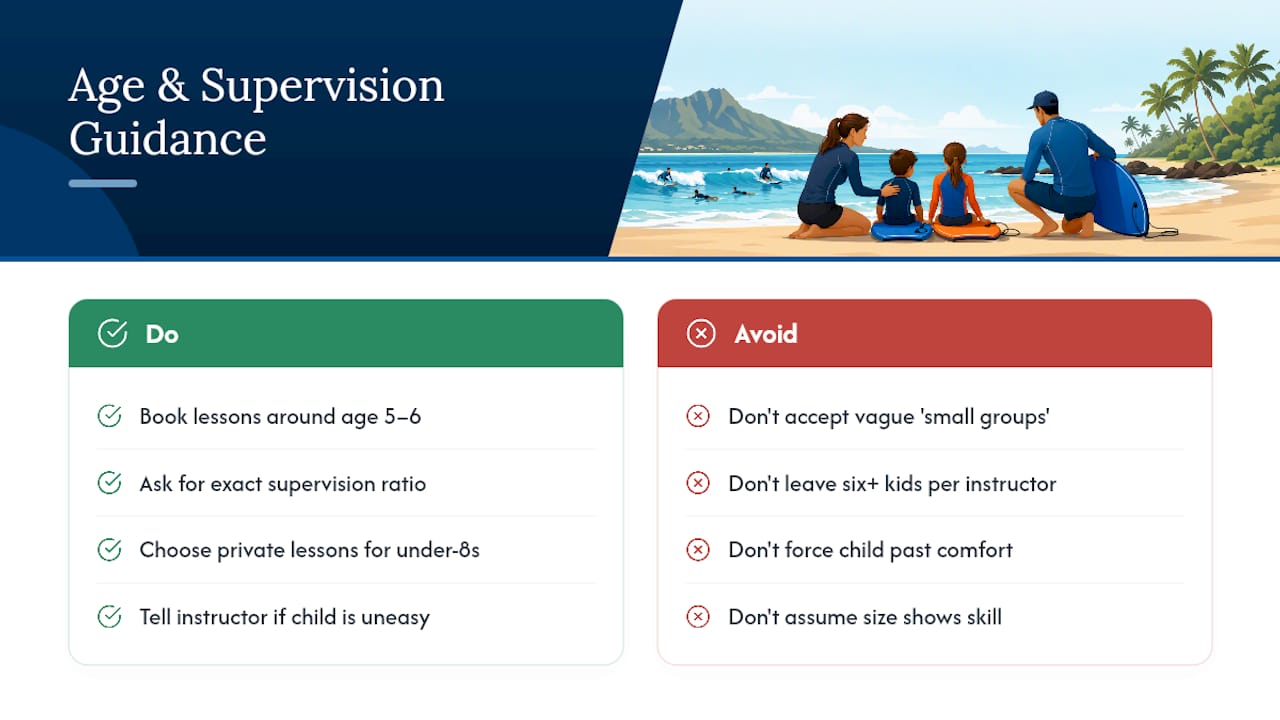
Most kids are ready for a beginner bodyboard lesson around age 5 or 6, once they can comfortably float, kick, and follow verbal instructions in water over their head. Younger kids can still enjoy the shallows with a parent, but a structured lesson works better once they can handle brief separation from a parent and take direction from an instructor mid-wave.
Supervision ratios matter more here than almost anywhere else in the lesson. A single instructor watching six or seven kids in moving water cannot realistically track every wipeout, and that gap is where accidents happen. Ask what the group’s ratio actually is before booking, not just “small groups,” but a number. For nervous first-timers or kids under 8, private lessons close that gap entirely by putting one instructor’s full attention on one student.
Fitness matters less than comfort in the water. A confident 7-year-old who’s spent summers in a pool often does better than a bigger, older kid who’s never been past waist-deep water. If your child gets uneasy in waves at the local pool, mention that when booking. A good instructor adjusts pacing rather than pushing a rigid lesson script, and starting a session closer to shore in ankle-deep whitewater before working outward is a normal, smart adjustment, not a sign the lesson is going poorly.
Emergency Procedures And Who To Contact On Oahu Beaches
Every staffed Oahu beach has a lifeguard tower, and that tower is your first call in almost any water emergency, faster than dialing anyone else. Lifeguards carry rescue equipment, radios linked to emergency services, and the training to reach a struggling swimmer in the time it takes you to find your phone.
If you’re at a beach without a visible lifeguard nearby, or the emergency happens away from the tower, call 911 immediately. Hawaii’s ocean safety and fire rescue teams coordinate closely, and dispatchers are used to fielding beach emergencies specifically.
While you wait for help, don’t attempt a rescue yourself unless you’re a strong swimmer trained for it. More people drown attempting rescues than most visitors expect, and a second victim in the water only complicates things for responders. Instead, keep eyes on the person in trouble, point continuously so responders can find them fast, and send someone to flag the lifeguard if you haven’t already.
Know your beach’s name and the nearest cross street or landmark before you ever get in the water. It sounds unnecessary until you’re the one on the phone with 911 trying to describe “the beach near the pink hotel” instead of giving a clear location.
Safe Entry And Exit Techniques For Oahu’s Shorelines
Getting in and out of the water is where a surprising number of minor injuries happen, usually from a stumble in shorebreak rather than anything dramatic. Oahu’s beaches vary enough that a technique that works at Waikiki’s gentle sandy shorebreak won’t necessarily work at a beach with a steeper drop.
Enter sideways, not facing straight into oncoming waves, and keep your board between you and the wave rather than under your arm where it can get ripped away. Watch the wave sets for a moment before walking in. Most beaches run in patterns of bigger waves followed by a lull, and timing your entry for that lull cuts down on getting knocked over before you’ve even started.
Exiting works the same way in reverse. Ride your wave as far as it’ll carry you, then stand up carefully, since shorebreak sand shifts constantly and footing that felt solid five minutes ago might not be now. If you get caught in shallow, dumping shorebreak on the way out, the same wipeout rule applies: don’t fight it standing up. Curl up, protect your head, and let it pass before you try to stand again.
For beaches with any rock or reef near the entry point, understanding how shallow water surf behavior works before you go helps you spot the difference between a sandy entry and one that needs more caution.
How Crowd Density Affects Lesson Safety
A packed beach changes the safety equation more than most visitors expect. More boards in the water means more collision risk, and it means an instructor’s attention gets split between teaching and simply tracking where every student is relative to other swimmers.
Good instructors manage this actively rather than just hoping for the best. That usually means choosing a specific stretch of beach away from the densest swimmer traffic, staggering when different groups enter the water, and keeping beginner groups tighter and closer together when the lineup gets crowded. Some providers shift lesson timing to earlier morning slots specifically because Waikiki’s water traffic builds through the afternoon as more visitors head to the beach.
As a parent or student, you can read the crowd yourself before committing to a lesson time. If a stretch of beach is wall-to-wall with swimmers, surfers, and other lesson groups, that’s a reasonable moment to ask your instructor how they’re managing the traffic, or to consider booking an earlier or later slot when it thins out.
First Aid Basics For Common Bodyboarding Injuries
Most bodyboarding injuries on Oahu are minor: scrapes from sand or reef contact, mild sunburn, jellyfish stings, or the occasional bruised rib from a hard wipeout. Knowing basic responses means you’re not scrambling if something happens mid-lesson.
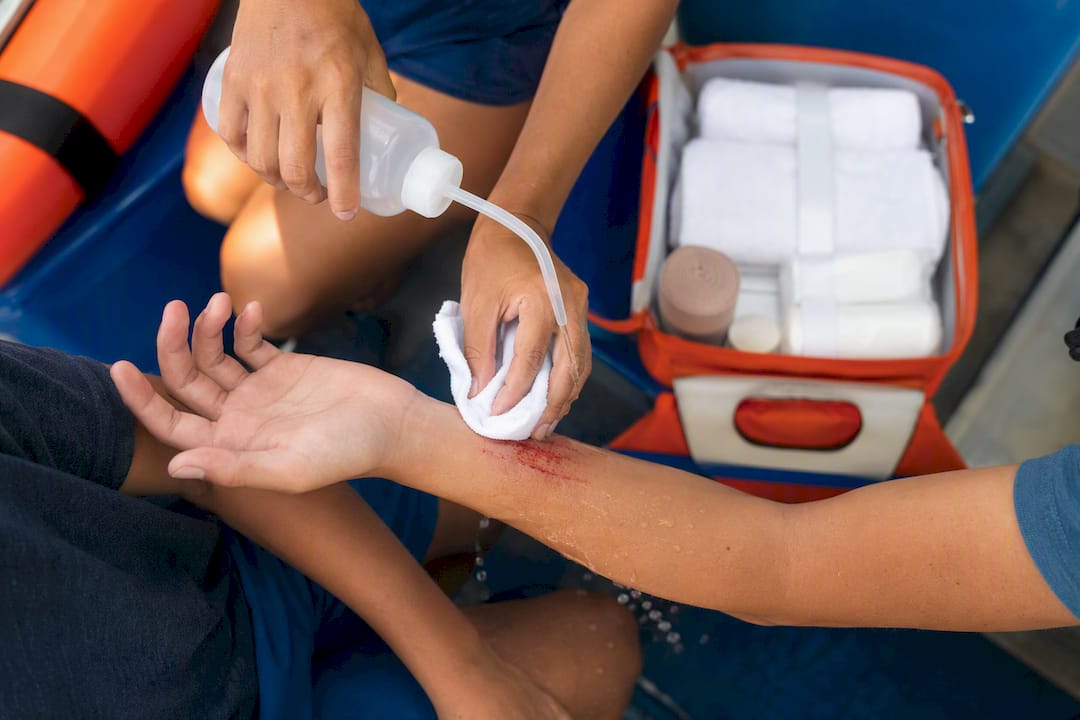
For scrapes and cuts, rinse thoroughly with clean water to remove sand, then apply pressure with a clean cloth if there’s active bleeding. Salt water actually helps disinfect minor cuts, but sand embedded in a wound needs a proper rinse first. For jellyfish stings, rinse with vinegar if available, and avoid rubbing the area, which can worsen venom release. Most lifeguard towers keep vinegar on hand specifically for this.
Suspected sprains or fractures need immobilization and a trip to urgent care rather than pushing through the rest of a session. Any head impact that causes confusion, dizziness, or vomiting is a signal to stop immediately and seek medical evaluation, since even a mild-looking bump can mask a concussion. Swallowed seawater causing persistent coughing or breathing trouble also warrants medical attention, since secondary complications from near-drowning incidents can show up hours later.
Lifeguard towers are stocked with basic first aid and trained personnel, which is one more reason lesson locations inside flagged zones matter as much as they do.
An Instructor’s Take On What Actually Keeps Beginners Safe
Most safety advice you’ll read treats every beginner the same, and that’s the part I’d push back on… The kids who struggle most aren’t usually the smallest or least athletic ones. They’re the ones who never got a real land briefing before someone handed them a board and pointed at the water.
If you’re prepping for a lesson, pack a rashguard even if the school provides one, since a spare means less time reapplying sunscreen mid-session. Ask about lesson length before booking. Sixty minutes is plenty for a first-timer’s attention span; 90 minutes only helps if your kid genuinely wants more water time. And always ask who’s watching the water, not just who’s teaching.
— Johann
Book A Safety-First Bodyboard Lesson In Waikiki
Hans Hedemann Surf School’s lessons in Waikiki put you in the water with certified instructors who coordinate with the beach’s own lifeguard presence, not lessons run off in a corner hoping nothing goes wrong. Families get small-group sessions built around real supervision, kids get age-appropriate pacing instead of a one-size lesson script, and nervous first-timers can book private instruction for full one-on-one attention.
Lesson options cover the range families actually need: group bodyboard lessons for kids old enough to handle a small group setting, dedicated kids’ lessons built around younger swimmers and closer ratios, and private lessons for anyone who wants an instructor’s full focus from the first wave to the last. Every session starts with the land briefing and safety walkthrough covered earlier in this guide, not a shortened version of it.
If you’re ready to get your family in the water this week, check available times and book a surf lesson directly through Hans Hedemann Surf School’s Waikiki booking page. And if you’re mapping out your beach day beyond the lesson itself, a solid shade and gear setup makes the waiting-around parts of the day easier on the rest of the family too.
Sources
- NOAA JetStream — Rip current safety
- RNLI — Bodyboarding safety
- CDC — Drowning prevention
- HawaiiGuide — Hawaii bodyboarding for visitors: best beaches, rentals, and safety
0 Comments