
Beginners can absolutely surf the North Shore, but only at a handful of spots and only when conditions cooperate. Puaʻena Point and Chun’s Reef are the two most reliable options, along with the sandy Haleʻiwa-area breaks for pure whitewater practice. Book a morning lesson on a soft-top board, check the tide and swell forecast the night before, and go with a qualified local instructor rather than paddling out solo.
TL;DR:
- Beginner surfers should focus on spots like Puaʻena Point and Haleʻiwa beach pockets for their sandy bottoms and gentle waves, especially in late summer or fall.
- Timing lessons in the morning with small groups, soft-top boards, and specific guidance from experienced instructors greatly increases the chances of standing up early.
- Conditions such as tide stage, swell height under 3 feet, period over 10 seconds, and offshore wind are essential for safe and manageable beginner surf sessions.
- Rip currents are a significant danger, so surfers must learn to recognize and swim parallel to the shore if caught, rather than fighting the pull directly inward.
- Choosing an instructor with experience, booking early morning sessions, and confirming conditions beforehand are crucial steps for an optimal beginner surfing experience.
Table of Contents
- Best Beginner Surf Spots on the North Shore
- When Should Beginners Go? Season, Tide, and Time of Day
- Rip Currents, Reef Cuts, and Other Things Beginners Need to Know
- What Happens in a Beginner Surf Lesson (And Why It Speeds Things Up)
- Why Hans Hedemann Surf School Is a Solid Choice for First-Timers
- What the Conventional North Shore Advice Gets Wrong
- Ready to Book Your North Shore Lesson?
- Check These Before You Head Out
- Sources
- FAQ
Best Beginner Surf Spots on the North Shore
North Shore beginner surfing works best when you pick your spot the way a local would, matching your skill level to the break instead of chasing the famous names you’ve seen in surf films. The stretch of coastline from Haleʻiwa to Sunset Beach hosts some of the most powerful waves on Earth, but a few pockets stay gentle enough for a first-timer nearly year-round.
Puaʻena Point, just north of Haleʻiwa Harbor, is the spot most local instructors point beginners toward first. It breaks over a sandy bottom with a protected channel, and the waves stay small and rollable even when the rest of the coast is firing. It’s one of the most reliable beginner surf spots on the North Shore, especially on low to mid tide when the inside section stays soft and forgiving. Parking is limited along Haleʻiwa Road, so arriving early matters as much for a spot in the lot as for the waves.
Chun’s Reef, a few minutes up the highway, is a mellow right-hand reef break that’s become a favorite for longboarders and lesson groups. It’s described as beginner-friendly and commonly used for lessons and longboarding, particularly when the swell stays under a few feet. Because it breaks over reef rather than sand, it does demand more caution, and it tends to suit surfers who already have some balance and paddling experience rather than absolute first-timers.
For pure whitewater practice, the sandy pockets around Haleʻiwa Beach Park and the protected bay near the harbor are hard to beat. There’s no reef to worry about, the shore break is soft, and it’s the kind of place where you can fall a dozen times without a second thought.
- Puaʻena Point: sandy bottom, gentle rollers, best on low to mid tide
- Chun’s Reef: mellow reef break, best for those with some board experience
- Haleʻiwa-area sandbars: safest whitewater for total beginners and family lessons
Lifeguards patrol most of these beaches, and lesson groups are a common sight in the morning, which makes the lineup feel less intimidating than the North Shore’s reputation suggests.
When Should Beginners Go? Season, Tide, and Time of Day
Timing matters more on the North Shore than almost anywhere else in Hawaii. Winter brings the swells that make this coastline famous, and those same swells make most of it unsurfable for anyone who hasn’t stood up on a board before.
Late summer and fall are your window. Smaller, more consistent surf typically occurs in late summer and fall, well before the big winter swells arrive. Mornings are the second half of the equation: the trade winds haven’t picked up yet, so the wave faces stay clean instead of chopped up by afternoon wind.
Tide changes the personality of each spot:
- Puaʻena Point performs best on a low to mid tide, when the inside section stays soft and the channel is easy to paddle out through.
- Chun’s Reef can get shallow and sharp at very low tide, so a mid to incoming tide usually gives a friendlier ride.
- Haleʻiwa’s sandy pockets are the most forgiving across tide stages, which is why they’re the default for total beginners.
Check swell height, period, and wind direction the night before and again the morning of your session using a forecasting service like Surfline. Anything under 3 feet with a period under 10 seconds and light or offshore wind is generally workable for a first lesson.
Rip Currents, Reef Cuts, and Other Things Beginners Need to Know
The North Shore’s danger isn’t really the waves you’ll be learning on. It’s what happens when a beginner drifts past the safe zone without realizing it.
Rip currents are the biggest risk. They’re the fast-moving channels of water pulling back out to sea, usually visible as a streak of choppy, discolored water between calmer sections. If you get caught in one, don’t fight it straight back to shore. Swim parallel to the beach until you’re clear, then angle back in, and raise an arm to signal a lifeguard if you’re struggling.
Reef versus sand matters more here than most beginners expect. A fall over sand is forgiving. A fall over reef, especially at low tide, can mean cuts, coral rash, or worse. That’s the main reason spots like Puaʻena Point, with their sandy bottom, are the smarter starting point over reef breaks like Chun’s.
Before you paddle out anywhere on the North Shore, run through this checklist:
- Confirm you’re a competent swimmer in open water, not just a pool.
- Stay in the whitewater until you can consistently catch and ride it.
- Never surf alone, even at the mellow spots.
- Give right of way to surfers already riding a wave, and don’t paddle straight through a crowded lineup.
- Wear a leash, a rash guard, and reef-safe sunscreen every session.
A large soft-top board reduces the chance of injury dramatically compared with a hard fiberglass board, both for you and for everyone paddling near you.
Pro Tip: If you’re not sure whether a current is a rip, watch the water for a minute before you paddle out. Foam or debris moving steadily out to sea, in a lane calmer-looking than the whitewater around it, is your signal to enter somewhere else.
What Happens in a Beginner Surf Lesson (And Why It Speeds Things Up)
A first lesson almost always starts on the sand, not in the water. You’ll practice the pop-up, the motion of pushing from lying down to standing, dozens of times before your board ever touches a wave. Instructors do this because muscle memory built on solid ground transfers far faster than trying to figure it out while getting knocked around by whitewater.
Once you’re in the water, the instructor picks the spot and the wave, not you. That’s the real advantage of a lesson over teaching yourself: a few coached sessions compress the typical learning curve because someone experienced is reading the conditions and positioning you exactly where a wave will do the work for you. Most first-timers stand up at least once early on with that kind of guidance.
Choosing the right lesson comes down to a short checklist:
- Ask how many years the instructors have been coaching and whether they’ve competed or worked professionally.
- Ask the group size. Four or fewer students per instructor is the range worth paying for.
- Confirm the boards are soft-top longboards, not hard rental boards.
- Ask about safety procedures, insurance coverage, and whether photo or video packages are available.
Pro Tip: When you book, specifically request a soft-top longboard and an instructor who plans to keep the group in whitewater for the first session. Making that one request measurably increases your odds of standing up on your first try. Book morning slots when you can, ask about the school’s weather cancellation policy, and confirm whether beginner sessions run at a dedicated beginner zone rather than a general lineup.
Why Hans Hedemann Surf School Is a Solid Choice for First-Timers
Hans Hedemann Surf School has a teaching method focused on helping beginners start surfing early, using professional surfers as instructors rather than seasonal hires. Students often report faster progress than expected, which the school associates with small group sizes and experienced instructors.
The school offers various lesson types and equipment rentals for beginners at North Shore and Waikiki. Optional photo and video packages let you keep proof of that first wave.
What the Conventional North Shore Advice Gets Wrong
Most guides to the North Shore treat it as one giant, uniformly dangerous stretch of coast, which scares off beginners who’d actually be fine at spots like Puaʻena Point in September. That framing is lazy. The real story is that this coastline has both some of the heaviest waves on the planet and a few genuinely mellow pockets, sometimes less than a mile apart.
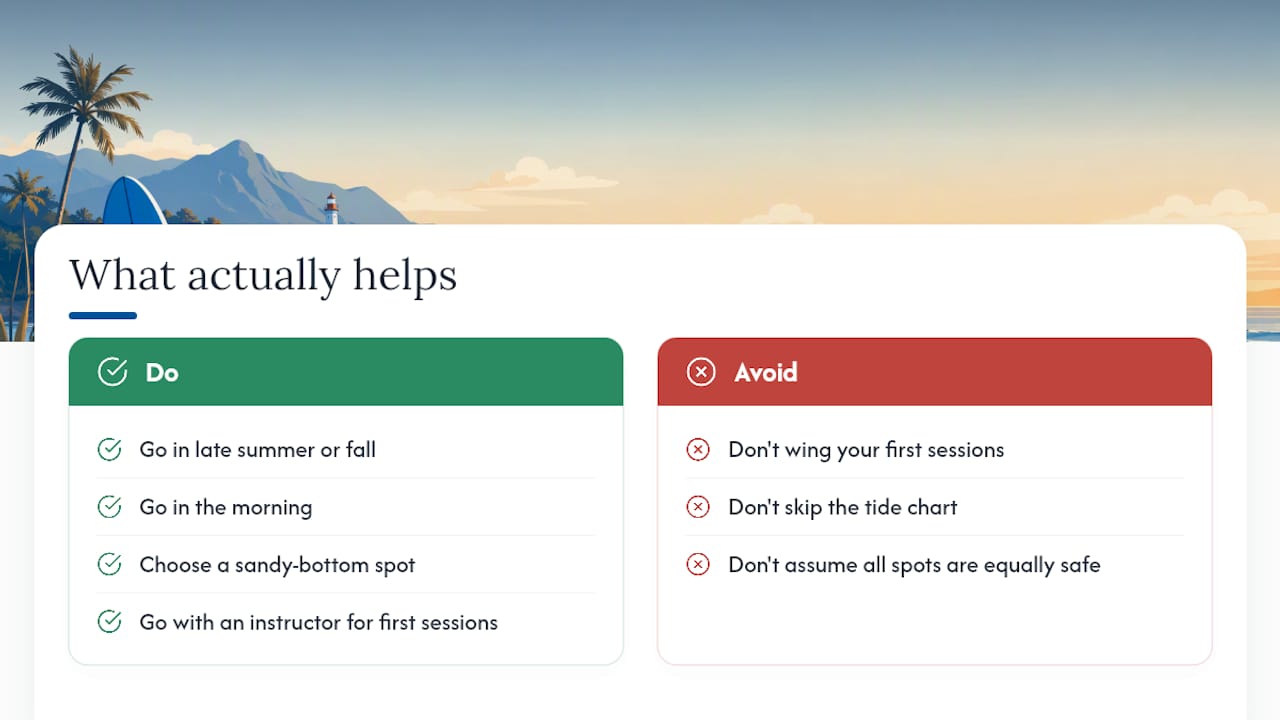
The advice that actually holds up is narrower than most articles admit: go in late summer or fall, go in the morning, go to a sandy-bottom spot, and go with an instructor for your first few sessions instead of winging it. Skip any one of those four and your odds of a good first experience drop fast.
What gets underrated is how much the tide alone changes a spot’s personality. Puaʻena Point at low tide and Chun’s Reef at low tide are not the same level of beginner-friendly, even though both show up on every “easy North Shore spots” list. Read the tide chart before you read the hype.
— Johann
Ready to Book Your North Shore Lesson?
Reading about rip currents and tide charts only gets you so far. What actually gets you standing on a board is an instructor who’s already scouted the day’s conditions and picked the safest wave for your skill level, which is exactly what a guided lesson replaces guesswork with. Hhsurf runs North Shore surf lessons built around small groups, soft-top boards, and instructors who spend their mornings reading exactly the spots covered above.
When you book, ask for a morning slot, a small group, and a soft-top longboard, the same combination that gives first-timers their best shot at catching a wave on day one. If North Shore timing doesn’t line up with your trip, Hhsurf’s Waikiki surf lessons run on a similar beginner-first approach closer to town. Either way, the next step is simple: pick your date and reserve your spot before the good morning slots fill up.
Check These Before You Head Out
Conditions on the North Shore can shift from one day to the next, so verify everything one more time before you leave your hotel.
- Go North Shore for local safety notices, seasonal updates, and lifeguard information.
- Surfline or a comparable forecasting app for swell height, period, and wind direction down to the hour.
- Hawai’i Visitors & Convention Bureau for general ocean safety guidance if you’re new to Hawaii altogether.
- Local tide charts to confirm whether Puaʻena Point or Chun’s Reef is on the tide stage that suits your level that day.
Check conditions again the morning of your lesson. Forecasts shift overnight more often than visitors expect.
Sources
- Best Time to Surf on the North Shore for Beginners | NSSG
- Chun’s Reef Surf Spot, Oahu — Hawaii Surf Spots
- How To Surf: The Ultimate Beginner’s Guide With Pro Tips – Surfer
- Go North Shore (local tourism resource)
FAQ
Can beginners surf the North Shore?
Yes, at specific spots like Puaʻena Point and the sandy breaks near Haleʻiwa, and ideally in late summer or fall with a lesson from a local instructor rather than solo in winter swell.
Where are the best places to surf in the US for beginners?
Oʻahu’s North Shore offers Puaʻena Point and Chun’s Reef as standout beginner options, and both perform far better for new surfers than most of the North Shore’s winter-famous breaks.
What is the 12 second rule in surfing?
Definitions vary among surf schools, but it generally refers to counting the interval between waves in a set to time your paddle-out and avoid getting caught inside when a bigger wave arrives.
Is the North Shore good for surfing?
It’s one of the most famous surf destinations in the world, but it’s best suited to beginners only at select spots and mainly outside the winter big-wave season.
How much do beginner surf lessons cost on the North Shore?
Pricing varies by group size and lesson type, with group lessons generally costing less per person than semi-private or private instruction; contact a local school directly for current rates.
How long does it take to learn to surf?
Most beginners can stand and ride whitewater within their first one to three lessons with proper instruction, though comfort in bigger or reef-break conditions takes considerably longer.
0 Comments