
Most surfing lower back pain comes from paddling with your spine locked in extension for too long, combined with a core and thoracic spine that aren’t doing their share of the work. The fix isn’t rest alone. Modify your paddling and pop-up technique, start pain-friendly mobility and breathing drills right away, and build back core endurance in stages. If you notice numbness, leg weakness, or bladder changes, stop surfing and get evaluated the same day.
TL;DR:
- Paddling with the spine extended causes repeated compression of facet joints, leading to lower back pain, especially when thoracic mobility is limited.
- Using a knee pop-up reduces lumbar extension and rotation during the pop-up, decreasing strain and lowering the risk of aggravating back pain.
- Daily mobility and strength exercises, such as thoracic rotations, glute bridges, and core stability drills, help rebuild tissue capacity and prevent flare-ups.
- Short, pain-free paddling sessions, early warm-ups, and a gradual return-to-surf plan are essential for safe recovery and avoidance of re-injury.
- Urgent medical evaluation is necessary if symptoms include saddle numbness, worsening leg weakness, or bladder changes, as these indicate serious nerve compression.
Table of Contents
- What Causes Lower Back Pain in Surfers?
- How Do You Know If It’s Serious?
- Exercises and Stretches for Surfing Lower Back Pain
- Fix Your Paddling and Pop-Up Technique
- Build a Pre-Surf Warm-Up and Weekly Routine
- Physiotherapy and the Return-to-Surf Timeline
- Red Flags: When Back Pain Needs Urgent Care
- A Coach’s View on Training Surfers’ Backs
- Want Coaching That Protects Your Back? Try a Guided Lesson
- Sources
- FAQ
What Causes Lower Back Pain in Surfers?
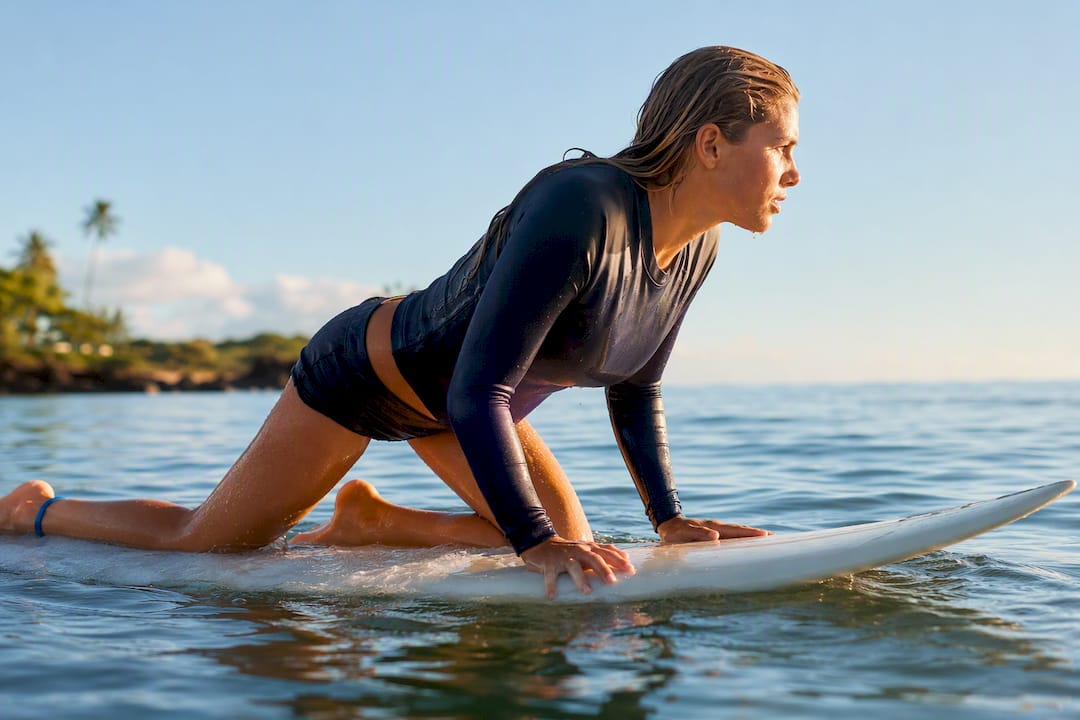
Paddling is the main offender, and the mechanics explain why. To keep your head above water and your eyes on the horizon, you extend your lumbar spine for minutes at a stretch, wave after wave, session after session. That sustained extension jams the small facet joints at the back of each vertebra, and over hundreds of paddling strokes, that repeated compression is where a lot of surfers first feel the ache set in.
Thoracic stiffness makes it worse. Your mid-back is supposed to share the job of arching you upward when you paddle. If it’s tight from a desk job or just years of poor mobility work, your lumbar spine picks up the slack. Physiopedia’s clinical overview of Surfer’s Back identifies this exact pattern, lumbar hyperextension compensating for a stiff thoracic spine, as one of the most common drivers of chronic pain in surfers.
The pop-up adds a second stress. It’s an explosive, loaded movement that combines rapid extension with rotation, often performed under fatigue at the end of a long paddle. Do that hundreds of times a season and you’re layering repetitive strain on top of a spine that’s already spent hours in an extended position.
A few other factors tend to stack the deck against you:
- Prolonged sitting off the water reduces hip extension and tightens hip flexors, which pulls your pelvis into a position that increases lumbar strain when you paddle.
- A weak posterior chain, glutes and hamstrings that aren’t pulling their weight, forces the lower back to stabilize movements it shouldn’t have to.
- Age and cumulative surf hours matter. A 2014 Australian study found low back pain was the single most commonly reported surfing injury, affecting roughly 23% of documented surfing injuries, and prevalence climbs the longer someone has been surfing.
- Board and paddling style play a role too. A board that sits low in the water forces more neck and back extension to see over the nose, which compounds the same postural fault.
None of this means you’re doing something uniquely wrong. It means paddling asks your spine to do a job it’s poorly built for, over and over, and most surfers never train the tissue that’s absorbing the load.
How Do You Know If It’s Serious?
Most surfing-related back pain is mechanical, meaning it comes from muscles, joints, and connective tissue, not nerves. Mechanical pain tends to be localized to the low back, worse with certain movements (extension, twisting), and eases with rest or position changes. It’s uncomfortable, but it’s not dangerous.
Radicular pain is different, and it’s the kind you want to catch early. Watch for:
- Pain that shoots down one leg past the knee, not just an ache that stays in the low back.
- Numbness, tingling, or a “pins and needles” sensation in the buttock, thigh, or foot.
- Noticeable weakness when lifting your foot, standing on your toes, or pushing off the ground.
A short list of red flags means you skip the home exercises and get seen urgently: saddle numbness (loss of sensation around the groin or inner thighs), new bowel or bladder changes, or leg weakness that’s getting worse day by day rather than better.
For everyday self-checking, try three things. First, lie prone and slowly extend into a paddling position. Sharp, localized pain that eases when you relax back down usually points to a mechanical issue. Second, simulate a pop-up on dry land and notice whether the pain spikes at the top of the extension or during the rotation. Third, pay attention to how pain behaves across the day: mechanical pain often improves with gentle movement and worsens with prolonged sitting, while nerve-related pain tends to be less predictable.
A physiotherapist assessing surfer’s back will typically check thoracic rotation and extension range, core endurance (how long you can hold a plank or dead bug position with good form), and hip flexor and hamstring length, since tightness in either directly loads the lumbar spine during paddling and pop-ups.
Exercises and Stretches for Surfing Lower Back Pain
The goal isn’t to avoid movement. It’s to load your spine in ways it can tolerate while you rebuild the capacity it’s missing. Here’s a progression that works whether you’re managing a flare-up right now or trying to bulletproof yourself before the next session.
Start here if you’re in pain:
- Diaphragmatic breathing. Lie on your back, knees bent, one hand on your chest and one on your belly. Breathe so only the belly hand rises. Two to three minutes, several times a day. This sounds too simple to matter, but it calms an overactive nervous system response to pain and resets your breathing pattern away from the shallow, chest-dominant breathing that often accompanies acute back pain.
- Pelvic tilts. Same position, gently flatten your low back into the floor, hold two seconds, release. Ten to fifteen reps. This teaches you to control lumbar position instead of defaulting to extension.
- Supine decompression holds. Practitioners who use ELDOA-style postures, structured stretches designed to create traction and open space at a specific spinal segment, report that surfers get real relief from these, though the technique has more practitioner backing than controlled trials behind it. A simple version: lie on your back, pull one knee to your chest while pressing the opposite leg long, and hold 30 to 60 seconds per side.
- Pool micromovements. If you have pool access, walking in waist-deep water or doing slow leg swings offloads gravity and lets you move through range without provoking pain, an approach some surf-specific rehab coaches use as an early-stage bridge before land-based loading.
Mobility work to do daily:
- Thoracic rotations (open books, either seated or side-lying) to restore the mid-back movement that paddling and pop-ups demand.
- Hip flexor release, a half-kneeling stretch with a posterior pelvic tilt, to counter the tightness caused by sitting and by the paddling position itself.
- Hamstring and quad balancing stretches, since one-sided tightness pulls your pelvis out of a neutral position and quietly loads the low back asymmetrically.
Strength progression, once acute pain has settled:
- Glute bridges, two sets of twelve, focusing on squeezing the glutes rather than arching the lower back.
- Single-leg bridges once double-leg bridges feel easy and pain-free.
- Anti-rotation Pallof press progressions, standing perpendicular to a cable or resistance band and resisting the pull, to train the deep core stabilizers (multifidus and transverse abdominis) that physiotherapy programs for surfer’s back target directly.
- Bird dog, opposite arm and leg extension from a hands-and-knees position, building toward slow, controlled reps with no lumbar sway.
- Loaded anti-rotation and single-leg drives, mimicking the explosive hip drive of a pop-up, as the final step before returning to full-intensity sessions.
Pro Tip: Track pain on a simple 0 to 10 scale before and after each session. Anything that stays under a 3 and settles within a couple of hours is fine to keep doing. Anything that spikes past a 5 or lingers into the next day means you back off that exercise and try an easier variation.
A workable starting dose is two to three sets of eight to twelve reps, three to four times a week, advancing to the next exercise in a category only once the current one is pain-free for a full week. Rushing this timeline is the single most common reason surfers cycle in and out of the same flare-up all season.
Fix Your Paddling and Pop-Up Technique
Technique changes are the highest-leverage move you can make, because they reduce the load that’s causing the problem in the first place rather than just building tolerance for it. Start with paddling posture. Stack your ribs over your pelvis instead of letting your chest sag and your lower back arch to compensate. Lift your head with a controlled, moderate extension rather than craning to see over the whitewater, and shift some of your upper body weight slightly forward on the board so your lumbar spine isn’t doing all the work of holding your chest up.
The bigger change is the pop-up itself. The traditional pop-up asks you to go from prone to standing in one explosive burst of lumbar extension and rotation, exactly the motion most likely to aggravate an already irritated spine. A peer-reviewed technique described in PMC’s research on pop-up alternatives for surfers with low back pain offers a real fix: the knee pop-up.
Instead of springing straight to your feet, you bring one knee forward under your body first, then stand from that half-kneeling position. It reduces the sudden lumbar extension and rotational torque of the standard pop-up, which makes it a legitimate technique to practice, not just a workaround for weaker surfers.
A few practical notes on using it:
- Practice the knee pop-up on your living room floor or a patch of grass until the movement feels automatic before you try it in the water.
- Use it as a bridge technique during a flare-up, then reintroduce the traditional pop-up gradually once pain has settled and your core strength has caught up.
- Pace your sessions differently while you’re managing pain: shorter paddling stretches, earlier walk-backs to shore instead of paddling back out, and using a relaxed prone rest position between waves rather than staying propped up on your elbows.
- If a particular board makes you paddle with more extension because it sits low in the water, a session on higher-volume, higher-floating equipment can reduce strain while you rebuild capacity.
None of this requires you to surf worse. It requires surfing differently for a stretch, which is a trade most people make happily once they realize it keeps them in the water instead of on the beach.
Build a Pre-Surf Warm-Up and Weekly Routine
A five-minute warm-up before you paddle out does more for prevention than almost anything else on this list, because it primes the exact tissue that’s about to get loaded.
- Cat-cow or thoracic rotations, thirty seconds each direction, to wake up mid-back mobility before it’s asked to extend for an hour straight.
- Hip flexor stretch with a gentle pelvic tilt, twenty seconds per side, since tight hips translate directly into extra lumbar strain during paddling.
- Glute bridges or a short plank hold, one set to activate the core and posterior chain before you ask them to stabilize you in the water.
- A few slow, controlled practice pop-ups on the sand, rehearsing the movement pattern you want your body to default to once you’re actually on a wave.
Cooling down matters just as much, even though almost nobody does it. A few minutes of gentle spinal mobility, some slow cat-cow stretches, a supported child’s pose, and the diaphragmatic breathing described earlier, helps your back settle out of the extended position it just spent an hour in rather than staying locked there for the rest of the day.
Weekly structure is where the real prevention happens. Surfing itself builds paddling-specific fitness, but it doesn’t build the core stability or thoracic mobility that protects you from surfing’s own demands. Aim for two dedicated core and stability sessions a week, using the strength progression outlined above, plus one focused mobility session if you’re not already stretching daily.
If you’re short on time, fold the mobility work into your existing routine rather than treating it as a separate task: five minutes of thoracic rotations while coffee brews, or a couple of pelvic tilts before bed. Consistency beats intensity here by a wide margin.
Physiotherapy and the Return-to-Surf Timeline
Physiotherapy is the backbone of recovery for most surfers dealing with anything beyond a mild, short-lived ache. A physiotherapist combines manual therapy, hands-on techniques to reduce joint stiffness and muscle tension, with a tailored exercise program and movement re-education, teaching you to paddle and pop up in ways that don’t reload the same irritated structures. Clinical guidance on low back pain management consistently points to activity modification and graded exercise, not prolonged rest, as the first-line approach, and surfer’s back responds to that same principle.
Modalities like heat, ice, or TENS units can take the edge off pain in the short term, but they don’t fix the underlying mechanical problem. Use them as a supplement to exercise and technique work, under a clinician’s guidance, rather than as the main plan.
A sensible return-to-surf timeline moves through four stages, and rushing any one of them is how surfers end up reinjured within a few weeks of getting back in the water:
- Stage one: symptom control. Pain settles with rest, gentle movement, and the breathing and pelvic tilt drills covered earlier. This can take anywhere from a few days to a couple of weeks depending on severity.
- Stage two: restore mobility. Thoracic rotation and hip flexor length return to something close to normal, checked either by a clinician or by noticing that the pop-up simulation test no longer provokes sharp pain.
- Stage three: rebuild paddling endurance. Start with short paddling sessions in calm water, building duration gradually, while continuing the strength progression on land.
- Stage four: full sessions. Return to normal surf duration and intensity, keeping the pre-surf warm-up and weekly core work in place as ongoing maintenance rather than something you drop once you feel better.
Imaging, X-rays or MRI, is rarely needed for straightforward mechanical pain. It becomes relevant if red-flag symptoms appear, if pain persists beyond six to eight weeks despite consistent conservative treatment, or if a clinician suspects something beyond a routine strain based on their assessment. A specialist referral follows the same logic: most surfers never need one, but persistent radicular symptoms or a lack of progress after a genuine course of physiotherapy is the point where it’s worth asking for one.
Red Flags: When Back Pain Needs Urgent Care
A short list of symptoms means you stop surfing and get evaluated the same day, not after a few more sessions to see if it settles:
- Numbness around the groin or inner thighs (saddle anesthesia).
- New difficulty controlling your bladder or bowels.
- Leg weakness that’s getting worse rather than better over hours or days.
- Pain that comes on suddenly and severely after a wipeout or hard fall, especially with any loss of leg function.
These symptoms can point to cauda equina syndrome, a compression of the nerve bundle at the base of the spinal cord, which is a medical emergency regardless of how it happened.
Surfer’s myelopathy deserves specific mention. It’s a rare but serious spinal cord injury linked to prolonged lumbar hyperextension, most often reported in people who are new to prone paddling and spend extended time arched backward. Clinical case reports describe it as presenting with sudden back pain followed by progressive leg weakness or numbness, sometimes within minutes to hours of a long paddling session. If that pattern shows up, get to an emergency room immediately rather than waiting to see a regular doctor.
When you do seek care, give clinicians the specifics: when the pain started, whether it followed a particular session or fall, whether it radiates and where, and whether you’ve noticed any numbness, weakness, or bladder changes. That detail shortens the path to the right diagnosis.
A Coach’s View on Training Surfers’ Backs
The mistake most surfers make with back pain is treating posture like a fixed target, one correct position they’re supposed to hold every time they paddle. That’s not how spines work, and it’s not what the research supports either. Coaching and clinical writing on this exact debate lands on the same conclusion: durable spinal health comes from strength, mobility, and the capacity to move through a range of positions, not from rigid alignment.
That’s the framing worth adopting. Train your thoracic spine to rotate, your core to resist unwanted movement, and your hips to share the load your lower back has been absorbing alone. Combine that with genuine on-water coaching, someone watching your paddling and pop-up in real time, because a movement pattern that feels fine to you can still be loading your spine badly, and you often can’t tell from the inside. If pain persists past a few weeks of consistent exercise and technique work, pair a physiotherapist’s assessment with coaching rather than choosing one over the other.
— Johann
Want Coaching That Protects Your Back? Try a Guided Lesson
Reading about pop-up mechanics only gets you so far. Feeling the difference between a jarring pop-up and a controlled one usually takes someone watching you do it and correcting you in real time, which is exactly what a lesson gives you that a YouTube video can’t.
At Hans Hedemann Surf School in Waikiki, instructors focus on the fundamentals from your first session, paddling posture, rib and pelvis alignment, and pop-up mechanics, so you’re not reinforcing the same extension-heavy habits that lead to back pain in the first place. Private lessons run $180 per person and give you full one-on-one attention to work through technique at your own pace, while group lessons at $100 per person are a solid, lower-cost way to get coached fundamentals if you’re newer to the sport. If you’d rather ease in with lower-impact equipment while your back settles, Waikiki surfboard rentals run $60 per day. Book a lesson and get real-time feedback on the exact movements that are loading your spine.
This article is general information, not a substitute for advice from a qualified doctor. Consult a qualified healthcare professional about your own circumstances before acting on anything here.
Sources
- Alternative Pop-Up for Surfers with Low Back Pain – PMC
- Surfer’s Back – Physiopedia
- Surfer’s Back — good posture debate (The Inertia)
FAQ
What Is the 12-Second Rule in Surfing?
The twelve-second rule isn’t a medical or biomechanical guideline. It’s a surf lineup etiquette convention about wave priority and right of way, unrelated to back pain or paddling technique.
What Are the Symptoms of a Lumbar Strain?
A lumbar strain typically causes localized low back pain that worsens with extension or twisting and eases with rest or position changes. Muscle stiffness, tenderness to touch, and pain that stays confined to the low back without radiating down a leg are the classic signs of a mechanical strain rather than nerve involvement.
How Can I Avoid Surfer’s Myelopathy?
Limiting how long you stay in a heavily extended paddling position, especially during your first few sessions as a new surfer, is the main preventive step, since surfer’s myelopathy is linked to prolonged lumbar hyperextension. Taking breaks to rest prone with your back relaxed, rather than staying arched up for extended stretches, and seeking immediate medical evaluation if sudden back pain is followed by leg weakness or numbness are both essential.
What Could Be Causing a Sharp Pain in My Lower Back After Surfing?
Sharp lower back pain after surfing is most often mechanical, caused by facet joint irritation from repeated lumbar extension during paddling or a sudden strain during an explosive pop-up. If the pain radiates down a leg, comes with numbness or weakness, or doesn’t ease with rest and gentle movement over a few days, it’s worth getting a physiotherapy assessment to rule out nerve involvement.
0 Comments