
For a Waikiki or Oahu surf lesson, choose a broad spectrum, water resistant sunscreen with SPF 30 or higher, and apply it about 15 minutes before you leave for the beach. Use roughly one ounce for full head to toe coverage on an adult, then plan to reapply at least every two hours and right after any towel drying or heavy time in the water. Pair it with a rash guard for the areas sunscreen alone won’t reliably cover.
TL;DR:
- Water resistance claims last only 40 or 80 minutes, so reapply after the labeled interval; no sunscreen can be labeled waterproof.
- Check ears, the back of your neck, scalp part, hands, and feet, and use SPF lip balm because ordinary sunscreen should not go near your mouth.
- The term reef safe has no standard legal definition; choose zinc oxide or titanium dioxide, and avoid oxybenzone and octinoxate where possible.
- For reactive skin, patch test a fragrance free mineral formula a day or two ahead; people prone to sunburn can choose SPF 50.
Table of Contents
- Sunscreen Essentials for a Hawaii Surf Lesson
- How to Apply Sunscreen Before, During, and After Your Lesson
- Pair Sunscreen With the Right Gear, Not Just Lotion
- Hawaii’s Rules on Sunscreen Ingredients and What “Reef-Safe” Really Means
- Your Pre-Lesson Sunscreen Checklist
- How We Build Sun Protection Into Every Lesson
- Cleaning Up and Disposing of Sunscreen Responsibly on Hawaii’s Beaches
- Choosing Sunscreen for Sensitive or Sunburn-Prone Skin
- A Few Words From the Water
- Book a Sun-Smart Surf Lesson in Waikiki
- FAQ
- Sources
Sunscreen Essentials for a Hawaii Surf Lesson
A surf lesson puts you in direct sun and reflected glare off the water for an hour or more, so the sunscreen you grab matters more than it would for a quick errand. Look for “broad spectrum” on the label, which means the product protects against both UVA and UVB rays rather than just the burn causing UVB wavelengths. The FDA recommends choosing a broad spectrum, water resistant sunscreen for exactly this kind of extended outdoor exposure.
Using a broad spectrum sunscreen with SPF 30 or higher is recommended for surf lessons due to prolonged sun and water exposure. Water resistance labeling is regulated too: a sunscreen can only claim 40 or 80 minutes of water resistance, tested and proven at that specific duration, and “waterproof” isn’t a label the FDA allows at all because no sunscreen is actually waterproof.
A few things worth knowing before you shop:
- Broad spectrum protects against both aging UVA rays and burning UVB rays, not just one.
- Water resistance ratings top out at 80 minutes and always require reapplication afterward.
- “Reef-safe” is a marketing phrase with no legal definition, so check the active ingredient list instead of trusting the front label.
How to Apply Sunscreen Before, During, and After Your Lesson
Timing matters almost as much as the product itself. Sunscreen needs time to bind to skin before it works, and most people apply far too little and far too late.
- Apply sunscreen about 15 minutes before you leave your hotel room, not once you’re standing on the sand, so it has time to set.
- Use roughly one ounce, about a shot glass full, to cover an adult’s entire exposed body for one application.
- Ask a friend, partner, or your instructor to help with your back and shoulders so coverage is even.
- Cover the spots people routinely skip: ears, back of the neck, tops of feet, backs of hands, backs of legs, and part line on the scalp.
- Use an SPF lip balm, since lips burn just like any other exposed skin and plain sunscreen doesn’t belong near your mouth.
- Reapply at least every two hours, and immediately after you towel off or spend extended time in the water, per FDA guidance.
The CDC specifically calls out ears, scalp, lips, neck, tops of feet, and backs of hands as the areas most people miss, which lines up with where sunburn tends to show up hardest after a morning surf lesson.
Pro Tip: Keep a small travel sunscreen in a resealable bag in your beach tote so sand and water don’t ruin the bottle before your reapplication window hits.
Pair Sunscreen With the Right Gear, Not Just Lotion
Sunscreen works better when it isn’t doing all the work alone. A rash guard covers your torso and arms for the full lesson, which means you’re not racing the clock on reapplication for the areas most likely to get missed or washed off in the first wave.
For a Waikiki or Oahu lesson, a few gear choices make a real difference:
- A snug, long-sleeve rash guard in quick-dry fabric covers your torso and arms without restricting paddling.
- A wide-brim hat and polarized sunglasses protect your face and eyes before and after you’re in the water.
- A few minutes of shade between paddling sessions gives your skin, and your sunscreen, a break from direct exposure.
- Lighter-colored, tightly woven fabric blocks more sun than thin, loose cotton.
Rash guards don’t replace sunscreen on your face, neck, hands, and feet, but they cut down how often you need to reapply everywhere else.
Hawaii’s Rules on Sunscreen Ingredients and What “Reef-Safe” Really Means
Hawaii’s coral reefs have drawn specific research attention to certain sunscreen chemicals, and it’s worth understanding the actual findings before you shop. Research indexed by the EPA’s HERO database documented oxybenzone contamination at Hawaiian sites and found adverse effects on coral in early life stages during laboratory testing. That research is part of why oxybenzone and octinoxate get called out by name in Hawaii sunscreen conversations.
Here’s the catch: “reef-safe” itself isn’t a regulated or standardized label, so a bottle can say it without meeting any consistent definition. Your best move is to skip the front-of-package marketing and read the active ingredient list directly.
- Favor mineral sunscreens with zinc oxide or titanium dioxide as the active ingredients when you have a choice.
- Skim the ingredient list for oxybenzone and octinoxate and avoid them where you can.
- Reapply on shore rather than right at the waterline to reduce how much immediately washes into the water.
Research note: Laboratory studies on oxybenzone cited by the EPA found harmful effects on coral planulae, the early life stage of coral, which is the basis for much of the “reef-safe” conversation in Hawaii.
Your Pre-Lesson Sunscreen Checklist
A little prep the morning of your lesson saves you from scrambling at the beach. Pack light, but don’t skip the reapplication sunscreen, since the bottle you put on at the hotel won’t last the whole session.
- Apply your first layer of sunscreen 15 minutes before leaving your hotel room.
- Pack a travel-size sunscreen in a leakproof bag for reapplication after the lesson.
- Bring SPF lip balm, a hat, and sunglasses for before and after your time in the water.
- Pack a towel and a full water bottle, since sun exposure and salt water both dehydrate you faster than you’d expect.
- If you’re flying in, remember TSA’s carry-on liquid limit applies to sunscreen bottles over 3.4 ounces, so pack a travel size or check a full-size bottle.
Our guide to your first surf lesson walks through what else to expect on lesson day, from gear to timing.
How We Build Sun Protection Into Every Lesson
Thirty years of teaching beginners in Waikiki has shown us that sun protection isn’t separate from surf instruction, it’s part of it. Our lessons are built around getting students riding waves quickly, which means more time in direct sun and reflected glare than a typical beach day, so we treat sunscreen timing as part of the pre-lesson routine rather than an afterthought.
Our instructors remind students to reapply after long sets and point out the spots people miss once they’re out of the water. Equipment is included in every lesson, and that extends to encouraging rash guards for the beginners who spend the most time paddling and falling, since repeated splashes wash off sunscreen faster than a calm swim would. Our sun protection guide for surfers goes deeper into the specifics if you want more detail before your lesson.
Cleaning Up and Disposing of Sunscreen Responsibly on Hawaii’s Beaches
What happens to your sunscreen after it washes off matters in Hawaii’s nearshore waters, where coral and marine life sit close to popular beaches. A few simple habits reduce your footprint without complicating your beach day.
Rinse off at an outdoor shower before you leave the beach rather than at the waterline, which keeps residual lotion out of the sand and surf. If you reapply on shore, wipe excess product off your hands with a towel before touching your gear or getting back in the water, so you’re not adding an extra dose directly into the shallows. Pack out your sunscreen bottle, any used wipes, and empty tubes rather than leaving them in the sand, since plastic containers and applicator caps are common beach litter in Waikiki and along the North Shore.

Choosing a mineral sunscreen with zinc oxide or titanium dioxide, as covered earlier, is itself a form of responsible use, since it lowers the amount of chemical UV filters entering the water with every wave. Showering off sunscreen residue at home or your hotel rather than in the ocean during a swim session is a small habit that adds up across the thousands of visitors who surf Hawaii’s beaches each year. None of this requires special gear or extra cost, just a bit of attention to where the rinse water goes.
Choosing Sunscreen for Sensitive or Sunburn-Prone Skin
Beginners often spend more time exposed than they expect, falling, resurfacing, and paddling back out repeatedly, so sunburn-prone skin needs extra thought before lesson day. Mineral sunscreens with zinc oxide or titanium dioxide tend to sit better on sensitive skin than chemical filters, since they work by sitting on top of the skin rather than being absorbed, which lowers the chance of a reaction.
If you’ve had a reaction to a sunscreen before, patch test a new product on your inner arm a day or two before your lesson rather than finding out at the beach. Fragrance-free formulas are worth seeking out too, since added fragrance is a common irritant in sunscreen for people with reactive skin.
For fair skin or a history of easy sunburn, SPF 50 is a reasonable step up from the SPF 30 baseline, paired with a rash guard to reduce how much skin needs sunscreen at all. Stick to one product for the full lesson rather than layering different formulas, since mixing sunscreens can affect how evenly either one sits on your skin. If your skin is unusually reactive or you’re not sure what’s causing a past reaction, a dermatologist can help you pick an active ingredient that works for you before your trip.

A Few Words From the Water
Every season we see the same thing: beginners who apply sunscreen at the hotel and pack a spare for later have a noticeably better time than those who skip it and try to tough it out. Reapplying after you towel off isn’t optional, it’s what keeps the rest of your trip comfortable. Good sun protection isn’t a chore here, it’s what lets you focus on standing up on the board instead of your shoulders.
— Johann
Book a Sun-Smart Surf Lesson in Waikiki
We’ve built sun protection into how we teach, not as an extra step but as part of getting you up on a board safely and quickly. Whether you book a group lesson, semi-private, or private session, bring the kids for a dedicated kids lesson, or head to the North Shore for a quieter beginner setting, our instructors factor reapplication timing and shade breaks into every session.
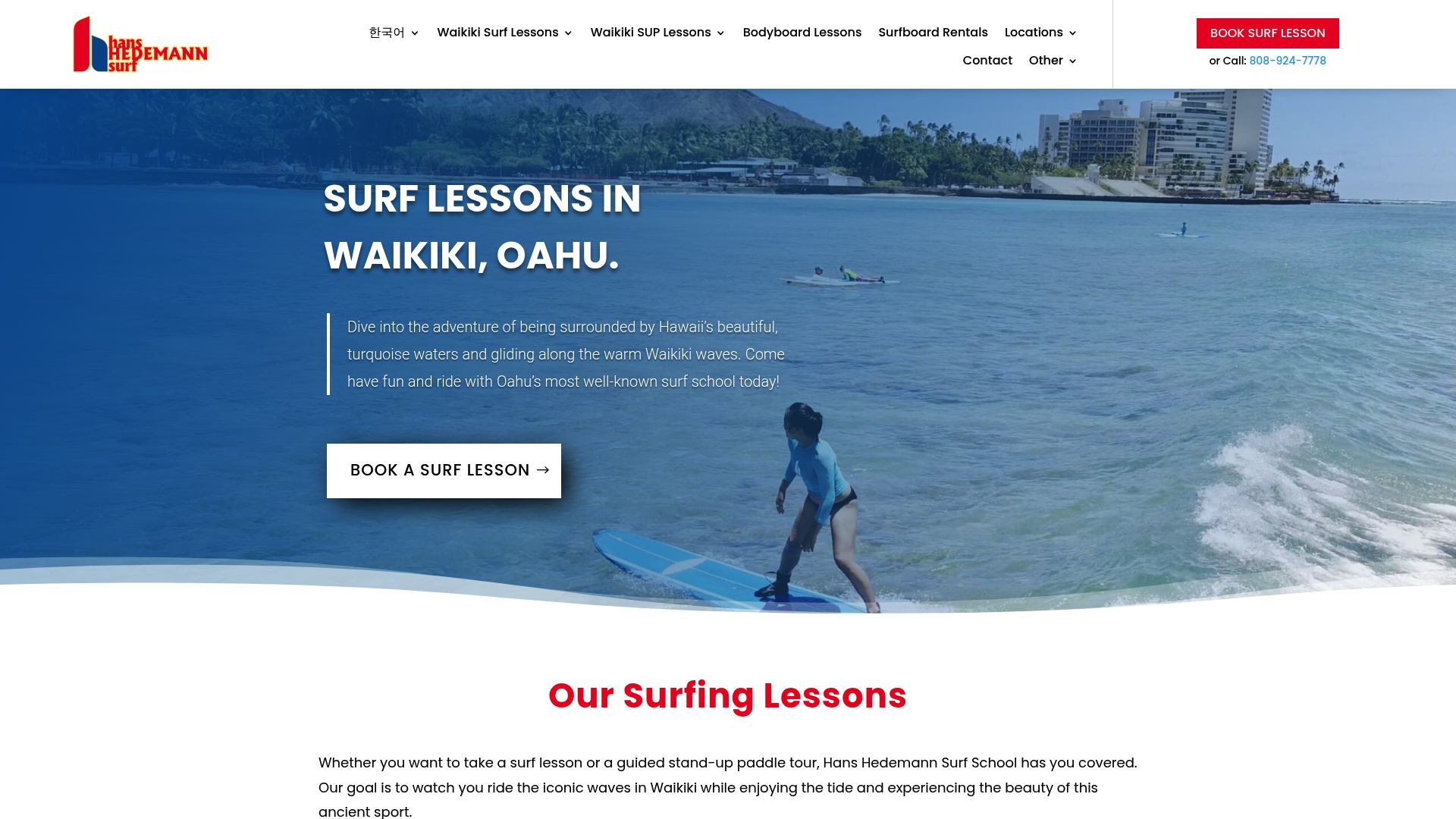
Group lessons, private instruction, and North Shore group lessons are available; check current prices on our surf lessons page. Check lesson types, times, and availability on our surf lessons page and book the session that fits your trip.
This article is general information, not a substitute for advice from a qualified doctor. Consult a qualified healthcare professional about your own circumstances before acting on anything here.
FAQ
Do I need sunscreen for a surf lesson in Hawaii?
Yes. A surf lesson puts you in direct sun and reflected glare off the water for an extended stretch, and the FDA recommends broad spectrum, water resistant sunscreen for exactly this kind of exposure. Pair it with a rash guard for added coverage during the lesson itself.
What SPF should I use for surfing in Hawaii?
SPF 30 or higher is a solid baseline for a surf lesson, since you’re in the water and sun for an hour or more. Fair skin or a history of sunburn can justify stepping up to SPF 50, combined with a rash guard to reduce exposed skin.
How often should I reapply sunscreen during a surf lesson?
Reapply at least every two hours, and immediately after towel drying or any extended time in the water, following FDA guidance. Bring a travel-size bottle in a leakproof bag so you can reapply right on the beach.
Is “reef-safe” sunscreen actually better for Hawaii’s coral?
“Reef-safe” is a marketing term with no standardized legal definition, so it’s worth checking the ingredient list rather than the front label. Research indexed by the EPA has linked oxybenzone to adverse effects on coral, so mineral sunscreens with zinc oxide or titanium dioxide are a reasonable choice when available.
What areas do people usually miss when applying sunscreen?
The CDC specifically flags ears, the back of the neck, tops of feet, backs of hands, and the scalp’s part line as commonly missed spots. These areas burn just as easily as your shoulders or back, so it helps to check them deliberately during application.
Sources
- Sunscreen: How to help protect your skin from the sun | FDA
- Sun safety | CDC
- Toxicopathological effects of the sunscreen UV filter, oxybenzone (benzophenone-3), on coral planulae … | HERO
0 Comments