
Most Hawaii surf schools refund your money only if you cancel with sufficient notice before your lesson; miss that window and you’re usually looking at a credit instead of cash back. If the operator cancels because the surf is dangerous, you typically get a full refund or a free reschedule, no argument needed. The trick is knowing which window applies to your booking and acting on it fast.
TL;DR:
- Cancellation within 24 hours typically forfeits a refund for standard group lessons, while private bookings and experience packages require 48 to 72 hours.
- Refunds are processed back to the original payment method within 5 to 10 days, but lesson credits usually expire within 6 to 12 months and may not be transferable.
- Operator cancellations due to dangerous surf or unsafe ocean conditions generally provide full refunds or free reschedules, with prompt notification being crucial.
- Last-minute cancellations, no-shows, or late rescheduling often result in partial or full forfeiture of payment, with emergency reasons potentially allowing exceptions if documented.
- Booking earlier in your trip and selecting flexible or credit-based lessons reduces risk if travel plans or weather conditions change unexpectedly.
Table of Contents
- Understanding surf lesson cancellation windows in Hawaii (24, 48, 72 hours)
- Refund or credit: which one should you take?
- What happens when the school cancels for weather or ocean safety?
- Late cancellations, no-shows, and rebooking fees
- How to cancel or reschedule a surf lesson the right way
- Booking smart to avoid losing money on cancellations
- How Hans Hedemann Surf School handles cancellations and safety
- A quick word on flexibility before you book
- Book with Hans Hedemann Surf School in Waikiki or on the North Shore
- Sources
Understanding surf lesson cancellation windows in Hawaii (24, 48, 72 hours)
Every operator sets its own notice window, and the number they pick usually reflects how much staffing and prep goes into your lesson. A basic group lesson only needs one instructor and a board rack, so a 24-hour window is common. A private lesson or a multi-instructor group booking ties up more staff time in advance, which pushes some schools toward 48 hours. Add-on experiences with catering, photographers, or transportation often require 72 hours or more because the operator has already paid vendors on your behalf.
- 24-hour window: Standard for most group and semi-private lessons. Cancel after the cutoff and you likely forfeit the refund.
- 48-hour window: Common for private lessons, multi-person bookings, and North Shore excursions with limited daily slots.
- 72-hour window: Typical for packages that bundle a lesson with a catered experience or staffed event, where the operator has already committed to outside vendors.
Watch the time zone on your confirmation email. Booking platforms sometimes display cutoffs in your home time zone rather than Hawaii Standard Time, and that gap has cost travelers a refund they thought they still qualified for. When in doubt, call and ask what time the cutoff hits locally, not what your phone shows.
Refund or credit: which one should you take?
A refund sends money back to the card you paid with, usually within 5 to 10 business days depending on the payment processor. A lesson credit stays on file with the school, often expiring after 6 to 12 months, and it may or may not transfer to another person in your group. The two aren’t interchangeable, and picking the wrong one can cost you.
- Take the refund if your travel dates are fixed and you won’t be back in Hawaii before the credit expires.
- Take the credit if your trip is flexible or you’re planning a return visit within the year.
- Ask directly whether the credit is transferable. Some schools will let you gift it to a friend or family member; others won’t.
Pro Tip: If you booked through a third-party platform rather than directly with the school, refund timing depends on that platform’s own processing schedule, which can add several extra business days on top of the operator’s approval.
What happens when the school cancels for weather or ocean safety?
Operators watch surf and marine conditions daily, often cross-checking National Weather Service local forecasts before deciding whether a lesson can safely run. Light rain almost never cancels a lesson. Dangerous swell, strong currents, or a high surf advisory usually does.
When the operator makes that call, you’re the one who benefits from clear cancellation-or-refund policies. Most schools in Hawaii handle it the same way:
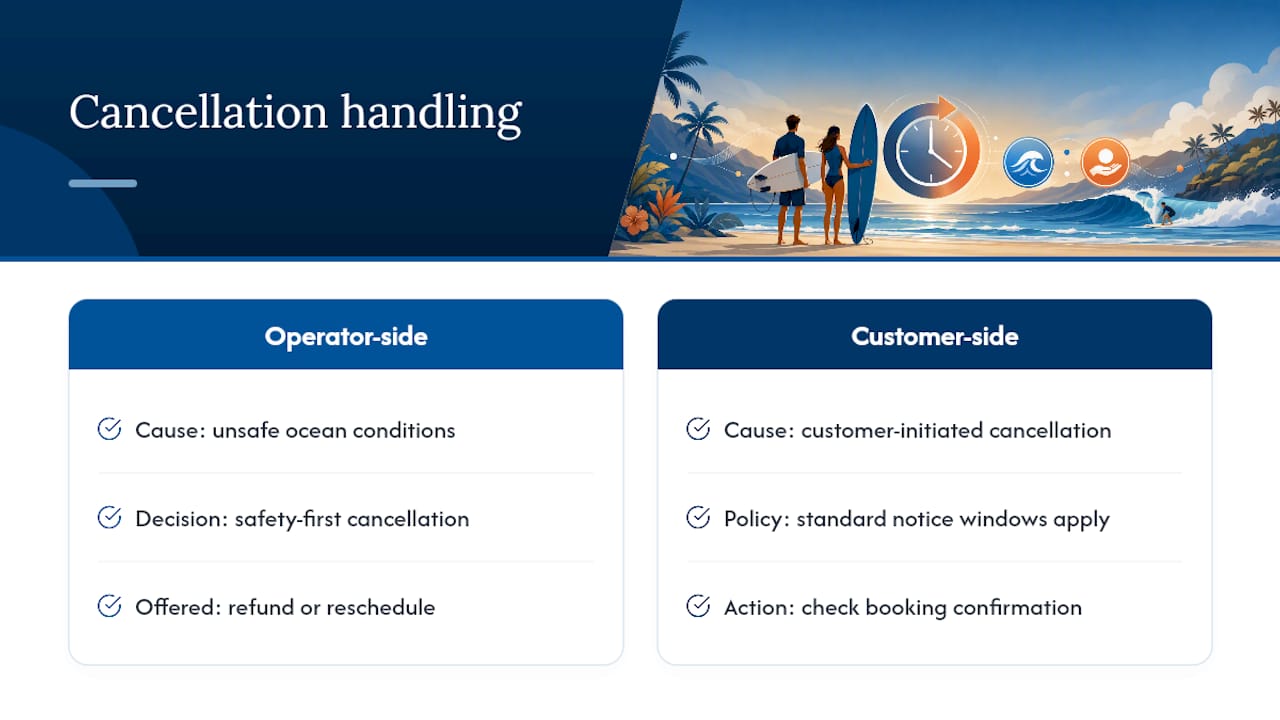
A cancellation initiated by the operator for unsafe conditions typically comes with a full refund or a free reschedule, since the decision wasn’t yours to begin with. Reputable operators communicate the cancellation as soon as conditions are confirmed unsafe, rather than waiting until the last minute.
If communication feels slow, don’t just wait around. Call the school directly, ask for a written cancellation confirmation by email or text, and keep that message. It’s your proof if the refund doesn’t post on time. Water safety guidance from the American Red Cross explains why operators err on the side of caution rather than risk putting students in rough surf.
Late cancellations, no-shows, and rebooking fees
Cancel inside the notice window, or simply don’t show, and you’re in different territory than a standard cancellation. Here’s what typically applies:
- Inside the notice window: Expect to lose some or all of your payment, sometimes with a partial credit offered as a goodwill gesture.
- No-show with no contact: Most schools treat this as a full forfeiture. There’s no lesson to reschedule and no refund to process.
- Late reschedule requests: Some operators charge a rebooking fee per person, especially for group bookings that already had a set instructor-to-student ratio planned.
If a real emergency comes up, contact the school the moment you know, not after the lesson time has passed. Documenting the reason, illness, flight delay, family issue, gives the school a basis to make an exception even outside its normal rules.
How to cancel or reschedule a surf lesson the right way
Speed and documentation both matter here. Use the phone for anything urgent since it gets a live answer, use the booking platform to make the change official, and follow up by email so there’s a written trail.
- Have your reservation number, name on the booking, and lesson date and time ready before you call.
- Mention your original payment method, since some refunds can only be issued back to the same card.
- Take a screenshot of your booking confirmation and any cancellation confirmation you receive.
- Ask explicitly: “Can you send written confirmation of this refund or credit?” Don’t assume it’s automatic.
Booking smart to avoid losing money on cancellations
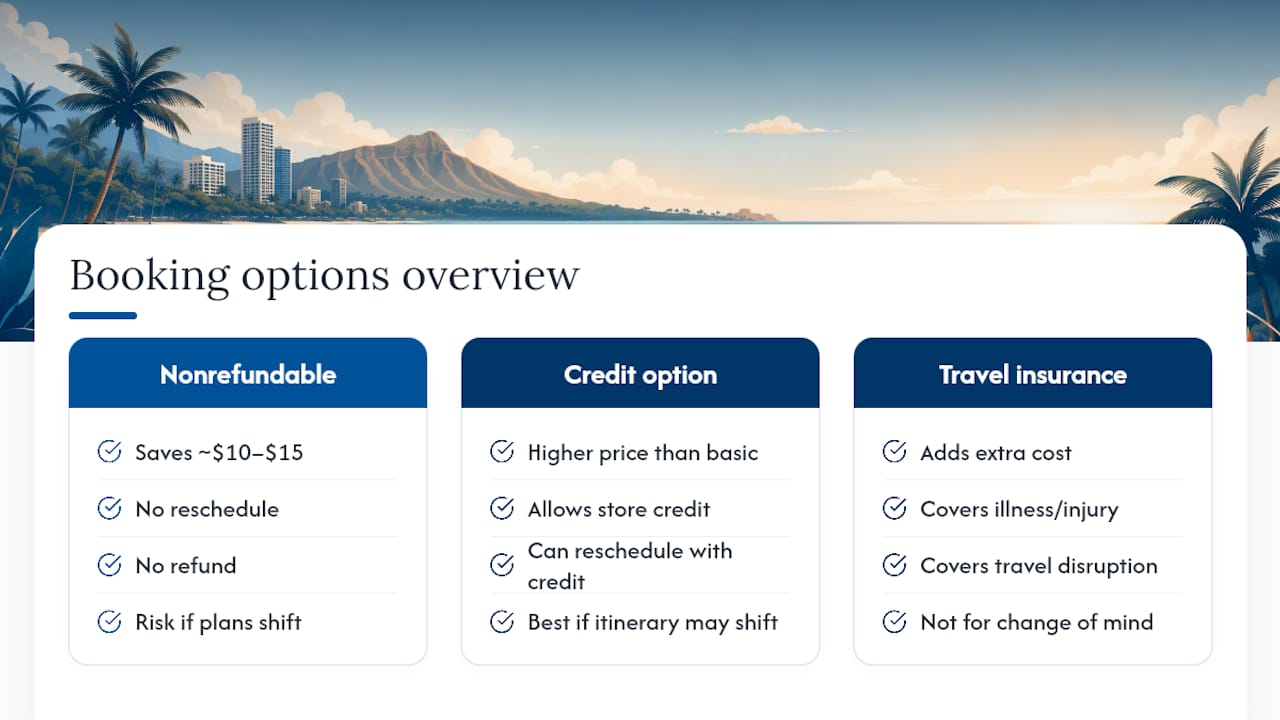
The cheapest lesson isn’t always the smartest booking if your plans are still shifting. A nonrefundable rate might save $10 or $15 upfront, but it locks you into a fixed time slot with zero flexibility if a rain system rolls through or your flight gets delayed.
If you know your Hawaii itinerary could shift, book the option that allows a credit rather than the lowest listed price. Travel insurance can help too, but read the fine print: most policies only cover activity cancellations tied to documented illness, injury, or a covered travel disruption, not a simple change of mind or mediocre surf.
Pro Tip: Book earlier in your trip rather than on the last full day. A rescheduled lesson needs somewhere to land, and a lesson booked for your final afternoon has nowhere to move to if conditions turn.
How Hans Hedemann Surf School handles cancellations and safety
Some surf schools build lessons around individual attention and a safety-first approach. When ocean conditions turn unsafe, this safety focus governs cancellation decisions, protecting both students and instructors rather than pushing a lesson through regardless of surf. Customers affected by an operator-side cancellation are generally offered a refund or reschedule. Customer-initiated cancellations still follow standard notice windows, so check the exact terms on your booking confirmation before you pay.
A quick word on flexibility before you book
If your travel dates are locked in, take the refund option every time. If you’re still deciding on your Hawaii schedule, a lesson credit is worth more than it looks. Either way, check the local surf forecast and confirm your cancellation window before you enter your card number, not after.
— Johann
Book with Hans Hedemann Surf School in Waikiki or on the North Shore
Hans Hedemann Surf School gives you a straightforward alternative to guessing at generic cancellation fine print: a local, safety-focused team that has run lessons on these exact beaches for years and applies its policies the same way every time.

Beyond the standard group lesson, you can pick the format that matches your trip and your risk tolerance:
- Group lessons in Waikiki for first-timers and casual surfers
- Private lessons for faster progress and more individual attention
- Kids lessons built around younger beginners
- North Shore lessons for a different wave environment and setting
Before you pay, check the exact cancellation and reschedule terms listed on the booking page for your chosen lesson type. Once you know your window, reserve your spot directly through the Waikiki surf lesson booking page and lock in a time that fits your trip.
Sources
Check NWS coastal forecasts before your lesson date, review the Hawaii Visitors & Convention Bureau for trip planning, and read Red Cross water-safety guidance for ocean risk basics. The Surfrider Foundation offers community context on local conditions, and platforms like TripAdvisor and FareHarbor show real examples of typical cancellation windows.
0 Comments