
The biggest obstacles first-timers face in group surf lessons are wave timing, board positioning, pop-up mechanics, paddling fatigue, and the crowd dynamics that come with sharing waves. The fastest fix for all of them? Book a small managed group with a low number of students per instructor and make sure you’re on a foam soft-top board in the 7–9 foot range. That single equipment choice does more for your first session than any amount of pre-reading.
Here’s what to have ready before you show up:
- Board: Foam/soft-top longboard (7–9 ft) — usually provided by the school
- What to wear: Rash guard or wetsuit (usually included), reef-safe sunscreen applied before you arrive
- What to bring: Water bottle, light snack, towel, change of clothes
- What to expect from your instructor: A beach safety briefing, active wave selection for your group, hands-on corrections in the water
- Safety note: Confirm the school runs a pre-lesson ocean-awareness briefing and that instructors hold recognized surf coaching credentials
Schools like Hans Hedemann Surf School in Waikiki are built around exactly this model: small groups, professional instructors, and a structured progression from sand drills to whitewater rides that gets most beginners standing on their first session.
Pro Tip: Before booking, ask the school one question: “What is your instructor-to-student ratio?” Anything above 8:1 means you’ll spend more time waiting than surfing.
Table of Contents
- What does a typical beginner group surf lesson look like?
- What are the most common challenges first-timers face in group lessons?
- How does learning in a group change the experience?
- What safety rules and surf etiquette does every group beginner need to know?
- What equipment do you need for a beginner group lesson?
- How should you prepare physically and mentally before your first group lesson?
- What progress can you realistically expect after one lesson and beyond?
- What do group lessons typically include and cost in the U.S.?
- Why does professional instruction actually shorten the learning curve?
- Group lessons vs. private lessons: which one is right for you?
- Key Takeaways
- What group lessons taught me that solo practice never could
- Ready to catch your first wave in Waikiki?
- Useful sources
What does a typical beginner group surf lesson look like?
A well-run group lesson follows a clear sequence. Knowing it in advance means you spend less mental energy figuring out what’s happening and more on actually learning.
- Arrival and gear setup (15–20 minutes): Instructors assign foam boards and leashes, check that everyone’s rash guard or wetsuit fits, and run through basic ocean safety. This is also when the instructor scans the lineup and picks the safest entry point for the group.
- Beach briefing (15–20 minutes): You’ll cover how to read the break, instructor hand signals, right-of-way basics, and what to do if you wipe out. Pop-up mechanics get practiced on the sand here, which is where most of the technical learning actually happens.
- Whitewater practice (30–40 minutes): The group moves into the shallows. Instructors position each student, call the wave, and often give a physical push to help beginners feel the momentum. The goal is short, repeated reps — not long rides.
- Feedback cycles and adjustments (ongoing throughout): Good instructors rotate through the group between waves, correcting board position, paddle timing, and pop-up form in real time.
- Debrief (10–15 minutes): Back on the beach, the instructor walks through what worked, what to fix, and what to focus on next time. Some schools, including those following a structured beginner roadmap, build 2-hour sessions with a post-lesson debrief into their standard format.
A few things to look for when evaluating a school’s lesson structure:
- Instructor-to-student ratio of 4–6:1 for genuine beginner groups
- Active wave selection by the instructor (not just standing on the beach watching)
- Sand-based pop-up drills before anyone enters the water
- Whitewater-only practice for first-timers, not open-face green waves
What are the most common challenges first-timers face in group lessons?
Most beginner problems fall into three buckets: technical, physical, and psychological. Group lessons add a fourth: the crowd itself.
Technical challenges:
- Wrong board position: Lying too far back means you won’t catch waves; too far forward and the nose dives. A shift of just 2–3 inches on the board often determines whether a beginner catches a wave or misses it entirely. Paddling and positioning are the foundational skills that control progress, not the pop-up alone.
- Poor paddle timing: Most beginners start paddling too late. By the time the wave reaches you, you need to already be moving at close to wave speed.
- Early or late pop-up: Pop up too soon and the wave hasn’t caught you yet; too late and you’re already past the sweet spot. Sand drills fix this faster than any in-water repetition.
Physical challenges:
- Paddling fatigue hits earlier than almost every beginner expects. The shoulder and upper-back muscles used for paddling are rarely trained in everyday life.
- Limited pop-up explosiveness. The movement requires a fast, controlled push-up combined with a foot placement that feels unnatural at first.
- Swim fitness matters more than most people realize. You don’t need to be a competitive swimmer, but being comfortable in moving water reduces panic and conserves energy.
Psychological challenges:
- Fear of waves is real, especially when a set rolls in and looks bigger than expected from the shore.
- Embarrassment after wipeouts in front of a group. Everyone wipes out. The sooner you accept that, the faster you learn.
- Anxiety in a crowded lineup, particularly when other students are paddling nearby.
Group-specific challenges:
- Multiple beginners paddling for the same wave at the same time, which creates collisions and frustration.
- Uneven skill levels within the group mean some students progress faster and others feel left behind.
- Inconsistent instructor attention when groups are too large.
Pro Tip: Practice 10 pop-ups on the floor at home every day in the week before your lesson. It sounds basic, but the movement becomes automatic faster than you’d think, and that frees up mental bandwidth for everything else in the water.
How does learning in a group change the experience?
Group learning has genuine advantages that solo practice or even private lessons can’t replicate. Watching someone else attempt the same pop-up and seeing exactly where they go wrong is one of the fastest ways to correct your own form. You recognize the mistake before you make it yourself.
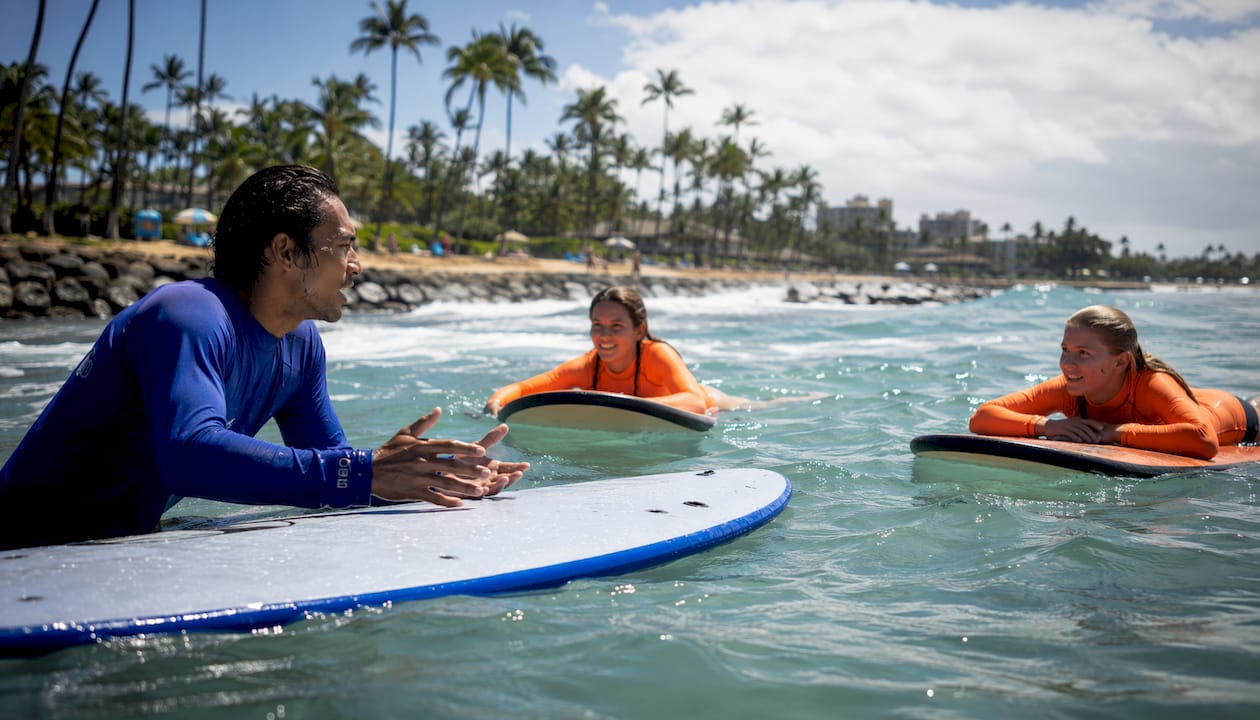
The social dynamic also matters. When someone in your group stands up for the first time, the energy shifts. That kind of peer motivation is hard to manufacture in a private lesson. Group settings in outdoor activities consistently show that social learning accelerates skill acquisition when the group is managed well.
The trade-offs are real, though. You get less individual instructor time. In a group of six, you might get two or three direct corrections per session versus ten or more in a private lesson. There’s also the wave-competition problem: beginners naturally cluster at the same peak, which means fewer reps for everyone. A skilled instructor solves this by splitting the group across secondary peaks and timing pushes so students aren’t paddling into each other.
| Factor | Group Lesson | Private Lesson |
|---|---|---|
| Cost | Lower per session | Higher per session |
| Instructor attention | Shared across 4–6 students | Fully individual |
| Peer learning | High | None |
| Wave reps per hour | Fewer (shared peaks) | More (dedicated positioning) |
| Social motivation | Strong | Absent |
| Best for | Social learners, budget-conscious beginners | Fast-progress priority, anxiety, or specific technique work |
Pro Tip: At the start of the lesson, tell your instructor your main goal for the session (“I want to nail the pop-up timing”) and ask them to flag you specifically when they see that mistake. It turns a general group session into something closer to targeted coaching.
What safety rules and surf etiquette does every group beginner need to know?
Safety in a group lesson isn’t just about the ocean. It’s about managing six beginners with foam boards in close proximity, all of them excited and a little unpredictable.
Core safety checklist before entering the water:
- Confirm the instructor has run a full ocean-awareness briefing covering rip currents, wave sets, and exit points
- Check that lifeguard coverage is present at the beach (most managed lesson beaches in the U.S. have it)
- Know the instructor’s hand signals before you paddle out
- Be honest about your swim ability. Most schools require students to be comfortable swimming at least 50–100 yards unassisted
Basic etiquette to prevent collisions:
- The surfer closest to the breaking part of the wave has right-of-way. In a group lesson, your instructor manages this, but you should understand the rule.
- Call your direction (“going left” or “going right”) so other students know where you’re heading.
- After a wipeout, hold onto your board. A loose foam board traveling at wave speed is a hazard to everyone nearby.
- Don’t paddle back through the lineup where others are riding. Paddle wide around the break.
For a deeper look at the rules that matter in the water, the surfing etiquette guide from Hhsurf covers right-of-way, drop-in rules, and how to handle crowded breaks.
Instructors reduce risk by choosing whitewater over green waves for beginners and by actively monitoring the lineup for rip currents. High-quality group lessons include ocean-awareness briefings and instructor-managed wave selection as standard practice, not optional extras.
Pro Tip: If you spot a rip current (a channel of water moving away from shore, often darker and choppier than the surrounding water), don’t paddle directly against it. Paddle parallel to the shore until you’re out of the current, then angle back in. Tell your instructor immediately if you feel pulled.
What equipment do you need for a beginner group lesson?
Most schools provide everything you need for the water. What you bring from home is mostly about comfort and sun protection.
What the school typically supplies:
- Foam/soft-top longboard: sized for beginner stability. The extra volume gives you the buoyancy to catch whitewater waves without perfect technique.
- Leash: attaches to your ankle and keeps the board from washing away after a wipeout
- Rash guard or wetsuit: depends on water temperature. In Waikiki, a rash guard is usually enough; colder water requires a full wetsuit.
- Optional on-water photography or video packages (offered by some schools, including Hhsurf)
What to bring from home:
- Reef-safe sunscreen, applied 20–30 minutes before you hit the water
- Water bottle (you will be more dehydrated than you expect)
- Light snack for after the session
- Towel and a full change of clothes
- Flip-flops or water shoes if the beach has rocky sections
Must-have vs. optional:
| Item | Status |
|---|---|
| Reef-safe sunscreen | Must-have |
| Water bottle | Must-have |
| Change of clothes | Must-have |
| Rash guard/wetsuit | Provided by school |
| Foam board + leash | Provided by school |
| Waterproof camera | Optional |
| Water shoes | Optional (location-dependent) |
One note on footwear: sandy beach breaks like Waikiki don’t require water shoes. If you’re surfing near reef or rocky entry points, they’re worth having.
How should you prepare physically and mentally before your first group lesson?
Showing up unprepared physically is the most common reason beginners burn out in the first 30 minutes. A little targeted prep makes a noticeable difference.
- Swim a few laps in the days before your lesson. You don’t need to be fast. The goal is to activate the shoulder and upper-back muscles you’ll use for paddling. Even two or three 20-minute pool sessions will reduce early fatigue.
- Practice pop-ups on a yoga mat or firm floor. Lie flat, hands under your shoulders, and push up into a surf stance (one foot forward, knees bent, arms out). Do 10 reps daily in the week before your lesson.
- Work on shoulder mobility. Arm circles, chest openers, and lat stretches take five minutes and meaningfully reduce the stiffness that builds up during a paddling session.
- Eat a light meal 1–2 hours before the lesson. Heavy food and vigorous paddling don’t mix well. Hydrate well the night before and again the morning of.
- Confirm logistics the day before. Meeting point, start time, what’s included, and your instructor’s name. Arriving stressed and late is a terrible way to start a surf lesson.
- Apply reef-safe sunscreen before you leave your accommodation. It needs time to absorb properly, and you won’t want to be doing it on the beach while everyone else is getting briefed.
Mental preparation matters just as much. Your first lesson will not look like the surf videos you’ve watched. You will fall. You will miss waves. That’s the whole point of a first lesson. The students who progress fastest are the ones who treat every wipeout as information rather than failure.
Pro Tip: If you’re nervous about the ocean, tell your instructor before the lesson starts. A good instructor will keep you in shallower whitewater longer, which builds confidence faster than being pushed into deeper water before you’re ready.

What progress can you realistically expect after one lesson and beyond?
Most beginners stand up on their first or second lesson under managed conditions with the right board and instructor. That’s a realistic expectation, not a marketing promise. What it doesn’t mean is that you’ll be surfing independently after one session.
| Stage | Typical milestone | Recommended next step |
|---|---|---|
| After 1 lesson | Whitewater rides, first pop-ups in assisted conditions | Book 2–3 more group lessons to reinforce technique |
| After 3–5 lessons | Consistent pop-ups, catching small whitewater waves unassisted | Consider a semi-private or private lesson for technique refinement |
| After 6–9 lessons | Beginning to read waves, attempting small green waves | Move to supervised independent sessions or a surf package |
| After months of regular practice | Independent surfing in beginner-friendly conditions | Ongoing practice, surf clinics, or intermediate group sessions |
A few honest caveats:
- Progress is not linear. You’ll have sessions where everything clicks and sessions where nothing does. Both are normal.
- Frequency matters more than total hours. Two short sessions per week beats one long session every two weeks for skill retention.
- The jump from whitewater to green waves is the biggest skill gap most beginners face. It requires better timing, stronger paddling, and the ability to read an unbroken wave. That transition typically takes 6–9 lessons, as beginner guides consistently recommend.
What do group lessons typically include and cost in the U.S.?
Pricing varies by location, school reputation, and group size, but there are consistent patterns across U.S. surf destinations.
| Lesson type | Typical duration | Typical U.S. price range | Common inclusions |
|---|---|---|---|
| Budget group lesson | 2-hour sessions | $50 per person | Board, leash, basic instruction |
| Standard group lesson | 2-hour sessions | $80 per person | Board, leash, rash guard, instruction |
| Small-group premium | 2-hour sessions | — | Board, wetsuit/rash guard, small group (4–6), photos optional |
| Private lesson | 2-hour sessions | — | Full individual instruction, all equipment |
These ranges reflect general U.S. market pricing and will vary by destination. Waikiki lessons, for example, are priced within this range and typically include board, leash, and rash guard as standard.
Before you book, confirm:
- Maximum group size (ask for the number, not just “small group”)
- Whether a wetsuit or rash guard is included or costs extra
- Instructor certification (look for recognized surf coaching credentials)
- Cancellation and rescheduling policy
- Whether photos or video are included or available as an add-on
- Exact meeting location and what to bring
Surf lessons at Hhsurf in Waikiki include board, leash, and rash guard as standard, with optional photo packages available for those who want to capture the session.
Why does professional instruction actually shorten the learning curve?
The difference between a managed beginner lesson and paddling out on your own isn’t just safety. It’s the speed at which you build correct habits. Bad technique practiced repeatedly becomes harder to unlearn than technique never practiced at all.
Hans Hedemann Surf School’s approach centers on a few specific elements that directly address the challenges beginners face in group settings:
- Structured beach briefing: Every session starts on land, covering ocean awareness, pop-up mechanics, and instructor signals before anyone gets wet.
- Active wave selection: Instructors choose waves appropriate to the group’s level, keeping beginners in manageable whitewater rather than exposing them to green waves before they’re ready.
- Hands-on corrections: Instructors physically adjust board position and stance in real time, not just from the shore.
- Confidence-first progression: Starting in whitewater removes the fear variable so students can focus entirely on technique.
Trust signals to check when evaluating any surf school:
- Instructor holds a recognized surf coaching certification
- Stated instructor-to-student ratio of 6:1 or better for beginner groups
- Pre-lesson safety briefing is a stated part of the program
- Equipment is foam/soft-top boards in the appropriate size range
- The school can point to student success stories or a stated first-lesson standing rate
Questions worth asking before you book:
- “What is your maximum group size for beginner lessons?”
- “Are photos or video included, or are they an add-on?”
- “What certification do your instructors hold?”
- “What happens if conditions are unsafe on the day?”
At Hans Hedemann Surf School, the beginner method is built around one principle: get students standing in their first session by removing every avoidable obstacle. That means the right board, the right waves, and an instructor who is in the water with you, not watching from the beach.
For a closer look at what separates a good beginner instructor from a great one, the 9 key traits guide from Hhsurf is worth reading before you book.
Group lessons vs. private lessons: which one is right for you?
The honest answer is that it depends on why you’re learning and how you learn best.
Group lessons work well when you’re social, budget-conscious, or traveling with friends who want to learn together. The peer observation effect is real: watching someone else attempt the same move and seeing the correction applied often clicks faster than hearing an explanation directed at you. The social benefits of group outdoor learning extend well beyond surfing, and the energy of a group session is genuinely motivating for most beginners.
Private lessons make more sense when you have specific anxiety about the ocean, when you want to progress as fast as possible, or when your schedule only allows one or two sessions and you want maximum return on that time. You’ll get more wave reps, more direct corrections, and an instructor whose full attention is on your specific technique gaps.
A few practical criteria to help you decide:
- Choose group if: You’re traveling with friends, you’re comfortable in the ocean, you want the social experience, or you’re working with a tighter budget.
- Choose private if: You have significant fear of the water, you’ve already had a group lesson and want to break through a specific plateau, or you have limited time and want accelerated progress.
- Consider semi-private (2–3 students): A good middle ground that keeps costs lower than a full private while giving you far more instructor attention than a standard group.
One thing that doesn’t change between formats: the quality of the instructor matters more than the format itself. A mediocre private instructor will produce slower progress than an excellent group instructor with a well-managed small group.
Key Takeaways
The most important thing a first-timer can do before a group surf lesson is choose a school with a small managed group, a certified instructor, and foam boards in the 7–9 foot range.
| Point | Details |
|---|---|
| Board choice is the biggest variable | A 7–9 ft foam soft-top board gives beginners the stability and buoyancy to stand up in their first session. |
| Small groups outperform large ones | Groups of 4–6 students per instructor give you enough reps and enough individual attention to actually improve. |
| Prepare physically before you arrive | Practice pop-ups on land daily and swim a few laps in the days before your lesson to reduce early fatigue. |
| Safety and etiquette protect everyone | Know right-of-way rules, hold your board after wipeouts, and listen to your instructor’s signals in the water. |
| Hhsurf structures lessons for first-timers | Hans Hedemann Surf School in Waikiki uses a beach briefing, active wave selection, and hands-on corrections to get beginners standing in their first session. |
What group lessons taught me that solo practice never could
The conventional wisdom around learning to surf tends to focus on the individual: your pop-up, your paddle, your fear. What gets underestimated is how much the group format itself shapes the learning experience, for better and for worse.
Watching a peer attempt the same pop-up three times and finally nail it on the fourth is more instructive than any explanation. You see the exact adjustment that made the difference. That’s something a private lesson, for all its advantages, simply can’t replicate. The peer observation effect is one of the most underused tools in beginner surf instruction.
The flip side is also true. A poorly managed group, one where the instructor is outnumbered, where students are competing for the same peak, or where the safety briefing gets rushed, produces frustration faster than almost any other learning environment. The format isn’t the problem. The execution is.
What Hhsurf gets right, and what any good school should get right, is treating the group as a learning tool rather than a cost-cutting measure. Small ratios, active positioning, and a structured progression from sand to whitewater aren’t premium extras. They’re the baseline for a lesson that actually works.
If you’re on the fence about group versus private, start with a well-managed small group. You’ll learn something about how you learn, and that knowledge is worth more than any single session.
Ready to catch your first wave in Waikiki?
Hhsurf’s beginner group lessons in Waikiki are built around everything this article covers: small groups, certified instructors, foam boards, and a structured progression that gets most students standing in their first session. Board, leash, and rash guard are included as standard. Optional photo packages let you capture the moment without needing someone on the shore with a camera.
For those who want faster progress or have specific anxiety about the ocean, private surf lessons in Waikiki are available with full individual instruction and all equipment included. If you’re heading to the North Shore, dedicated North Shore surf lessons are also on offer.
Before you book, confirm your group size, instructor credentials, and what’s included. Then book your Waikiki surf lesson and show up ready to paddle.
Useful sources
- How to Surf: The Ultimate Beginner’s Guide — Surfer.com: Covers wave selection, paddling technique, and whitewater practice as the core early lessons for new surfers.
- How to Surf for the First Time — TheSurfStar: Practical guide on board selection and why professional lessons shorten the learning curve for beginners.
- Surfing 101: The No-Nonsense Beginner’s Guide — Searplugs: Emphasizes paddling and positioning as the foundational skills that control early progress.
- How to Surf for Beginners — Aqua Surf: Step-by-step breakdown of first-lesson expectations, board choice, and the realistic timeline for independent surfing.
- Your First Surf Lesson: What to Expect — Hhsurf: Detailed walk-through of a first lesson’s structure, outcomes, and what to prepare, directly from the school’s perspective.
- Surf Lessons in Waikiki — Hhsurf: Overview of lesson inclusions, group sizes, and booking details for beginners planning a session in Waikiki.
0 Comments