
Most Hawaii surf schools give you a full refund or free reschedule if you cancel within a certain advance notice window before your lesson, depending on the operator and lesson type. Cancel later than that and you’ll usually get a credit instead of cash, or nothing at all for a no-show. Weather and safety cancellations called by the school are the exception: those almost always mean a full refund or a free reschedule, no penalty attached. Hans Hedemann Surf School spells out its terms on its booking pages, which is the first thing to check before you pay.
TL;DR:
- Cancellation windows vary by lesson type, with 24 hours for group lessons, 48 hours for private lessons, and 72 hours for multi-day packages.
- Last-minute cancellations often result in credits with a six to twelve-month expiration, rather than full refunds to the original payment method.
- Weather and safety cancellations typically qualify for full refunds or free reschedules, confirmed via direct communication and written proof.
- No-shows generally forfeit the entire payment, while late reschedules incur fixed fees, making early cancellation and clear communication crucial.
- Rental cancellations usually require at least three days’ notice, with non-refundable deposits and damage costs between $40 and $700 depending on equipment.
Table of Contents
- Hawaii Surf Cancellation Policy: Typical 24, 48, and 72 Hour Windows
- Refunds, Credits, and Reschedules: How the Money Actually Moves
- What Happens When the School Cancels for Weather or Safety
- No-Shows, Late Reschedules, and Group Booking Exceptions
- How to Cancel or Reschedule Without Losing Your Money
- Rental Reservations and Damage Liability Work Differently
- What to Check Before You Book: A Quick Pre-Booking Checklist
- Local Laws or Consumer Protections Affecting Cancellation Rights in Hawaii
- How COVID-19 and Other Emergencies Reshaped Cancellation Policies
- Why Cancellation Rules Vary So Much Between Hawaii Surf Schools
- A Local Perspective on Fair Policies and Safety-First Cancellations
- Book with Clear Terms: Hans Hedemann Surf School’s Waikiki and North Shore Lessons
- Sources
- FAQ
Hawaii Surf Cancellation Policy: Typical 24, 48, and 72 Hour Windows
The window you’re working with depends on what you booked, not just where you booked it. A standard group lesson usually falls under a 24-hour cancellation policy, meaning canceling the day before typically protects your refund or credit. Private lessons, multi-day packages, and anything bundled with food or event staff tend to require more lead time, often 48 to 72 hours, because the operator has already committed money to reserve your slot or order supplies.
Here’s how the windows typically break down:
- 24 hours: Standard group surf or SUP lessons, single-day bookings.
- 48 hours: Private lessons, semi-private bookings, and some add-on packages.
- 72 hours: Multi-day guided packages, group experiences with catering, and rental reservations tied to specific dates.
- Event-based bookings (birthdays, corporate outings) often carry the longest notice requirement, sometimes a week or more, because the operator has coordinated third-party vendors.
Don’t guess. Your exact window shows up in the confirmation email you received at booking, usually in a section labeled “cancellation policy” or “terms.” If you booked through a platform like FareHarbor, that language is embedded right in the confirmation page. When in doubt, call the operator directly and ask them to read the window back to you.
Refunds, Credits, and Reschedules: How the Money Actually Moves
Cancel within the window and you’ll typically get one of two outcomes: a refund to your original payment method or a lesson credit. Refunds to a credit card commonly take 3 to 10 business days to post, while digital payment methods like Venmo or PayPal often move faster.
Credits are the more common default for last-minute changes because they’re easier for operators to issue instantly, without waiting on a payment processor. That convenience comes with strings attached:
- Credits often expire within 6 to 12 months of issue.
- Transferring a credit to another person is sometimes restricted or requires advance notice.
- Some operators only offer credits, not cash refunds, for cancellations inside the standard window.
Quick fact: operators frequently favor credits over refunds for short-notice cancellations, and those credits typically carry a 6 to 12 month expiration window. If you specifically want your money back rather than a credit, say so when you call, and ask the operator to confirm in writing which option applies to your booking.
What Happens When the School Cancels for Weather or Safety
Operators don’t leave wave and swell judgment to guesswork. Most rely on National Weather Service point forecasts and their own instructors’ reading of the ocean to decide whether conditions are safe for beginners. When a school calls off a lesson for surf, wind, or lightning risk, you’re typically looking at a full refund to your original payment method or a free reschedule to another date, no fee either way.
Notification usually comes by phone, text, or email, often the morning of or the night before. If you wake up and the surf looks sketchy but you haven’t heard from the school, call them. Don’t assume the lesson is canceled just because the waves look big from your hotel balcony.
Pro Tip: Always ask for written confirmation, even a text, when a lesson is canceled for weather. It’s your proof if a refund takes longer than expected or a dispute comes up later.
No-Shows, Late Reschedules, and Group Booking Exceptions
Missing your lesson entirely without canceling is the one scenario almost no operator refunds. A no-show typically forfeits the full amount, no credit, no reschedule. Late reschedules, meaning you call after the cancellation window has closed but still show intent to rebook, often trigger a fixed fee rather than a full loss.
Group bookings play by different rules:
- Packaged experiences with catering or event staff usually need 72 hours or more of notice.
- Deposits on group bookings are often non-refundable regardless of when you cancel.
- One person typically has to serve as the point of contact for the whole group, so changes don’t get lost between six different phone calls to the operator.
If you’re booking for a birthday or family reunion, confirm upfront who’s responsible for notifying the school of any headcount changes.
How to Cancel or Reschedule Without Losing Your Money
Acting fast and communicating clearly is most of the battle. Here’s the sequence that gets you the best odds of a refund or credit:
- Pull up your confirmation email and locate your booking number and the exact cancellation policy text.
- Contact the operator through their preferred channel (usually phone or email) rather than a generic contact form.
- State your cancellation window clearly and reference the specific hours listed in your confirmation.
- Ask for written confirmation of the refund or credit, including the amount and expected processing time.
- Escalate if you hear nothing within a few days. Most credit card issuers give you a window (often 60 days from the statement date) to file a dispute if a promised refund never shows up.
Keep every email and text. If a phone call is your only option, jot down the date, time, and the name of who you spoke with.
Rental Reservations and Damage Liability Work Differently
Renting a board is not the same transaction as booking a lesson, and the cancellation rules reflect that. Some rental businesses require cancellation at least 3 days before your rental start date to avoid a late fee, which can run around $25 per board. Multi-day rentals tend to be stricter than single-day pickups because the shop has turned away other customers to hold your gear.
A few things worth knowing before you book a rental:
- Deposits are frequently non-refundable, even if the rental itself is canceled in time.
- Damage costs vary by equipment: soft-top boards commonly run $300 to $500 to replace, SUP boards $600 to $700, hard boards $400 to $700, and a simple ding repair around $40.
- Most shops put a credit card hold on file with your CVV and billing zip code as security, separate from your rental payment.
Photograph the board before you paddle out. It’s the easiest way to avoid an argument over a scratch that was already there.
What to Check Before You Book: A Quick Pre-Booking Checklist
Before you hand over a card number, confirm these six items, either in the confirmation email or by asking directly:
- The exact cancellation window (24, 48, or 72 hours).
- Whether cancellations refund to your card or issue a credit.
- How long any credit is valid before it expires.
- What happens if the operator cancels for weather (refund or reschedule).
- The deposit amount and whether it’s refundable.
- The no-show policy and any late reschedule fee.
A simple script works: “If I need to cancel, what’s the notice window, and do I get my money back or a credit?” Any operator worth booking with will answer that in one sentence.
Local Laws or Consumer Protections Affecting Cancellation Rights in Hawaii
Surf lessons and rentals in Hawaii fall under general state consumer protection law rather than any surf-specific statute. Hawaii doesn’t have a law that forces tour operators or surf schools to offer refunds on a set timeline. What you’re entitled to comes down almost entirely to the contract you agreed to when you booked, which is why reading the cancellation terms before you pay matters more here than in states with stronger cooling-off rules.
That said, general consumer protections still apply. If an operator advertises one cancellation policy and enforces a different, harsher one at the point of cancellation, that’s a deceptive trade practice issue you can raise with the Hawaii Office of Consumer Protection. Credit card companies also offer a layer of protection independent of state law: if a business collects payment for a service it doesn’t deliver, or refuses a refund it promised in writing, a chargeback through your card issuer is often the fastest path to getting your money back.
Where you booked matters too. Purchases made through a third-party platform like a hotel concierge desk or a vacation activity marketplace sometimes carry that platform’s own cancellation terms on top of the operator’s, and the two don’t always match. Always check whether you’re bound by the surf school’s direct policy or an intermediary’s separate rules, since disputes get more complicated when two sets of terms apply to the same booking.
How COVID-19 and Other Emergencies Reshaped Cancellation Policies
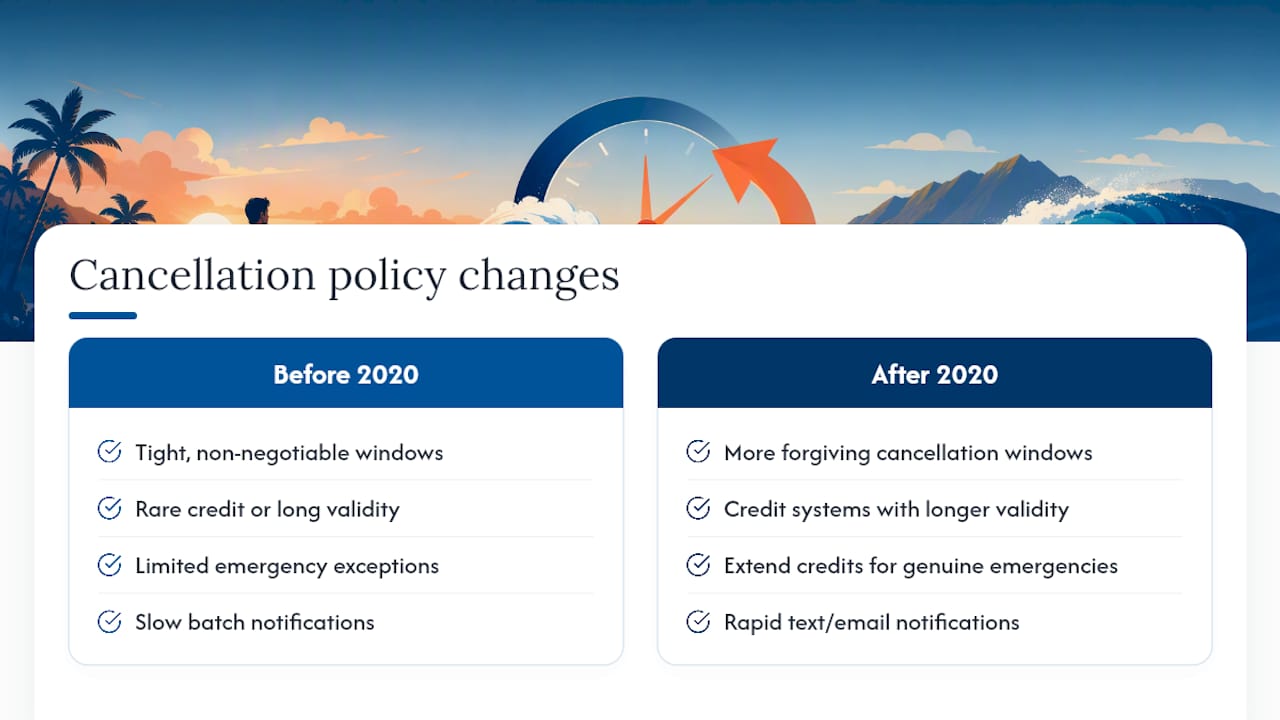
The pandemic changed how flexible Hawaii’s tourism operators are willing to be, and much of that flexibility stuck around. Before 2020, most surf schools ran tight, non-negotiable windows. Mass cancellations during lockdowns forced operators to build in more forgiving credit systems and longer validity periods, since customers were canceling trips they had no control over.
That legacy shows up today in how schools handle non-weather emergencies: flight cancellations, sudden illness, family emergencies. Many operators will now extend a credit, even outside the standard cancellation window, if you can show a genuine emergency, something that was far less common before the pandemic normalized this kind of accommodation.
It also changed communication habits. Operators got used to notifying large batches of customers quickly by text and email, and that infrastructure hasn’t gone away. If a hurricane watch, tsunami advisory, or other island-wide emergency threatens your lesson date, expect the same rapid-notification approach schools used during pandemic closures: a text or email well ahead of your scheduled time, often with an automatic reschedule offer rather than making you call in.
The practical takeaway: emergency flexibility exists, but it’s discretionary, not guaranteed by policy. If something outside your control forces a cancellation, contact the operator immediately, explain the situation clearly, and ask what options they have. Most schools would rather rebook you than process a dispute.
Why Cancellation Rules Vary So Much Between Hawaii Surf Schools
Two schools a mile apart on the same beach can run completely different cancellation policies, and the reason usually comes down to business model. A small operation running one or two instructors and a handful of boards has less flexibility to absorb a no-show, so those shops often enforce stricter windows and firmer no-refund rules. Larger schools with more instructors and higher lesson volume can absorb an occasional cancellation more easily, which is part of why some offer more generous reschedule terms.
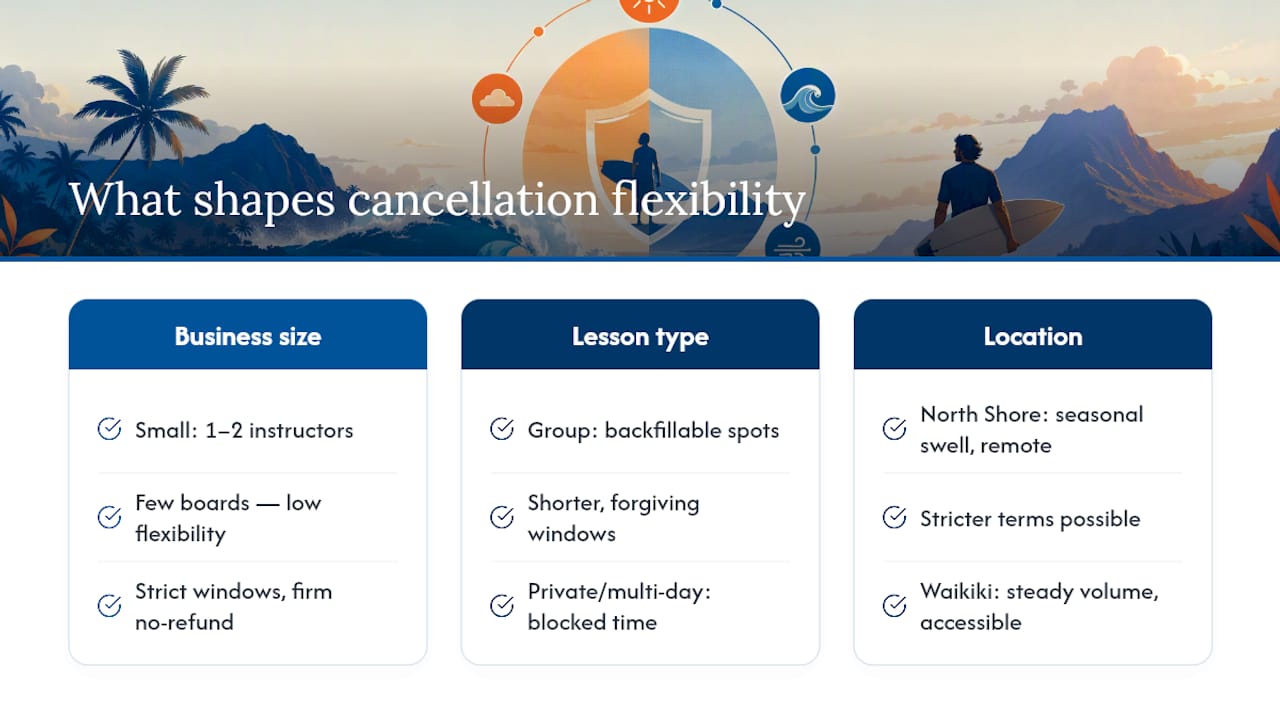
Lesson type also drives the difference. Group lessons, where an empty spot can sometimes be backfilled by a walk-up booking, tend to carry shorter, more forgiving windows. Private lessons and multi-day packages, where the instructor has blocked out exclusive time, come with longer windows and firmer penalties, since there’s no way to fill that slot last minute.
Location matters too. North Shore operators juggling seasonal swell and more remote logistics sometimes build in stricter cancellation terms than Waikiki-based schools, where conditions are more consistent and lesson volume is higher year-round. None of this means one policy is objectively better than another. It means the fine print is genuinely worth five minutes of your attention, because the “standard” policy you assume applies might not match what’s in your actual confirmation.
A Local Perspective on Fair Policies and Safety-First Cancellations
Hans Hedemann Surf School has built its approach around getting beginners standing on a board fast, and that same practical mindset carries over into how it handles cancellations. A school that guarantees quick progress for first-timers has an incentive to keep its booking terms straightforward rather than burying them in fine print designed to trip people up.
Safety calls on ocean conditions aren’t a judgment call made lightly. Instructors who surf professionally and teach daily read swell and wind patterns with more nuance than a forecast app alone provides, and that experience is exactly what should drive a cancellation decision. If you want to see how Hans Hedemann Surf School frames its own terms, the cancellation policy breaks down the exact windows and remedies before you book.
— Johann
Book with Clear Terms: Hans Hedemann Surf School’s Waikiki and North Shore Lessons
Hhsurf is the alternative to guessing at fine print buried in a third-party booking widget. Every lesson page states the terms upfront: Group Lessons start at $100 per person, Private Lessons at $180, and Surfboard Rentals in Waikiki run $60 per day, all with policy details you can read before you pay a cent.

If you’re planning a multi-day trip, the 3 Day and 5 Day Guided Packages lay out exactly what advance notice a cancellation requires, so there’s no surprise fine print after you’ve already paid. Group outings, family reunions, or a birthday on the water? Contact the school directly before booking to confirm exceptions for larger parties. Ready to lock in a date? Head to the surf lessons page and check the current schedule for Waikiki or North Shore.
Sources
Check the National Weather Service point forecast for Oahu conditions before your lesson date. Review surfboard rental rates and cancellation fees and rental terms and conditions if you’re renting separately from a lesson. Always cross-check against your own confirmation email, since the operator’s exact policy overrides any general guide.
FAQ
What Is the Best Month to Surf in Hawaii?
Fall through spring, roughly September through April, brings the biggest and most consistent swells, especially on the North Shore, while summer months tend to offer smaller, calmer waves better suited to beginners in Waikiki.
Is Hawaii Good for Surfing?
Yes. Hawaii has some of the most varied surf conditions in the world, from gentle beginner-friendly breaks in Waikiki to serious big-wave spots on the North Shore, making it suitable for first-timers and experienced surfers alike.
Is Surfing Good in Hawaii in December?
December often brings larger, more powerful North Shore swells that suit experienced surfers, while Waikiki’s south-facing breaks stay calmer and remain a solid choice for beginner lessons even during winter months.
What Are Some Good Surf Breaks in Hawaii?
Waikiki Beach offers some of the most consistent, gentle breaks for beginners, while spots like Pipeline and Sunset Beach on the North Shore draw advanced surfers chasing bigger swells; Hhsurf runs lessons in both Waikiki and North Shore locations.
Do Hawaii Surf Schools Charge a Fee for Late Cancellations?
Many do, and it’s common for a late cancellation or no-show to forfeit part or all of your payment, though some schools offer a credit instead of a full loss depending on how much notice you gave.
How Do I Find My Specific Cancellation Window?
Check your booking confirmation email, which typically states the exact hours required for a full refund, credit, or free reschedule; if it’s unclear, call the operator directly and ask them to confirm it in writing.
0 Comments