
Structured surf instruction speeds skill acquisition, reduces injury risk, and builds genuine water confidence faster than self-teaching alone. Whether you’re stepping on a board for the first time or trying to break through a plateau, the advantages of surf coaching go well beyond just having someone watch you paddle.
Here’s what structured lessons consistently deliver:
- Faster progression: Structured lessons significantly reduce the time needed to consistently catch waves compared to self-teaching.
- Safer ocean practice: Instructors teach rip-current recognition, safe falling, and wave-zone awareness in a structured course before you ever need them.
- Better equipment choices: Certified instructors mandate high-volume foam boards that objectively increase catch rates for beginners
- Sustained confidence: Staged wins and real-time feedback build water confidence that casual paddling around rarely produces
- Physical and mental health gains: Regular surf practice improves balance, core strength, cardiovascular fitness, and mood
Hans Hedemann Surf School in Waikiki is a strong real-world example of this methodology in action. Their teach-first approach gets most beginners standing on a board within their first lesson, a benchmark that typically takes self-taught surfers weeks or months to reach.
Table of Contents
- 1. Structured lessons accelerate your progress beyond what self-teaching can match
- 2. Surf lessons teach ocean safety skills you can’t easily learn on your own
- 3. Physical and mental health benefits that go beyond the surf
- 4. Lessons build real confidence, and they’re especially powerful for kids
- 5. How to choose the right lesson format, what to expect, and what it costs
- 6. What lessons realistically deliver, and what they don’t
- 7. Why Hhsurf’s methodology produces results: a real-world example
- Key Takeaways
- What actually separates good lessons from wasted sessions
- Hhsurf brings these benefits to life in Waikiki
- Useful sources and further reading
1. Structured lessons accelerate your progress beyond what self-teaching can match
The core reason structured surf lessons outpace solo learning is the feedback loop. When you teach yourself, every mistake gets reinforced by repetition. An instructor catches a wrong foot position or a late pop-up between waves, before that pattern gets locked in as muscle memory.

The standard lesson sequence matters too. A well-designed program moves through dry-land pop-up practice, paddling and positioning, whitewater standing, and then green-wave progression. Each stage builds on the last. Skip any of them, and you create gaps that show up later as stubborn bad habits.
Dry-land pop-up mastery is often the single biggest accelerator. Getting the movement right on land turns ocean time into reinforcement rather than corrective learning. Most self-taught surfers skip this entirely, which is why they plateau early.
| Milestone | Typical self-teach | Structured lessons |
|---|---|---|
| First stand-up | Several weeks | First lesson (often) |
| Consistent whitewater rides | Several months | Few weeks |
| Catching unbroken green waves | Many months | Several weeks |
Source: SurfSpotGuide
Advanced learners benefit from video analysis, which coaches use alongside land drills to lock in technique before the next ocean session. That level of precision is simply not available when you’re learning alone.
Pro Tip: Between lessons, spend 10 minutes daily on dry-land pop-ups. Use a line of tape on the floor to mark your board outline and practice the movement until it’s automatic. Your cross-training routine between sessions is where real gains get cemented.
Local instructors add another layer. They know the exact breaks, tides, and currents you’ll face, which means the skills you learn apply immediately to your specific beach rather than some generic ocean scenario.
2. Surf lessons teach ocean safety skills you can’t easily learn on your own
Ocean literacy is not intuitive. Rip currents, wave zones, tidal shifts, and safe exit routes all require deliberate instruction. Most drowning incidents and surf injuries involve people who didn’t recognize the conditions they were in.
Structured lessons cover:
- Rip current identification: How to spot the discolored, choppy channel of water moving away from shore, and how to exit one by swimming parallel to the beach
- Wave zones: Where to sit, where to paddle, and which zones are off-limits for beginners
- Safe falling: Falling flat and away from the board, covering your head on surfacing, and never diving headfirst in shallow water
- Leash safety: Keeping the leash clear of your legs and knowing how to handle a board that’s coming back at you
- Equipment rules: Why a high-volume foam board is safer and more effective for beginners than a performance shortboard
Instructors are trained to assess ocean conditions before every session, monitor students in the water, and provide immediate assistance when needed. That real-time supervision creates a margin of safety that solo practice simply cannot replicate — especially for beginners who don’t yet know what they don’t know.
Certified instructors coordinate with lifeguards, carry first-aid training, and enforce safety protocols consistently. Look for CPR/BLS certification and background checks as baseline trust signals when evaluating any school. The Waikiki surf lesson environment at Hhsurf, for example, pairs professional instruction with one of the most closely monitored beginner surf zones in the United States.
Supervised sessions also let learners push slightly beyond their comfort zone safely. That’s where real skill gains happen. Without an instructor present, most beginners either stay too conservative or take risks they’re not equipped to handle.
3. Physical and mental health benefits that go beyond the surf
Surfing is a full-body workout, and structured lessons maximize the time you spend actually doing it. Rather than spending most of a session struggling in whitewater, lesson formats prioritize getting learners on appropriate boards and maximizing ride time under supervision.
Physical benefits you build through regular, instructor-led sessions:
- Paddling strength (shoulders, lats, triceps)
- Core stability and rotational control
- Balance and proprioception
- Cardiovascular endurance from sustained paddling
- Lower-body coordination through stance work and weight shifts
The mental side is just as real. Aerobic outdoor activity consistently links to improved mood and reduced stress. Surfing adds a layer of focused attention that quiets mental noise in a way that gym cardio rarely does. You’re reading the ocean, timing your paddle, and committing to a wave. There’s no room for rumination.
Structured progress amplifies these psychological gains. When you have a clear goal (catch three waves in a row, make it past the break) and an instructor confirming your improvement, the sense of accomplishment is concrete. That’s different from paddling around hoping something clicks.

Research on outdoor aerobic activity and skill acquisition consistently points to mood improvement and cortisol reduction as measurable outcomes. Surfing, with its combination of physical exertion, ocean exposure, and social engagement, hits multiple of those mechanisms at once.
4. Lessons build real confidence, and they’re especially powerful for kids
Confidence in the water doesn’t come from watching videos or reading about surfing. It comes from small, staged wins under safe conditions. That’s exactly what structured instruction is designed to produce.
The mechanics are straightforward: an instructor breaks the skill into manageable steps, confirms each one before moving to the next, and provides reassurance when something goes wrong. A student who stands up for the first time with an instructor’s guidance carries that experience differently than one who stumbles onto it alone.
For kids specifically, the benefits extend well beyond surfing:
- Coordination and body awareness: Surfing demands balance and spatial awareness that transfer to other sports and daily movement
- Risk literacy: Kids learn to read conditions, assess hazards, and make decisions, skills that build judgment over time
- Resilience: Falling off a board, paddling back out, and trying again is a low-stakes version of a high-value life lesson
- Social skills: Group lessons create peer encouragement and shared achievement, especially in kids surf programs designed for their age group
Is surfing safe for kids in structured lessons? Yes, when the program uses certified instructors, age-appropriate equipment, and beginner-friendly conditions. Most schools accept children from age 5 or 6 upward, with family programs available for mixed-age groups. Family surf lessons in a supervised environment like Waikiki are a particularly good entry point because the waves are consistent and the beach is well-monitored.
Group lessons add a social dimension that private lessons don’t. Watching a peer catch their first wave is motivating in a way that an instructor’s encouragement alone isn’t. That peer dynamic is one reason group formats often produce faster confidence gains for kids and social adults.
5. How to choose the right lesson format, what to expect, and what it costs
The choice between private and group lessons comes down to your goals, budget, and how you learn best.
| Factor | Private lessons | Group lessons |
|---|---|---|
| Cost (U.S. typical) | Moderate per session | Lower per person |
| Instructor attention | 100% focused on you | Shared (smaller groups preferred) |
| Progress speed | Fastest | Good, especially for social learners |
| Best for | Serious learners, adults with specific goals, kids who need extra support | Beginners, families, social learners, budget-conscious students |
| Recommended ratio | 1:1 | 1:4 to 1:6 for serious learners |
Smaller instructor-to-student ratios mean more feedback loops per session. Serious learners should seek programs with lower ratios for sufficient individual correction.
Realistic lesson timeline:
- First lesson: Stand up in whitewater, learn safe falling, understand basic paddle timing
- After 3 lessons: Consistent whitewater rides, beginning to read small waves, pop-up becoming automatic
- After 10 lessons: Catching unbroken green waves, understanding positioning, ready to practice independently or move toward coaching
Before you book, ask these questions:
- Are instructors CPR/BLS certified and background-checked?
- What is the student-to-instructor ratio?
- Is equipment (board, leash, rash guard) included?
- What safety protocols are in place for ocean conditions?
- Does the school use beginner-appropriate foam boards?
U.S. surf lesson prices vary by location and format. Expect to pay roughly $50–$100 per person for group lessons and $100–$200 for private sessions. Waikiki and other premium surf destinations may run slightly higher. Most reputable schools include equipment rental in the lesson price.
6. What lessons realistically deliver, and what they don’t
Structured lessons are not a shortcut to high-performance surfing. One session will not make you a competent surfer in all conditions. Wave quality, your physical fitness, and how consistently you practice between lessons all affect how fast you progress.
Honest limits to keep in mind:
- Lessons teach fundamentals; advanced maneuvers (cutbacks, tube riding) require months of independent practice after the lesson foundation is set
- Progress slows if you only surf during lessons and don’t practice between them
- Physical fitness matters: paddling endurance and core strength accelerate learning, and their absence slows it
- Wave conditions on lesson day affect what you can practice; a flat day limits progression opportunities
Pro Tip: After each lesson, write down the two corrections your instructor gave you most often. Before your next session, spend 15 minutes drilling those specific movements on land. Instructors notice when students come back having worked on feedback, and the in-water time becomes far more productive.
The transition from lessons to coaching happens when your fundamentals are solid and you’re ready to refine specific techniques. A good indicator: you can consistently catch green waves and you’re starting to think about direction and timing rather than just standing up. At that point, video analysis and technical coaching become the right next step.
7. Why Hhsurf’s methodology produces results: a real-world example
Hans Hedemann Surf School, operating out of Waikiki under the Hhsurf brand, implements the instruction techniques described throughout this article in a structured, repeatable program.
How their methodology maps to learner outcomes:
- Dry-land pop-up practice → students arrive in the water with the movement already partially automated, reducing corrective time
- Ocean reading drills → safer wave selection and fewer dangerous situations for beginners
- High-volume foam boards → higher catch rates and more ride time per session
- Professional surfer instructors → technical corrections grounded in real performance experience, not just teaching theory
- Staged progression → beginners move from whitewater to green waves only when fundamentals are confirmed
Hhsurf’s surf lesson program emphasizes individual attention even in group formats, with instructor credentials and safety protocols built into every session. The school’s track record of getting beginners standing within their first lesson reflects the dry-land-first, feedback-heavy approach that the research consistently supports.
The Hhsurf methodology prioritizes getting students on the right equipment, in the right conditions, with immediate corrections between every wave. That combination, not any single element, is what produces the fast beginner success rate the school is known for.
Trust signals to look for at any school, and which Hhsurf delivers: certified instructors with professional surfing experience, documented safety protocols, lifeguard coordination, and a clear lesson progression from whitewater to open-ocean waves. The instructor feedback process at Hhsurf is designed to prevent bad habits from forming in the first place, which is the single most valuable thing a beginner can get from a structured program.
Key Takeaways
Structured surf instruction delivers faster skill gains, safer ocean practice, and measurable confidence improvements that self-teaching rarely matches in the same timeframe.
| Point | Details |
|---|---|
| Lessons cut learning time | Structured programs reduce time to consistent wave-catching from several months to a few weeks. |
| Safety requires instruction | Ocean literacy, rip-current awareness, and safe falling are taught, not intuited. |
| Kids gain beyond surfing | Coordination, risk literacy, and resilience are developmental outcomes of structured programs. |
| Format choice matters | Private lessons offer faster individual progress; group lessons build social confidence at lower cost. |
| Hhsurf delivers the method | Hans Hedemann Surf School’s dry-land-first, feedback-heavy approach gets most beginners standing in their first lesson. |
What actually separates good lessons from wasted sessions
Most students focus on the wrong thing. They want the instructor’s push. They want to be launched into a wave and feel the ride. That’s understandable, but the push is the least valuable part of a lesson.
What actually moves the needle is the correction between waves. The moment an instructor adjusts your foot position, repositions your hands, or tells you to look forward instead of down, that’s the lesson. That’s the feedback loop that prevents a bad habit from becoming permanent. Students who pay attention to those corrections and then drill them on land between sessions progress at a rate that surprises even experienced instructors.
The other thing most beginners underestimate is equipment. A high-volume foam board isn’t a beginner’s compromise. It’s the right tool for the job. Switching to a performance board too early is one of the most reliable ways to stall your progress for months.
If you take one thing from this: master the pop-up on land before you care about anything else in the water. Everything else in surfing builds on that one movement.
Hhsurf brings these benefits to life in Waikiki
Most surf schools teach you to stand up. Hhsurf teaches you to surf. The difference shows up in the first lesson: professional surfers as instructors, high-volume foam boards matched to your size, dry-land technique before you touch the water, and real-time corrections between every single wave.
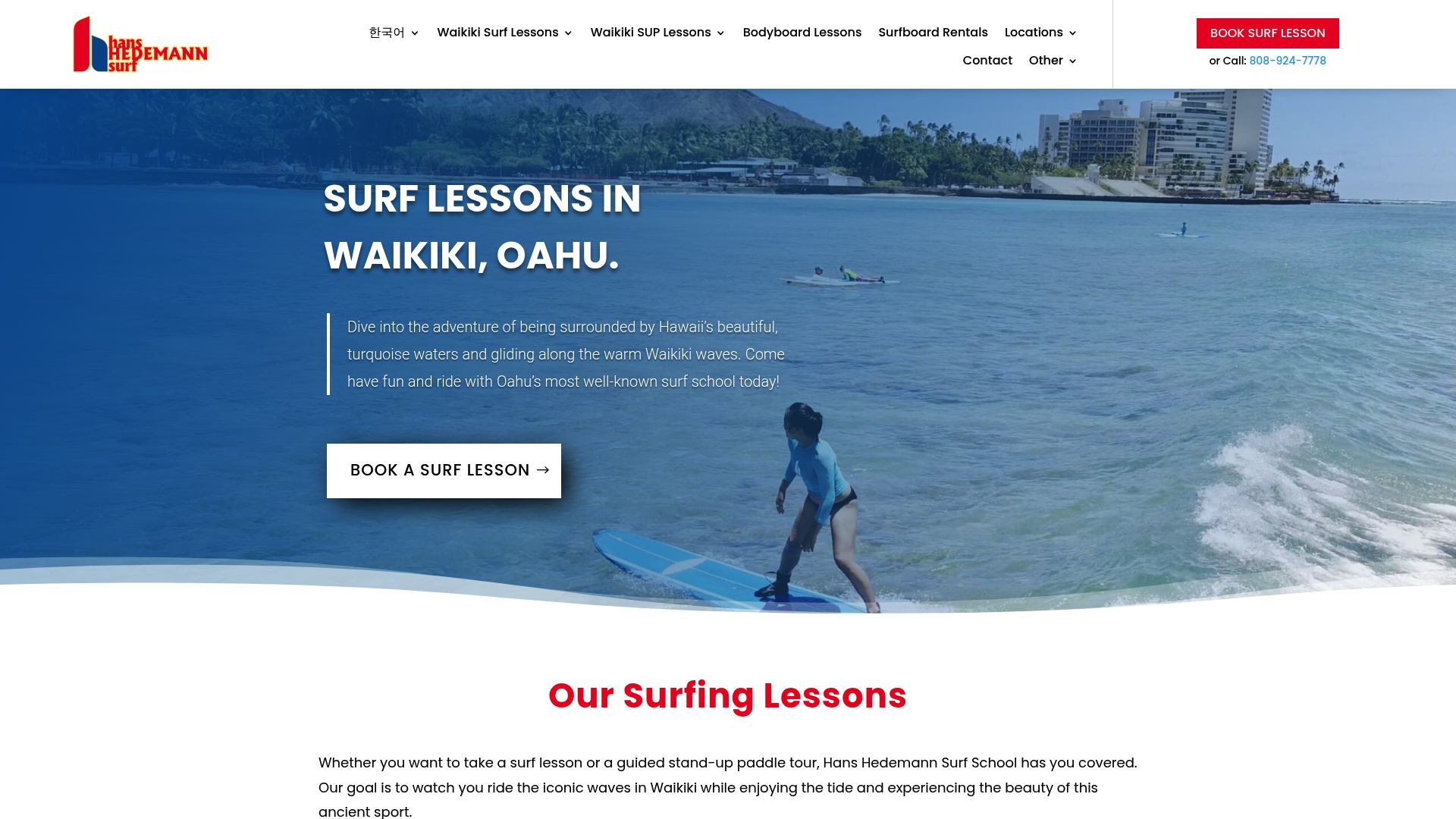
Hhsurf’s programs in Waikiki cover every format discussed in this article: private surf lessons for focused one-on-one progress, group sessions for families and social learners, and kids-specific programs built around age-appropriate safety and confidence-building. The beach at Waikiki is one of the best learning environments in the United States: consistent small waves, warm water, and a well-monitored shore.
Bring a swimsuit and sunscreen. Hhsurf provides the board, leash, and instruction. Arrive 15 minutes early for the dry-land session. To book your first lesson or ask about group availability, visit the Hhsurf surf lesson page and reserve your spot.
Useful sources and further reading
- Are surf lessons worth it? — SurfSpotGuide: Compares self-teaching and structured lesson timelines; the primary source for the time-to-milestone claims in this article.
- Surf Lesson vs Surf Coaching — Extra Surf School: Explains the progression from beginner lessons to technical coaching and how standardized sequencing accelerates skill consolidation.
- What Does a Surf Coach Do? — Elite Surf Coaching: Covers video analysis, land drills, and the tools coaches use to accelerate technical gains for intermediate and advanced surfers.
- How a Surf School Helps You Learn Faster and Safer — Malibu Makos Surf Club: Details how lesson formats maximize ride time and build confidence through supervised progression.
- Benefits of Learning with Local Instructors — Blue Mystic Surf: Makes the case for place-based instruction and how local knowledge transfers directly to practical skill.
- Hhsurf Surf Lessons — Waikiki, Oahu: Hhsurf’s primary lesson page covering programs, instructor credentials, safety protocols, and booking.
0 Comments