
For rapid surf progression in the U.S., your two strongest routes are a local intensive block with a pro-led private or semi-private coach, or a destination multi-day surf camp built around structured daily training. Hhsurf (Hans Hedemann Surf School) in Waikiki stands out as the leading U.S.-based option for focused, coach-led intensive work, combining professional instruction, consistent wave access, and a methodology that moves surfers past plateaus fast.
Here is how to choose between the two formats:
- Local intensive block (private/semi-private): Best if you have limited travel flexibility, want to stack sessions over a week or two, and prefer to train in familiar conditions. Hhsurf’s private surf lessons in Waikiki fit this model directly.
- Destination multi-day camp: Best if you want full immersion, structured daily schedules, and the mental reset that comes with leaving home. Expect 10–20 hours of guided water time per week, off-water training, and video analysis built into the program.
- Decision rule: If you can travel and want the deepest immersion, book a destination camp. If you need flexibility or want to test intensive training before committing to a trip, start with a local intensive block through Hhsurf.
Table of Contents
- What does an “intensive” surf coaching program actually mean?
- Who benefits from intensive coaching, and what do you need before you enroll?
- What should you look for in a high-quality intensive program?
- What formats do intensive programs come in, and what does a week look like?
- Which training methods actually speed up your surfing?
- How much does intensive surf coaching cost in the U.S.?
- How should you prepare before an intensive program starts?
- How does Hhsurf map to an intensive coaching brief?
- Key Takeaways
- What most surfers get wrong about intensive training
- Hhsurf intensive blocks: book your session in Waikiki
- Sources and further reading
What does an “intensive” surf coaching program actually mean?
An intensive surf coaching program delivers 10–20 hours of guided water time per week, structured around deliberate skill targets rather than open-water repetition. That is the floor. Anything less is a regular lesson package with a marketing upgrade.
Structured programs typically run two sessions per day in 1.5–2 hour blocks, one coached and one guided freesurf, with flexibility to extend into a single longer session when conditions are ideal for deeper learning. The off-water hours matter just as much: video review, surf-skate drills, and breathwork fill the gaps between water sessions.
Why does the hours-per-week figure matter for skill development? Motor learning research is clear that frequency and repetition within a short window accelerates pattern formation faster than the same total hours spread over months. Two sessions a day for seven days beats one session a week for fourteen weeks, every time.
10–20 guided water hours per week is the benchmark that separates a genuine intensive program from a standard lesson package. Programs delivering fewer than 10 structured hours per week are not intensive by any meaningful standard.
Common intensive schedule formats include:
- Two-a-day structure: Morning coached session (technical focus) + afternoon guided freesurf (application)
- Single extended session: Used on high-quality swell days when conditions justify longer uninterrupted water time
- Theory and video evenings: Off-water sessions reviewing footage, discussing wave physics, and setting the next day’s targets
Who benefits from intensive coaching, and what do you need before you enroll?
Intensive programs produce the fastest gains for surfers in the intermediate-to-advanced transition: people who can already catch green waves independently, execute a basic pop-up, and paddle out without assistance. If you are still working on those fundamentals, an intensive will spend its first two days getting you to the starting line rather than pushing you past it.
The clearest candidates are surfers who have hit a plateau. They can ride waves but cannot consistently generate speed, link turns, or read a lineup. That gap between “riding waves” and “surfing with intention” is exactly what a structured intensive is designed to close.
Before you enroll, honestly assess these prerequisites:
- You can catch unbroken (green) waves on your own, without a push
- You can paddle out independently in chest-to-head-high surf
- Your pop-up is automatic, not something you think through each time
- You can angle your takeoff left or right by choice
- You have baseline cardiovascular fitness for two sessions per day
The physical and mental demands are real. Two sessions a day in the ocean, combined with video review and off-water training, is genuinely exhausting. Many high-performance programs screen applicants or run a day-one assessment to confirm program fit, protecting both the student’s progress and the group’s learning pace.
What should you look for in a high-quality intensive program?
The highest-impact selection criteria, in order: coaching ratio, structured methodology with measurable session goals, professional video analysis, consistent wave access, and off-water training components. A program that checks all five will outperform one that simply offers more water hours.
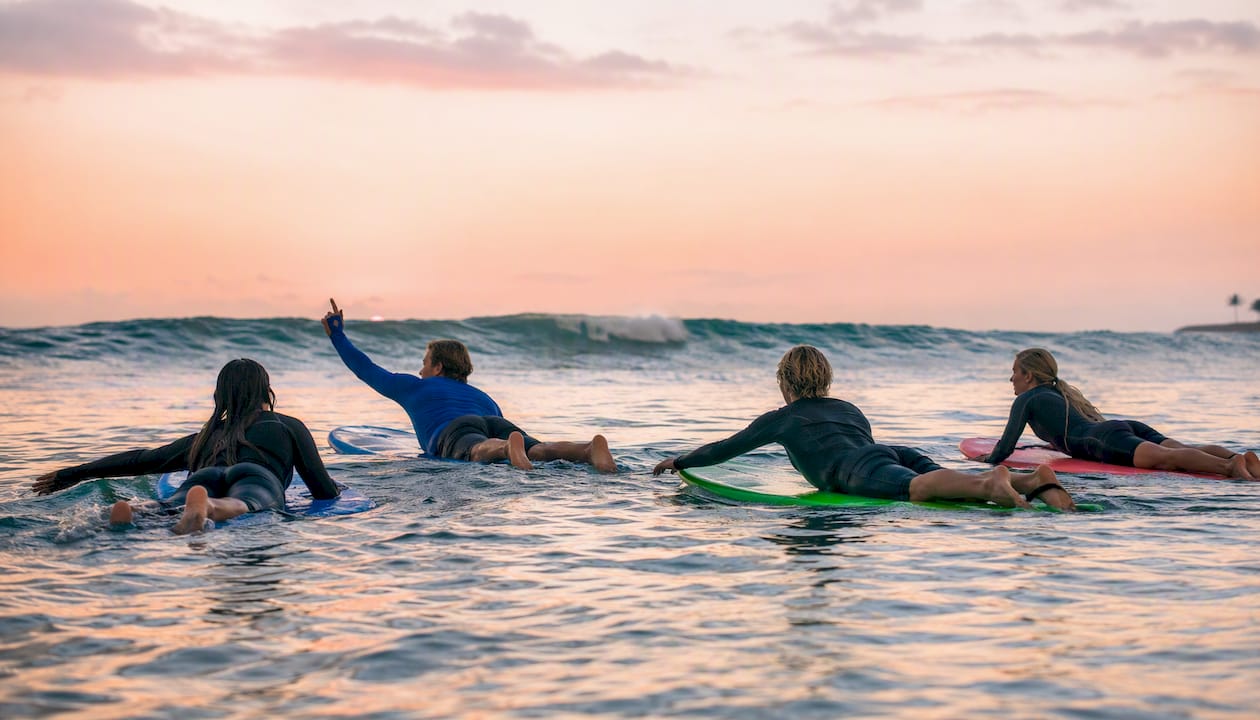
Coaching ratio is the most immediate quality signal. A 2:1 student-to-coach ratio is the sweet spot for small-group intensive work: individualized attention is preserved, and you benefit from watching a peer’s corrections in real time. Ask programs directly: “What is the maximum number of students per coach in the water?” If the answer is vague, that is your answer.
Structured methodology means each session has one measurable target, not a general goal like “improve your turns.” Deliberate practice frameworks, where a coach isolates a single mechanical fix and repeats it until it becomes automatic, produce faster and more reliable progression than high-volume repetition alone. Surf coaching frameworks built around this principle consistently outperform volume-first approaches.
Video analysis is only as good as how it is captured and reviewed. Professional footage (dedicated videographer, good equipment, multiple angles) reviewed frame-by-frame to identify root mechanical causes is a different tool entirely from a coach watching a phone video on the beach. Look for programs that schedule video review sessions at least three times per week.
Wave access matters more than location prestige. Consistent, learnable waves beat famous breaks that are too powerful or too crowded to practice in. Ask what the backup plan is when conditions are poor.
Pro Tip: Ask any program: “What is the single focus for each session, and how do you track whether a student has achieved it?” A coach who can answer that question specifically is running a deliberate practice program. One who talks about “getting lots of waves” is not.
| Dimension | What to ask | Red flag |
|---|---|---|
| Coaching ratio | Max students per coach in water? | “It depends” or no clear answer |
| Methodology | How are session goals set and tracked? | “We surf a lot” |
| Video analysis | Who films, what equipment, how often reviewed? | Phone footage, no scheduled review |
| Wave access | What is the backup spot when conditions are poor? | One location only |
| Off-water training | What happens between water sessions? | Nothing structured |
What formats do intensive programs come in, and what does a week look like?
The three main formats are local intensive day-blocks, residential multi-day camps, and private pro packages. Each serves a different goal and budget.
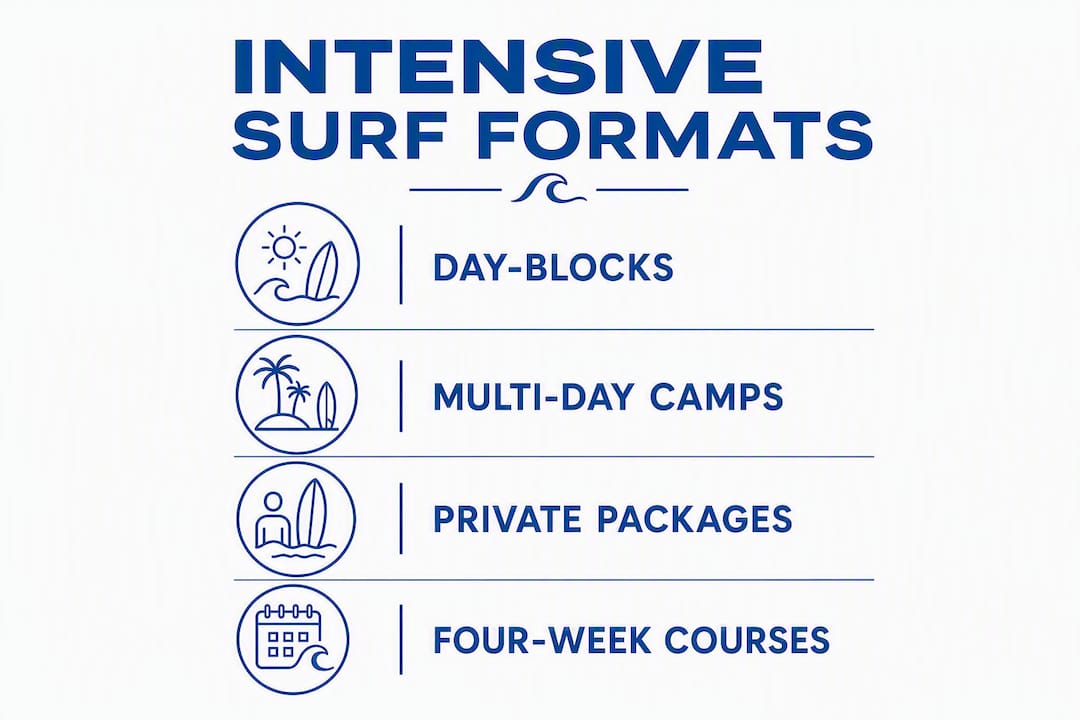
| Format | Hours/week | Coaching ratio | Mobility | Best for |
|---|---|---|---|---|
| Local intensive day-block | 10–20 | 1:1 or 2:1 | No travel | Intermediate surfers, limited time |
| Residential multi-day camp | 10–20 | 2:1 to 4:1 | Travel required | Full immersion, plateau-breaking |
| Private pro package | — | 1:1 | Flexible | Advanced surfers, specific skill targets |
Sample 1-week residential camp schedule:
- Day 1: Morning assessment surf (2 hrs) + video review + goal-setting session
- Days 2–5: Morning coached session (2 hrs, single technical target) + afternoon guided freesurf (1.5 hrs) + evening video review
- Day 6: Extended morning session on best available break (3 hrs) + surf-skate or apnea session
- Day 7: Final coached session + debrief and post-program plan
Sample 3-day private intensive block:
- Day 1: 2-hour coached water session + 1-hour video review + dry-land biomechanics
- Day 2: 2-hour coached water session (applying Day 1 corrections) + 1-hour surf-skate
- Day 3: 2-hour coached water session + final video debrief + written progression notes
Four-week intensive courses layer these elements across multiple spots and swell windows, compounding gains in a way a single week cannot replicate. The tradeoff is cost and time commitment.
Which training methods actually speed up your surfing?
The top proven methods are video analysis, surf-skate dry-land biomechanics, apnea and breath training, and deliberate practice frameworks. Each targets a different part of the performance gap.
- Video analysis: Lets a coach show you what your body is actually doing versus what you think it is doing. The gap between perceived and actual movement is often the entire reason a surfer is stuck. Professional capture and frame-by-frame review identify root mechanical causes rather than surface symptoms. Three scheduled review sessions per week is the standard in high-quality programs.
- Surf-skate: Replicates the hip and shoulder rotation of surfing on land, allowing hundreds of repetitions per session without ocean fatigue. Coaches use it to drill turn mechanics before applying them in the water, which compresses the learning timeline significantly.
- Apnea and breath training: Builds the breath-hold confidence and relaxation response that allows surfers to stay calm in hold-downs and commit to bigger, more powerful waves. Programs that include apnea workshops report faster progression into more challenging conditions.
- Deliberate practice: Each session targets one specific, measurable fix. The coach sets the target before paddling out, observes and cues during the session, and reviews footage against the target afterward. Volume without this structure produces habit reinforcement, not skill development.
Pro Tip: When evaluating a program’s video analysis, ask: “Do you use a dedicated videographer, or does the coach film from the beach?” A coach filming from shore while simultaneously coaching cannot do either job well. Dedicated capture is the baseline for useful footage.
The shift from intermediate to advanced is driven by structured methodology, not more hours in the water. Programs that combine deliberate practice with video review and off-water training consistently outperform volume-first approaches.
How much does intensive surf coaching cost in the U.S.?
Private coaching rates for local intensive day-blocks typically run $150–$300 per session, with multi-session packages reducing the per-session cost. Residential multi-day camps range from $1,500 to $4,000+ for a week, depending on inclusions. Premium pro packages with 1:1 coaching, professional video, and recovery support sit at the higher end of that range or above it.
The main cost drivers:
- Coach experience and credentials: ISA-certified coaches with competitive backgrounds command higher rates, and the premium is usually justified by the quality of feedback.
- Coaching ratio: A 1:1 private session costs more than a 2:1 or 4:1 group, but the individualized attention accelerates progress faster per hour.
- Inclusions: Accommodation, meals, professional video, transfers between breaks, and recovery services (massage, physio) all add to the base price. A camp that includes these is not necessarily more expensive per outcome than a bare-bones option where you pay for each separately.
- Wave access logistics: Boat access to uncrowded breaks, or travel between multiple spots, adds cost but often adds more value in learning opportunities.
Where you can save without losing coaching quality: choose a 2:1 ratio over 1:1 for general skill-building (the group learning benefit is real), skip accommodation inclusions if you are staying locally, and prioritize programs that include video analysis over those that offer more water hours without it.
How should you prepare before an intensive program starts?
The highest-impact preparation steps are building paddling endurance, arriving with a clear skill target, choosing the right board, and planning your recovery. Coaches at intensive programs cannot spend the first two days getting you fit enough to train.
Preparation checklist:
- Fitness: Six to eight weeks of paddling-specific conditioning before arrival. Swimming, outrigger, or SUP all transfer well. Cross-training for surfers that includes rotational strength and hip mobility pays off immediately in the water.
- Board: Bring or rent a board that is appropriate for your current level, not your aspirational level. A board that is too small will slow your learning.
- Gear: Rash guard, reef boots if the program involves reef breaks, spare leash, fins appropriate for your board, and a waterproof notes app or small notebook for logging video review observations.
- Recovery plan: Budget sleep. Two sessions a day on top of video review and off-water training will fatigue you faster than you expect. Eight hours of sleep is not optional.
- Mental framing: Pick one skill target before you arrive. Coaches can refine it, but arriving with a specific goal (“I want to consistently generate speed through my bottom turn”) focuses the program from day one.
Pro Tip: Two weeks before your intensive, start surfing or paddling every day, even for 30 minutes. The goal is not fitness gains at that point. It is resetting your body’s tolerance for daily ocean exposure so the first two days of the program do not wipe you out.
How does Hhsurf map to an intensive coaching brief?
Hhsurf delivers an effective U.S.-based intensive option for rapid progression, combining professional coach-led instruction with consistent Waikiki wave access and flexible formats that scale from group to fully private.
| Dimension | Hhsurf offering |
|---|---|
| Format | Group, semi-private, private, and pro-led sessions |
| Hours/week | Scalable: stack daily private sessions for 10–20 hrs/week |
| Coaching ratio | 1:1 (private), 2:1 (semi-private), small group |
| Methodology/tools | Professional instruction, video packages available, technique-focused feedback |
| Price shape | Tiered by group size; private and pro-led at premium |
| Skill-level suitability | All levels; intensive formats best suited to intermediate→advanced |
| What’s included | Instruction, equipment, optional photo/video package |
Hhsurf’s coaches are professional surfers with deep experience in Waikiki’s wave patterns, which means session planning accounts for tide, swell direction, and crowd windows rather than defaulting to a fixed spot. The North Shore lessons option adds access to more powerful, advanced conditions for surfers ready to push past Waikiki’s gentler breaks.
E-E-A-T proof points:
- Founded by Hans Hedemann, a four-time Duke Kahanamoku Classic finalist and one of Hawaii’s most recognized surf coaches
- Instruction delivered by professional surfers, not general fitness coaches
- Consistent track record of students standing up and riding waves within their first lesson
- Optional on-water photography and video packages for post-session review
To book a private or semi-private intensive block, visit Hhsurf’s surf lessons page and select the format that matches your schedule and skill level.
Key Takeaways
The fastest route to measurable surf progression combines a high coaching ratio, deliberate practice methodology, and professional video analysis, whether in a local intensive block or a destination camp.
| Point | Details |
|---|---|
| Hours per week matter | Genuine intensive programs deliver 10–20 guided water hours per week, not just more sessions. |
| Methodology beats volume | Deliberate practice with one measurable target per session outperforms high-volume repetition alone. |
| Video analysis is non-negotiable | Professional capture reviewed frame-by-frame three times per week is the diagnostic engine of real progression. |
| Prerequisites are real | You need to catch green waves independently before an intensive can skip basics and focus on advanced skills. |
| Hhsurf for U.S. bookings | Hhsurf in Waikiki offers private, semi-private, and pro-led formats that map directly to an intensive coaching brief. |
What most surfers get wrong about intensive training
The conventional wisdom says more time in the water equals faster progress. It does not. The surfers who improve fastest in intensive programs are not the ones who log the most waves. They are the ones who arrive with a specific target, engage fully with video review, and apply one correction at a time until it becomes automatic.
The other thing people underestimate is recovery. Skipping sleep to get an extra dawn patrol session is a net negative during an intensive block. Skill consolidation happens during rest, not during the session itself. Programs that build recovery into the schedule are not going soft. They are protecting the gains you made that morning.
On the 1-week versus 2-week question: one week is enough to break a specific bad habit and replace it with a better pattern, if the program is structured correctly. Two weeks compounds that by adding a second learning cycle after the first has had time to consolidate. If you can commit to two weeks, the second week will feel dramatically different from the first, and that difference is where the real gains live.
Hhsurf intensive blocks: book your session in Waikiki
Hhsurf gives you the fastest path to structured intensive coaching in the U.S., without the cost or logistics of a destination camp. Private and semi-private sessions in Waikiki put you in the water with a professional coach, a specific skill target, and optional video review, stacked as many days in a row as your schedule allows.
Available formats that map directly to an intensive brief:
- Private surf lessons: 1:1 coaching with a professional surfer, fully focused on your specific progression goals
- Semi-private sessions: 2:1 ratio with individualized feedback and the added benefit of observational learning
- Pro-led packages: Advanced coaching for surfers targeting specific maneuvers or preparing for more powerful conditions
Stack sessions across consecutive days, add the video package, and you have a local intensive block that delivers the core elements of a destination camp without the flight. To check availability and book your first session, visit the Hhsurf surf lessons page.
Sources and further reading
The claims and training-method descriptions in this article draw from the following sources:
- Breakers Surf Academy, Intense Surf Camp Arugam Bay — source for 10–20 hours/week figures and session-block structure
- Sōleïa Surf, Surf Progression Bali — source for video analysis methodology, professional capture standards, and three-weekly review cadence
- NOMB Surf, Intense Surf Camp Fuerteventura — source for 2:1 coaching ratio examples and recovery inclusions in premium intensives
- NOMB Surf, Tripnotes Intensive Coaching Fuerteventura — source for daily schedule structure (coached session + guided freesurf)
- Progress Surf School, Intensive Surf Course Ericeira — source for multi-week program structure layering video analysis, surf-skate, and apnea training
- Surf Simply — source for deliberate practice frameworks applied to surf coaching
- School of the World, Surf Intensive — reference for advanced-only enrollment criteria and 4-hour daily coaching formats
- International Surfing Association — reference for coach certification standards and instructor credential frameworks
0 Comments