
Hawaiian surf culture, known formally as heʻe nalu (wave sliding), is a sacred, royal, and deeply spiritual practice that defines the identity of the Hawaiian Islands. This is not a sport that happened to originate in Hawaii. It is a living cultural system with its own hierarchy, rituals, language, and ethics that shaped an entire civilization. Understanding Hawaiian surf culture means understanding the soul of Hawaii itself, from its ancient Polynesian roots to the global surf industry it created.
What is Hawaii surf culture explained through its ancient origins?
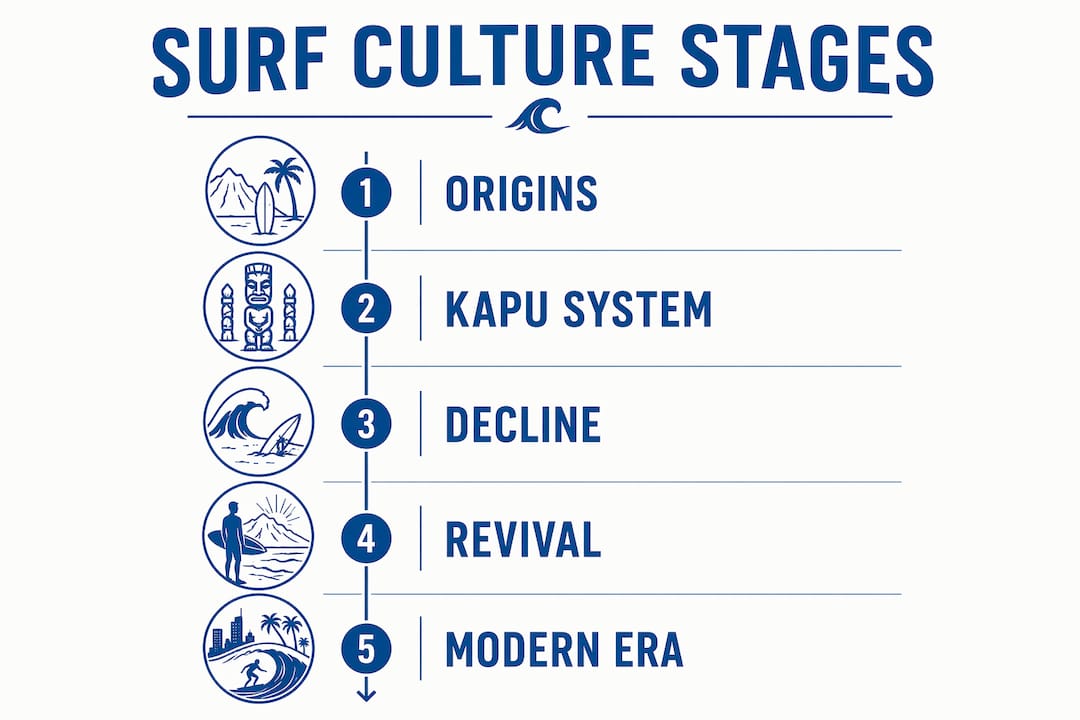
Heʻe nalu traces back to the earliest Polynesian settlers of Hawaii, who brought wave riding as a spiritual and communal practice from their ancestral islands. Surfing was not recreation. It was a direct expression of a surfer’s connection to the ocean, the gods, and the community around them.
The social hierarchy of surfing was strict and deliberate. The aliʻi, Hawaiian royalty, were the master surfers. They rode the longest, most powerful boards and claimed the best breaks as their own. Traditional Hawaiian surfboards came in two primary forms:
- Olo boards: Up to 20 feet long, carved from wiliwili or koa wood, reserved exclusively for royalty
- Alaia boards: Shorter, thinner, and more maneuverable, used by commoners
- Paipo boards: Small belly boards used by children and beginners
The crafting of these boards was a spiritual ceremony in itself. Craftsmen chose specific trees, made offerings to the gods, and consecrated the finished board before it ever touched water. This deep reverence for nature ran through every aspect of the practice.
The kapu system, a strict code of laws governing Hawaiian society, also regulated surfing. Certain waves belonged to certain chiefs. Breaking these rules carried serious consequences. Surfing was simultaneously a sport, a status symbol, a spiritual act, and a social institution.
Pro Tip: When you read about Hawaiian surf culture, pay attention to the word “mana.” It refers to spiritual power and prestige. In ancient Hawaii, a chief’s ability to surf well was direct evidence of his mana. The ocean itself was the judge.
What caused the near extinction of Hawaiian surfing in the 19th century?
The collapse of traditional Hawaiian surf culture was swift and devastating. American Protestant missionaries arrived in Hawaii beginning in 1820 and viewed surfing as immoral, a waste of time that encouraged nudity and gambling. They actively discouraged the practice among Native Hawaiians.
“The decline of heʻe nalu was not a natural evolution. It was a cultural suppression, driven by outside forces that viewed Hawaiian traditions as obstacles to civilization rather than expressions of it.”
The missionaries were not the only force at work. Disease brought by Western contact decimated the Native Hawaiian population. By 1900, Native Hawaiians were only 25.7% of the island population, a catastrophic drop that removed the very people who carried surfing knowledge from generation to generation.
The kapu system, which had organized Hawaiian society and surfing culture for centuries, was abolished in 1819. With it went the social structures that gave surfing its meaning, its rules, and its prestige. By the late 19th century, heʻe nalu was nearly extinct. The practice that had defined Hawaiian civilization for over a thousand years had been reduced to a handful of practitioners on a few beaches.
How did Duke Kahanamoku revive and globalize Hawaiian surf culture?
The revival of Hawaiian surfing is inseparable from one name: Duke Kahanamoku. Born in Honolulu in 1890, Duke was an Olympic gold medal swimmer who used his international fame to reintroduce surfing to the world. He gave surfing demonstrations in Australia, New Zealand, and across the continental United States, planting the seed of surf culture on every coastline he visited.
Duke’s impact was not just athletic. He embodied the aloha spirit, a philosophy of warmth, generosity, and respect that became the cultural signature of Hawaiian surfing. Duke’s global demonstrations shaped Hawaii’s international identity and made Waikiki the center of the surfing world.
Alongside Duke, the Waikiki Beach Boys played a critical role in this revival. This group of Native Hawaiian surfers, watermen, and cultural ambassadors formed clubs like Hui Nalu in the early 1900s. Their work was strategic, not just social:
- They established surfing instruction as a profession, teaching tourists to ride waves and earning income that supported their community
- They blended surfing with outrigger canoeing and cultural performance, creating an ocean-centered hospitality culture that became the foundation of Hawaii’s tourism industry
- They preserved Hawaiian leadership and surf ownership at a time when outside commercial interests threatened to erase local culture
- They made Waikiki’s long, forgiving reef breaks famous worldwide, attracting visitors who wanted to experience surfing in its birthplace
The surfing industry rooted in this Hawaiian revival is now valued at over $20 billion annually in Hawaii’s tourism economy. That number reflects the direct legacy of Duke Kahanamoku and the Waikiki Beach Boys.
Waikiki vs. North Shore: how do the two surf cultures compare?
Surf culture in Hawaii is not monolithic. The two most famous surf zones on Oahu represent completely different cultural experiences, and confusing them is the most common mistake outsiders make.
| Feature | Waikiki | North Shore |
|---|---|---|
| Wave type | Long, gentle reef breaks | Powerful, heavy big waves |
| Skill level | Beginner to intermediate | Advanced and expert |
| Cultural tone | Inclusive, hospitality-driven | Local-centric, respect-required |
| Best season | Year-round | November through February |
| Famous for | Surf schools, tourism, aloha spirit | Pipeline, Eddie Aikau, localism |
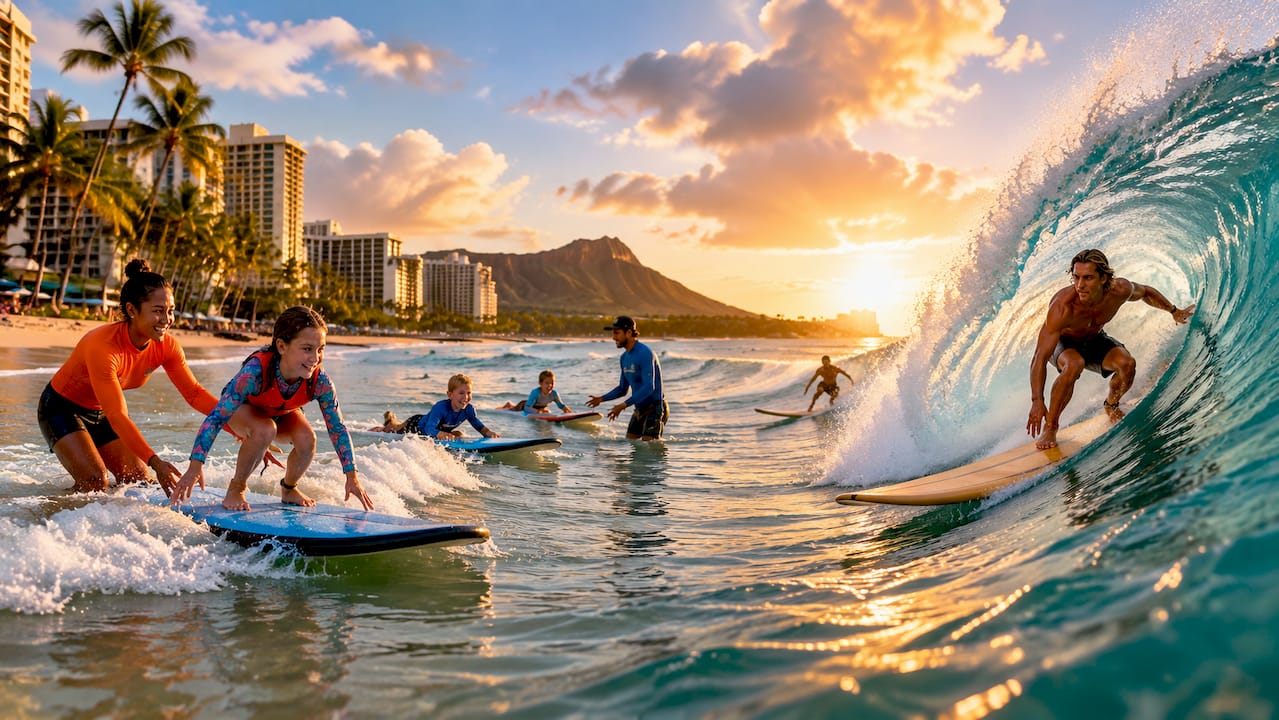
Waikiki’s long reef breaks create ideal conditions for beginners, which is exactly why the Waikiki Beach Boys built their instruction culture there. The same reefs that royal surfers rode centuries ago now allow first-time surfers to stand up on their boards within a single lesson. The culture here is open, welcoming, and built on sharing the ocean.
The North Shore operates by entirely different rules. Recognized as the Surfing Capital of the World, it hosts waves from November through February that demand years of experience to survive, let alone enjoy. Breaks like Pipeline, Sunset Beach, and Waimea Bay are not playgrounds. They are proving grounds.
Localism on the North Shore is real and purposeful. Local surfers maintain strict wave priority rules and social protocols to protect their breaks from overcrowding and preserve the cultural integrity of the lineup. Dropping in on someone’s wave, paddling around the priority order, or showing disrespect to local surfers carries genuine social consequences, including exclusion from the water.
Pro Tip: Before paddling out anywhere on the North Shore, sit on the beach and watch for at least 30 minutes. Identify who the locals are, how the lineup is organized, and where the waves are breaking. Entering with awareness signals respect. Paddling straight out signals ignorance.
How does Hawaiian surf culture shape lifestyle, fashion, and global surfing today?
The cultural reach of Hawaiian surfing extends far beyond the water. The Hawaii surf scene created the visual and philosophical language that the entire global surf industry speaks.
- Apparel and design: Brands like Quiksilver, Billabong, and Patagonia built their aesthetics on Hawaiian surf imagery, from floral prints to board short cuts originally designed for Waikiki waters
- Board design: The longboard revival of the 1990s drew directly from Hawaiian alaia and olo traditions, reconnecting modern surfers with ancient wave-riding philosophy
- Terminology: Words like “hang ten,” “wipeout,” and “lineup” entered global vocabulary through Hawaiian surf culture and now appear in languages worldwide
- Competition: The Vans Triple Crown of Surfing, held annually on the North Shore, links the heritage of Hawaiian wave riding to the modern professional sport, drawing the world’s best surfers to compete where the tradition began
- The aloha spirit: Surfing as a living history and deeply cultural experience extends beyond commercial tourism. The aloha spirit, with its emphasis on resilience, joy, and communal respect, functions as a cultural backbone for surf communities from California to Portugal to Indonesia
The annual Eddie Aikau Big Wave Invitational at Waimea Bay stands as the clearest example of how Hawaiian surf culture honors its own. Eddie Aikau was a Native Hawaiian lifeguard and big wave surfer who died in 1978 attempting to save his crewmates after a canoe capsized. The contest held in his name runs only when waves reach 40 feet or more. It is not a commercial spectacle. It is a ceremony.
Key takeaways
Hawaiian surf culture is a living spiritual and social tradition, not a sport, and understanding its distinctions between Waikiki’s welcoming culture and the North Shore’s respect-driven localism is the foundation of genuine engagement with it.
| Point | Details |
|---|---|
| Heʻe nalu is the foundation | Hawaiian surfing is a spiritual and royal practice, not just a recreational activity. |
| Decline was externally imposed | Missionary influence and population collapse nearly erased surf culture by 1900. |
| Duke Kahanamoku rebuilt it | His global demonstrations and the Waikiki Beach Boys created the modern surf tourism industry. |
| Two distinct surf cultures exist | Waikiki is inclusive and beginner-friendly; the North Shore demands respect and experience. |
| Global surf culture is Hawaiian | Board design, terminology, competition formats, and the aloha ethos all trace back to Hawaii. |
Why most visitors only scratch the surface of Hawaiian surf culture
I have spent years watching visitors arrive in Hawaii with genuine curiosity about surf culture and leave having experienced only the commercial version of it. They take a lesson in Waikiki, buy a board short with a floral print, and feel like they understand something. They understand the surface. The depth is somewhere else entirely.
The most revealing moment I have witnessed repeatedly is when a visitor paddles out on the North Shore without any awareness of local protocols. The reaction from local surfers is not anger. It is a quiet, collective withdrawal. The visitor gets waves because no one challenges them directly. But they are not in the lineup. They are beside it. That distinction is invisible to them and obvious to everyone else.
What I find genuinely moving about Hawaiian surf culture is that it survived. The missionaries tried to end it. Disease nearly finished the job. And yet Duke Kahanamoku stood on a beach in Sydney in 1915 and showed the world what heʻe nalu looked like. That act of cultural transmission was not accidental. It was deliberate preservation.
My honest advice to anyone seeking a real connection to this culture: approach it as a student, not a consumer. Learn the history of surfing in Hawaii before you paddle out. Understand that the ocean here carries memory. The waves at Waimea Bay have been ridden by royalty, by Duke, by Eddie Aikau. When you sit in that lineup, you are sitting in a very long conversation. Enter it with humility.
— Johann
Experience authentic Hawaiian surf culture with Hhsurf
Hhsurf, the Hans Hedemann Surf School in Waikiki, teaches surfing the way it was meant to be shared: with genuine aloha, professional instruction, and deep respect for the culture that created this sport. Every lesson connects students to the same waves that Hawaiian royalty and the Waikiki Beach Boys called home.
Whether you are standing on a board for the first time or looking to deepen your understanding of Hawaiian wave riding, Hhsurf’s instructors bring both technical skill and cultural knowledge to every session. Book your surf lesson in Waikiki and experience heʻe nalu the way it was always meant to feel: joyful, respectful, and alive with the aloha spirit. For those ready to push further, North Shore surf lessons offer an immersive look at the world’s most storied surf culture.
FAQ
What does heʻe nalu mean in Hawaiian surf culture?
Heʻe nalu translates directly to “wave sliding” and is the traditional Hawaiian term for surfing. It describes a practice that was spiritual, social, and royal in nature, not simply a sport.
Why was surfing nearly lost in the 19th century?
American Protestant missionaries discouraged surfing as immoral, and disease reduced the Native Hawaiian population to just 25.7% of the islands by 1900, removing the cultural carriers of the tradition.
What is the difference between Waikiki and North Shore surf culture?
Waikiki is inclusive and beginner-friendly, built on the hospitality tradition of the Waikiki Beach Boys. The North Shore is the Surfing Capital of the World, with powerful waves and strict local protocols requiring experience and respect.
Who is Duke Kahanamoku and why does he matter?
Duke Kahanamoku was a Native Hawaiian Olympic swimmer who reintroduced surfing to the world in the early 20th century. His demonstrations across Australia and the United States made Hawaiian surf culture a global phenomenon.
How do I show respect in a Hawaiian surf lineup?
Wait your turn, never drop in on another surfer’s wave, observe local priority rules, and spend time watching before paddling out at any unfamiliar break, especially on the North Shore.
0 Comments