
Six inventions changed surfing more than everything else combined: Tom Blake’s 1935 fin, the foam board transition of the late 1950s, the leash (1971), the bodyboard (1971), sensor systems like TRAX and SurfOne, and advanced materials like WYVE’s 3D-printed cores. For a tourist booking a first lesson in Waikiki or the North Shore, these aren’t history trivia. They’re the reason you’ll stand up faster, stay safer, and have more fun.
Here’s what each one means for you:
- Tom Blake’s fin (1935): Directional control. Without it, boards slid sideways. With it, instructors can teach you to steer from your first wave.
- Foam boards (late 1950s): Lighter, more buoyant, easier to paddle. The modern soft-top you’ll ride in your lesson descends directly from this.
- The leash (1971): Your board stays with you after a wipeout. Fewer collisions, less swimming, more surfing.
- The bodyboard (1971): Proved that foam-based wave riding could be accessible to anyone, which accelerated the soft-top movement.
- Sensor tools (TRAX, SurfOne): Turn angles, speed, weight shifts — measurable feedback that used to take years to develop by feel alone.
- Advanced materials (WYVE, Album Surf Exo Flex, Newave Wrocket): Lighter, more durable, and now even travel-friendly boards that split into three pieces.
Hhsurf (Hans Hedemann Surf School) uses modern gear and a proven step-by-step method to get beginners standing in their first lesson. That’s not a promise built on hype. It’s built on a century of surf invention.
Table of Contents
- How surf inventions evolved from the 1920s to today
- What each invention actually changed for beginners
- How these inventions shape your first lesson in Oahu
- How Hhsurf applies modern gear and teaching to get you standing fast
- What to ask before you book a surf lesson
- Patents, legal history, and the ownership of surf inventions
- How surf inventions changed competitive surfing and athlete performance
- Sustainable surf equipment and the environment
- Key Takeaways
- The part that doesn’t show up in the history books
- Useful sources
How surf inventions evolved from the 1920s to today
| Era | Invention | Who / Where | Why It Mattered |
|---|---|---|---|
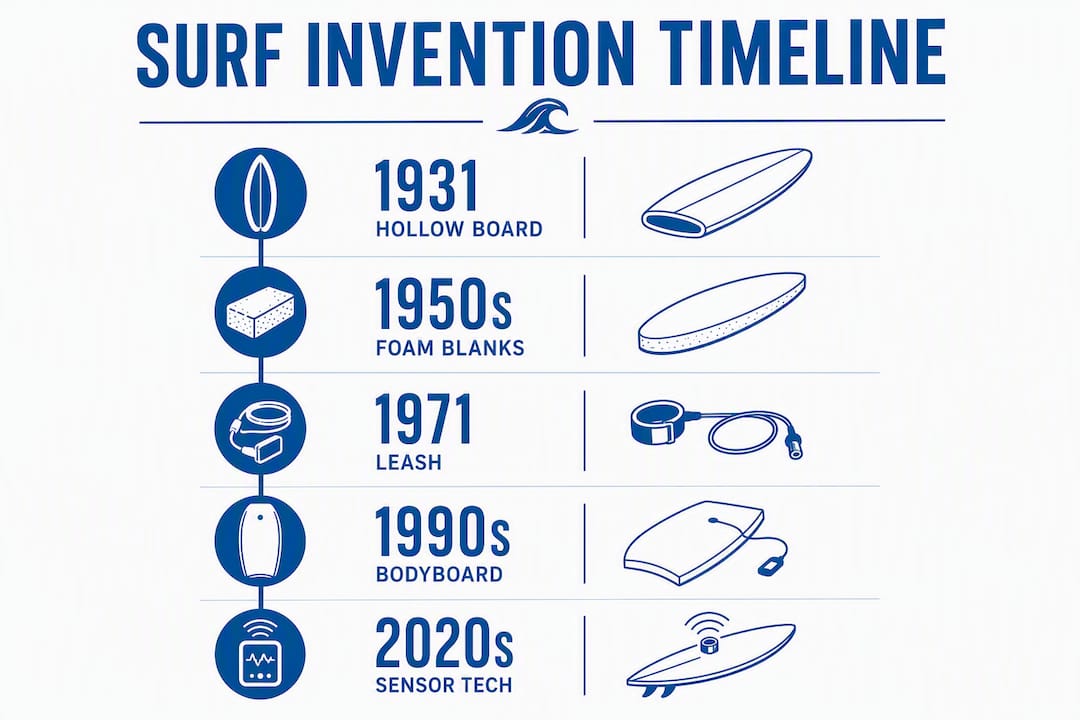
| 1931 | Hollow board & “water sled” patent | Tom Blake, Hawaii/California | Cut board weight dramatically; first commercially produced surfboard |
| 1935 | Surfboard fin | Tom Blake | Directional control; still the most lasting structural feature on any board |
| 1950–1958 | Foam blank experiments → full production | Bob Simmons, Hobie Alter, Gordon Clark, Dave Sweet | Lighter, more buoyant boards; full-scale polyurethane production began mid-1958 |
| 1971 | Surfboard leash | Pat O’Neill, Santa Cruz | Safety standard; initially ridiculed, now universal |
| 1971 | Bodyboard (boogie board) | Tom Morey | Polyethylene foam; opened wave riding to beginners and children |
| Modern | Sensor systems | TRAX, SurfOne | Objective metrics replace pure guesswork in training |
| Recent years | 3D-printed cores | WYVE 4DCore | Engineered flex, vibration control, and impact resistance at the structural level |
| 2026 | Modular travel board | Newave Wrocket | Travel-friendly, modular design that splits into multiple sections |
One detail most people miss about Tom Blake: he adapted his fin concept from boat keels, and even with the clear hydrodynamic advantage, elite Hawaiian surfers were slow to adopt it through the 1940s. Cultural resistance to new gear is as old as surfing itself.
Album Surf’s Exo Flex technology, tested by pro surfer Asher Pacey, replaces the traditional wood stringer with a kinetic-energy system that functions like a leaf spring, delivering more responsive flex through turns. It’s a performance tool today, but the same principle of engineered flex will filter into beginner boards over time.
What each invention actually changed for beginners
The fin is the single biggest reason a beginner can stand up and go somewhere instead of spinning in circles. Before 1935, riding a wave in a straight line required constant weight adjustments that took years to master. The fin handles most of that automatically.
Foam blanks changed the physics of paddling. A lighter, more buoyant board gets on a wave earlier, which means you spend less energy fighting the water and more time actually riding. For a tourist who hasn’t paddled in years, that difference is felt within the first ten minutes.
The leash is less glamorous but arguably more important for safety. Pat O’Neill introduced it at the 1971 Malibu international competition and was disqualified for wearing it. Within a year, it was everywhere. A runaway board is a projectile. The leash keeps it attached to your ankle, protecting you and everyone around you.
Tom Morey’s bodyboard proved something important: you don’t need a full-length board or years of training to experience wave riding. He cut polyethylene foam in half and sold the result at a price almost anyone could afford. That grassroots logic directly influenced the soft-top boards used in beginner lessons today.
Modern sensor systems like TRAX and SurfOne track weight shifts, turn angles, speed, and wave counts. SurfOne pairs that data with video for session review, essentially putting a coach’s eye on every wave you ride. For beginners, the value isn’t the data itself but the translation: an instructor can show you exactly where your weight shifted too early, rather than describing it in the abstract.
Pro Tip: If your lesson offers video review, watch it before your second session, not after. Seeing your own stance from outside is worth more than ten verbal corrections.
How these inventions shape your first lesson in Oahu
What you actually experience in a Waikiki or North Shore lesson is the product of a century of these improvements. Here’s what to expect and look for:
- Foam soft-top board: Standard for beginners. More buoyant than a hard-top, softer on impact, and easier to paddle. Ask specifically for a soft-top if you’re not sure what you’re getting.
- Appropriate fin setup: A beginner board typically uses a three-fin setup (thruster) for stability. Single-fin longboards are also common in Waikiki’s gentler surf.
- Functioning leash: Non-negotiable. Confirm it’s included and properly fitted before you enter the water.
- In-water instructor support: The best schools keep instructors in the water with you, not just on the beach. This is where the teaching actually happens.
- Location awareness: Waikiki’s waves are smaller and more consistent, making it ideal for first-timers. The North Shore is more powerful and seasonal. If you’re a complete beginner, Waikiki is the right starting point.
Waikiki’s beginner surf zones are deliberately separated from more advanced breaks. Modern gear, especially the foam soft-top and leash combination, makes those zones genuinely safe for people who have never surfed before.
How Hhsurf applies modern gear and teaching to get you standing fast
Hans Hedemann Surf School’s method follows a clear sequence: land demonstration, board selection matched to your size and ability, in-water positioning, and then escorted waves with an instructor physically guiding the board. The goal is a real stand-up in the first session, not a promise for next time.
The school uses foam soft-tops and properly fitted leashes as standard. Optional photo and video packages let you review your session afterward, which accelerates retention in a way that verbal feedback alone can’t match. Where sensor tools are available, instructors can translate the data into plain corrections rather than overwhelming you with numbers.
At Hhsurf, safety and progression aren’t separate priorities. The gear we use, the zones we teach in, and the way instructors stay in the water with you are all chosen to make your first wave feel achievable, not accidental. Modern surf inventions gave us better tools. The teaching method is what puts those tools to work for you.
The school’s step-by-step teaching approach is built around quick wins: get you standing, get you steering, build confidence before complexity. That’s the right order for a tourist with one or two sessions available.
What to ask before you book a surf lesson
Decision checklist:
- Group size and instructor-to-student ratio (smaller is better for beginners)
- Whether foam soft-top boards are included
- Leash provision and fitting
- CPR certification of instructors
- In-water vs. beach-only instruction
- Cancellation and refund policy
- Photo/video package availability
Questions worth asking directly:
- What size board will I use, and is it a soft-top?
- Do instructors stay in the water during the lesson?
- Are your instructors CPR-certified?
- Do you offer video review or sensor feedback?
- What happens if conditions are too rough on my booked day?
- Is the lesson location appropriate for a complete beginner?
Private lessons cost more than group sessions but deliver faster progress for most beginners. If you have only one day in the water, a private lesson in Waikiki is usually worth the difference. For families or groups, semi-private formats balance cost and attention well. North Shore lessons suit intermediate surfers or those visiting in summer when conditions are calmer.
Patents, legal history, and the ownership of surf inventions
Tom Blake filed his hollow “water sled” patent in 1931, making it one of the earliest formal intellectual property claims in surfing. The fin followed in 1935. These patents mattered because they enabled commercial production: from 1932 into the early 1950s, four companies manufactured Blake’s hollow boards under license.
The leash has its own legal history. Pat O’Neill’s early design used surgical cord attached with a suction cup. The urethane leash design was later patented by David Hattrick, who established Pipe Lines surfing products and won an Australian Design Award in 1979. Peter Wright of New Zealand created an early leg rope in the early 1970s but never copyrighted it, which is why O’Neill and Hattrick receive the formal credit.
Modern patents cluster around materials and sensor systems. WYVE’s 4DCore technology involves proprietary 3D-printed geometries. Sensor companies like TRAX and SurfOne hold IP around their data capture and machine-learning feedback systems. The Newave Wrocket’s modular connection system is a recent example of travel-specific design IP. Patent activity in surfing today is as much about software and materials science as it is about board shapes.
How surf inventions changed competitive surfing and athlete performance
The foam board transition of the late 1950s didn’t just help beginners. It enabled the shortboard revolution of the late 1960s, which fundamentally changed what competitive surfing looked like. Lighter blanks meant shapers could experiment with shorter, thinner outlines that responded to aggressive turns. That’s the direct line from Hobie Alter and Gordon Clark’s polyurethane work to the aerial maneuvers scored in World Surf League events today.
Sensor systems have shifted how athletes train. TRAX and SurfOne give coaches objective data on turn mechanics, wave selection, and session volume. Before these tools, coaching relied entirely on observation and feel. Now a coach can show a competitor exactly where a turn lost speed, measured in degrees and meters per second.
Album Surf’s Exo Flex, tested by Asher Pacey, represents the next phase: boards engineered for specific flex profiles that match an athlete’s style. The California Surf Museum documents how the foam transition democratized surfing. Sensor and materials technology is now doing something similar for performance, making elite-level feedback available outside of elite-level budgets.
Sustainable surf equipment and the environment
Traditional polyurethane foam blanks are petroleum-based and difficult to recycle. A broken board typically ends up in a landfill. The industry has known this for decades and moved slowly. That’s starting to change.
WYVE’s 3D-printed honeycomb cores use additive manufacturing, which produces less material waste than traditional shaping. The technology also allows for more precise structural design, which means boards can be built to last longer rather than replaced after minor damage. Longer board life is the most straightforward sustainability gain available right now.
Bio-based resins, recycled foam cores, and plant-fiber laminates are in active development across several shapers. None have reached mass-market scale yet, but the direction is clear. Smart fin research in Australia, led by teams at the University of Wollongong and UNSW Sydney, is also exploring advanced composite materials that could reduce the environmental footprint of fin production while embedding safety technology.
For beginners, the practical implication is simple: a well-made foam soft-top board, properly maintained, will outlast a cheaper alternative and generate less waste over time. Asking your surf school about board quality and maintenance is a reasonable sustainability question, not just a performance one.
Key Takeaways
Surf inventions from Tom Blake’s 1935 fin to today’s sensor systems and modular travel boards directly determine how safe, effective, and enjoyable your first lesson in Waikiki or the North Shore will be.
| Point | Details |
|---|---|
| Foam soft-tops are the right choice | More buoyant and forgiving than hard boards; standard at quality beginner schools. |
| The leash is non-negotiable | Introduced in 1971 and now universal; keeps your board attached and others safe. |
| Sensor tools speed up learning | TRAX and SurfOne translate feel into measurable data, helping instructors give precise corrections. |
| Location shapes your lesson | Waikiki suits first-timers; North Shore is better for intermediates or summer visits. |
| Book with the right school | Hhsurf’s in-water instruction method and modern gear give beginners the fastest path to standing. |
The part that doesn’t show up in the history books
Most articles about surf invention focus on the gear. What they miss is the teaching gap. A better board doesn’t automatically produce a better surfer. Tom Blake’s fin sat unused by elite Hawaiian surfers for nearly a decade after he introduced it. The same pattern repeats with every new technology: the tool arrives before the method catches up.
Sensor feedback is the current version of that gap. TRAX and SurfOne can generate precise data on every wave. But for a tourist with one afternoon in Waikiki, raw metrics are noise without an instructor who knows how to translate them into one clear correction. The technology is only as useful as the person explaining it.
What actually works for beginners is a tight loop: a forgiving board, an instructor in the water with you, one or two specific things to fix, and a wave that lets you feel the difference immediately. That’s not a new invention. It’s what good teaching has always looked like. The foam board and the leash just made it safer and more accessible. The sensor tools, used well, make the feedback sharper. The method is still the thing.
Useful sources
- Tom Blake | National Inventors Hall of Fame: Primary source for Blake’s hollow board patent (1931), fin invention (1935), and commercial production history.
- The invention of the surfboard fin — SurferToday: Detailed account of Blake’s fin design, its boat-keel origins, and the slow adoption among Hawaiian surfers.
- Who invented the foam surfboard — California Surf Museum: Documents the experimental foam work of the early 1950s and the Hobie Alter/Gordon Clark/Dave Sweet polyurethane transition.
- From wood to foam — Legendary Surfers: Timeline of foam blank experimentation (1951) through full-scale production (mid-1958).
- Surfboard leash — Wikipedia: Pat O’Neill’s 1971 introduction, the controversy, and David Hattrick’s patented urethane design.
- Tom Morey obituary — USC: Bodyboard origin story, polyethylene foam, and the grassroots accessibility argument.
- TRAX sensor system: Overview of board-mounted sensors tracking weight shifts, turn angles, and speed for training feedback.
- SurfOne performance tracking: Real-time analytics device capturing speed, turns, wave counts, and airtime with video pairing.
- WYVE 4DCore technology: 3D-printed honeycomb core construction for engineered flex, vibration damping, and impact resistance.
- Newave Wrocket — WorldKings: Specifications and travel design of the 2026 modular soft-top, designed to split into three sections for carry-on travel.
- Smart surfboard fins — Manufacturers’ Monthly: Australian research embedding sensors and electromagnetic shark-deterrent systems into composite fins.
0 Comments