
The best months for beginner-friendly surf, SUP, and bodyboard lessons on Oahu’s North Shore run May through September, when swell drops and the water turns glassy enough for first-timers to stand up safely. Book summer slots early since they fill up fast, or aim for September if you want the same calm water with noticeably lighter crowds. Whichever month you pick, your safety still depends on an instructor reading the reef and choosing the right spot that day.
TL;DR:
- Summer months from May to September offer the most consistent calm water, but conditions depend heavily on daily swell, wind, and tide, not just the calendar.
- Instructors choose lesson locations based on daily swell direction and reef shape, prioritizing sandy-bottom spots like Chun’s Reef for safety and ease.
- Early morning sessions are preferable in summer, as trade winds tend to be calmer and water remains glassy before wind and crowds pick up.
- Winter swells from November to February bring large, dangerous waves that are unsuitable for beginners and reserved for experienced surfers.
- Booking lessons well in advance, asking for specific spot choices, and preparing with reef-safe sunscreen and water optimize beginner success during the summer window.
Table of Contents
- What Drives the North Shore Surf Season
- Best Months for North Shore Surf Lessons, Month by Month
- Which North Shore Spots Work Best for Beginners
- What a Safety Briefing and First Lesson Actually Cover
- How to Book and Time Your North Shore Lesson
- What Peak Season Looks Like for Experienced Surfers
- How North Shore Swells Actually Form
- Weather and Water Temperature Through the Year
- Where Advanced Surfers Go Later in the Year
- How Wind and Tide Shift Conditions Day to Day
- The North Shore’s Competition Legacy
- Why Summer Instruction Beats Chasing Winter Swells for Beginners
- Book Your Lesson in the North Shore’s Calm Season
- Sources
- FAQ
What Drives the North Shore Surf Season
Oahu’s North Shore faces the open North Pacific, and that ocean has its own calendar. Storms spinning off Japan and the Aleutians send long, powerful swells south toward Hawaii from roughly October through March, which is why the same beaches that host world-class competitions in winter turn into something else entirely by June.
Summer flips the script. The North Pacific storm track shifts north, swell energy drops off, and the trade winds that blow steadily across the islands smooth out the surface instead of chopping it up. That combination is why May through September consistently produces smaller, gentler waves that work like training wheels for people who have never stood on a board.
A few things to keep in mind about the shift between seasons:
- Summer (May to September) brings the most consistent calm water for learning.
- Winter (November to March) brings the biggest, most dangerous swells of the year.
- Shoulder months (March, April, October) sit in between and can swing either way depending on the week.
- Trade wind direction matters almost as much as swell size for how clean the water looks on any given day.
None of this is a strict switch that flips on June 1. It’s a gradual trend, which is exactly why local instructors check conditions the morning of your lesson rather than trusting the calendar alone.
Best Months for North Shore Surf Lessons, Month by Month
Not every summer week looks the same, and knowing the differences helps you pick dates that match your goals, whether that’s cheap flights, empty beaches, or the calmest possible water.
- May and June. Early summer brings the first real calm after winter’s swells fade out. Crowds are lighter than peak summer, and lesson availability is usually easy to lock in with a week or two of notice.
- July and August. This is the warmest, calmest, and busiest stretch of the entire year. Book two to four weeks out if you have specific dates, since instructors and popular time slots go first.
- September. Late summer often delivers the same flat, gentle water as July with a fraction of the tourist traffic. Turtle Bay Hale’s seasonal guide calls this stretch a sweet spot for exactly that reason, and it’s one worth planning around if your schedule is flexible.
- March, April, and October. These shoulder months bring lower prices and thinner crowds, but conditions are inconsistent. Some weeks look like summer; others carry leftover winter energy.
- November through February. Big North Pacific swells arrive and stay. Standard beginner lessons pause on most breaks, though a trained instructor may still run a session in a genuinely protected cove on a small day.
September’s advantage is worth spelling out: you get summer-grade water with meaningfully shorter lines at rental counters and lesson check-ins, since school schedules pull family crowds back home by Labor Day.
Which North Shore Spots Work Best for Beginners
Instructors don’t teach beginners on the same breaks that make headlines every winter. They pick specific stretches of coastline where the bottom, the shape of the reef, and the way waves break all favor someone standing on a board for the first time.
Chun’s Reef is a go-to summer choice because it holds a forgiving, rolling wave that breaks over a wider area instead of dumping all at once. Pua’ena Point works as the backup plan. When Chun’s or another primary break gets bigger than expected, instructors often shift lessons here because its position offers more protection from open ocean swell.
A few things worth knowing about spot selection in general:
- Sandy-bottom areas are generally more forgiving for falls than exposed reef.
- Tide timing changes how a break behaves, sometimes making a spot workable in the morning and too shallow by afternoon.
- Instructors watch the swell direction that day, not just the forecast, before committing to a location.
- A spot that’s great for lessons on Tuesday can be wrong for lessons on Thursday if the swell shifts.
For a broader look at how different North Shore surf spots suit different skill levels, it helps to understand the terrain before you ever get in the water.
Pro Tip: Ask your instructor which spot they’re planning to use before you drive out. Locations change day to day based on conditions, and a good school will tell you exactly why.
What a Safety Briefing and First Lesson Actually Cover
North Shore reef breaks demand a different safety conversation than a sandy beach break, and any solid lesson starts on land, not in the water. The single most important skill an instructor teaches before you paddle out is how to fall. Diving headfirst or landing feet first onto shallow reef causes most of the injuries beginners see, so instructors drill a flat, controlled fall that keeps you away from contact with the bottom.
A typical first lesson usually covers:
- How to fall safely and where the reef sits relative to your board
- Paddling technique and how to read an incoming wave
- The pop-up motion, practiced on sand before you ever try it moving
- Catching small, rolling waves with the instructor pushing or guiding the board
- Basic board control once you’re standing
Instructors’ choices about which spot to use and whether conditions are safe that day function as the strongest protection beginners have on the North Shore. That judgment call matters more than any piece of gear.
That’s part of why Hans Hedemann Surf School’s North Shore lessons lean on a structured, proven beginner methodology built to get first-timers riding waves quickly while keeping the safety fundamentals front and center. Group sizes stay small enough that instructors can watch every student’s positioning, and gear gets matched to your size and skill level before you even reach the water.
How to Book and Time Your North Shore Lesson
Morning sessions almost always beat afternoon ones in summer. Trade winds tend to stay calmer before mid-morning, and the water hasn’t been chopped up by wind or crowded by other surfers yet.
- Book well in advance for summer months; shoulder months and May or June usually allow more flexibility.
- Ask which specific spot the school plans to use and why, since that tells you they’re actually checking conditions rather than defaulting to one location.
- Confirm group size or ask about semi-private and private options if you want more individual attention.
- Ask whether photo or video packages are available if you want to remember your first ride.
- Bring reef-safe sunscreen, a rash guard, water, and a towel; parking near popular breaks fills up early on summer weekends.
Pro Tip: Reserve the earliest slot your schedule allows. An 8 a.m. lesson in July can mean flat, glassy water, while the same break by 1 p.m. has wind lines and twice the crowd.
What Peak Season Looks Like for Experienced Surfers
November through February belongs to a completely different kind of surfer. This is when the North Pacific sends its biggest, most consistent swells toward Oahu, and breaks that sit calm and forgiving all summer turn into serious, powerful waves that demand real experience to handle safely.
Wave faces at well-known winter breaks can reach heights that dwarf anything seen in the same spots during June or July. That size difference is exactly why beginner lessons don’t run on these breaks once winter swells arrive. The same reef geometry that shapes a gentle summer roller at a place like Chun’s Reef produces something far more powerful when a big winter swell wraps in.
Advanced surfers plan entire trips around this window, chasing specific swell events and reading forecasts the way sailors read weather charts. Local knowledge matters even more here than in summer. Currents run harder, sets arrive in unpredictable pulses, and the margin for error narrows considerably. None of this affects the beginner-friendly season directly, but it explains why the North Shore’s reputation swings so hard between “gentle classroom” in summer and something else entirely once winter swells take over. Understanding that split helps explain why timing your visit around the calm months matters so much if lessons are the goal.
How North Shore Swells Actually Form
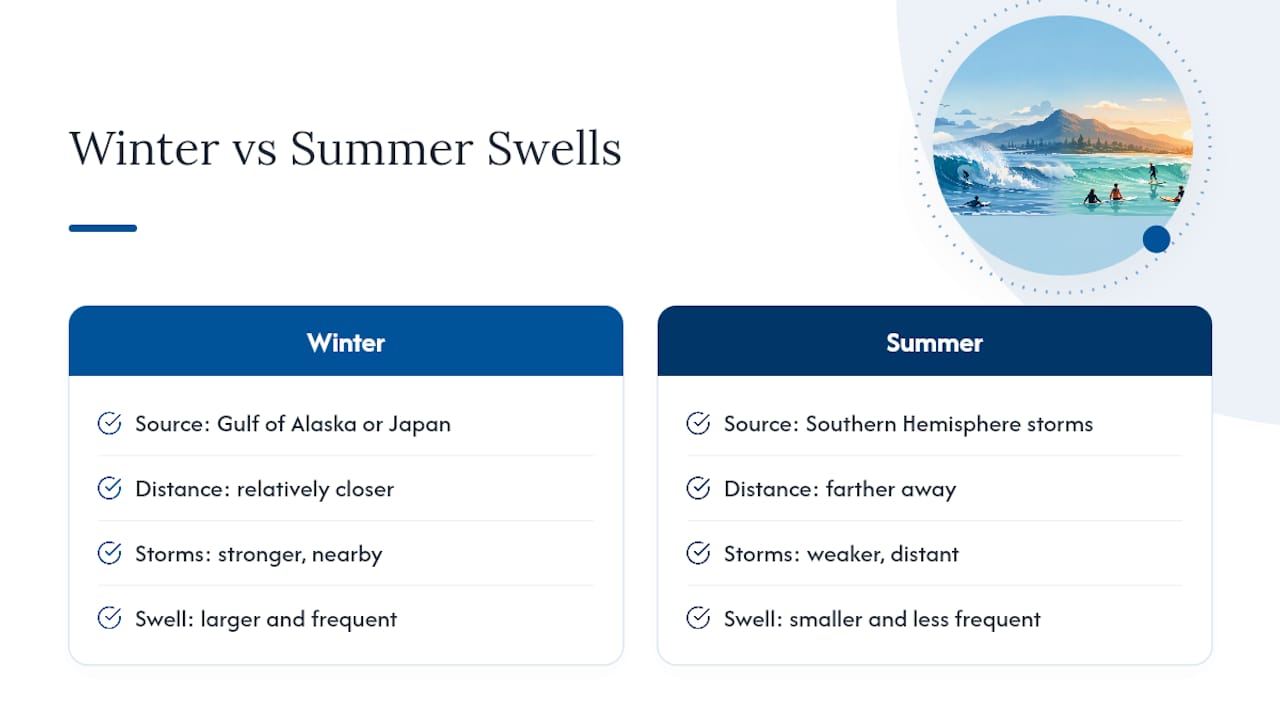
Every wave that reaches Oahu’s North Shore starts as wind energy somewhere out in the open Pacific, often thousands of miles away. Storms spinning through the Gulf of Alaska or off the coast of Japan push wind across open water for days, and that wind transfers energy into the ocean surface as long, organized swells that travel outward in every direction.
By the time those swells reach Hawaii, the chaotic, wind driven surface has organized itself into clean, evenly spaced lines. The North Shore faces almost directly into the path these Pacific storms travel, which is why it catches swell that many other Hawaiian coastlines miss entirely. Depth changes matter too. As a swell moves from deep open ocean into shallower water near shore, the wave slows down and the energy has nowhere to go but up, which is why the same swell can look modest offshore and much bigger by the time it reaches a shallow reef.
Summer swells, by contrast, tend to come from more distant, weaker source storms in the Southern Hemisphere, and they arrive smaller and less frequently. That’s the mechanical reason behind the seasonal split: winter storms sit closer and hit harder, summer storms sit farther and arrive gentler. Trade winds add a final layer, smoothing the surface texture on top of whatever swell happens to be running that week.
Weather and Water Temperature Through the Year
Oahu doesn’t have dramatic seasons the way mainland states do, but the differences that exist matter for planning a lesson. Water temperature stays warm year round, generally sitting in a range comfortable enough that most schools don’t require wetsuits even in winter.
Air temperature follows a similarly narrow band, with summer days running warmer and drier and winter bringing slightly more rain and cooler evenings. The bigger variable isn’t temperature at all. It’s wind and swell, which change far more dramatically across the year than the thermometer does.
Rain patterns shift somewhat by season, with winter months typically seeing more rainfall on the North Shore than the drier summer stretch. That said, tropical weather can turn quickly, and a sunny morning doesn’t guarantee a dry afternoon in any month. Pack layers for cooler mornings in winter, but don’t expect the kind of seasonal temperature swing you’d see somewhere like California or the Pacific Northwest. The ocean itself, not the air, is what really separates one North Shore season from another.
Where Advanced Surfers Go Later in the Year
Once winter swells arrive, experienced surfers migrate toward breaks built to handle serious size and power, spots that stay firmly off limits for lesson-based instruction. These are high-consequence waves that reward years of experience and local knowledge, not a first attempt at standing on a board.
Advanced surfers also use the shoulder seasons strategically. October and early November often bring the season’s first solid swells before the full winter lineup of crowds and competitions arrives, giving experienced surfers a window to score good waves with fewer people in the water. March and April work the same way on the tail end of winter, catching leftover swell energy before things settle into the calmer summer pattern.
For surfers building toward that level, Hans Hedemann Surf School’s cross-training resources point to a useful strategy: use the calm summer window to sharpen fundamentals like paddling strength and wave reading, so you’re actually ready to progress toward bigger conditions once winter swells return.
How Wind and Tide Shift Conditions Day to Day
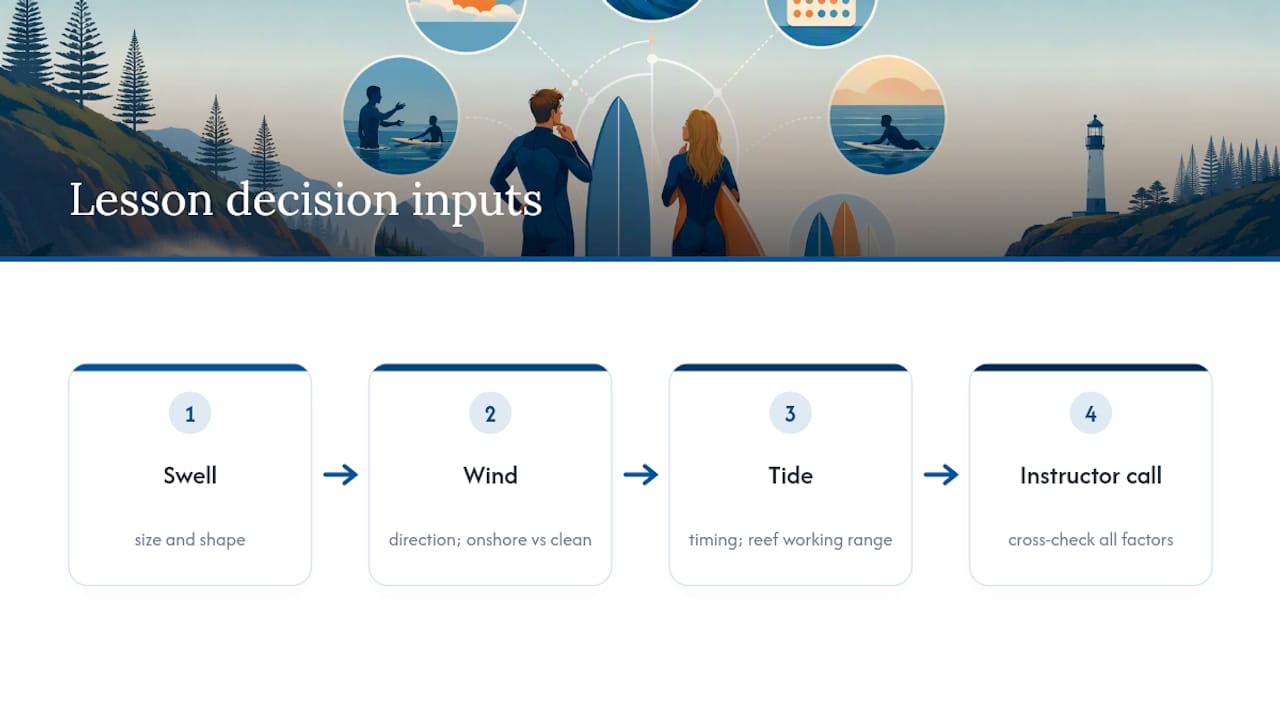
Swell size gets most of the attention, but wind and tide decide whether any given day is actually rideable. Trade winds blowing from the northeast are the summer default, and they tend to groom wave faces into clean, organized lines rather than chopping up the surface.
When trade winds falter or shift, onshore wind can turn a promising morning choppy and messy by early afternoon, which is exactly why instructors favor early sessions. Tide plays a quieter but equally real role. Many North Shore breaks sit over reef shelves that only work properly within a certain tide range, too low and the reef becomes a hazard, too high and the wave loses its shape entirely.
That’s part of why instructors don’t just check swell forecasts before booking a lesson. They cross reference wind direction, tide timing, and swell size together, since any one factor being off can turn a “good” wave forecast into a poor lesson day. Understanding how these variables interact is exactly why local instructor judgment beats any app or forecast alone.
The North Shore’s Competition Legacy
Winter’s big swells built the North Shore’s global reputation, and decades of major competitions have cemented specific breaks as some of the most storied stretches of coastline in the sport. The Vans Triple Crown of Surfing, held across multiple North Shore venues each winter, has run for decades and remains one of the sport’s most recognized competitive series.
These events happen exclusively during the winter swell season for an obvious reason: the waves that make for compelling competition surfing are the same powerful, well-formed swells that arrive between November and February. Summer’s gentle rollers, the very quality that makes them perfect for beginner lessons, don’t offer the size or power that professional competition demands.
That contrast tells you almost everything about how the North Shore’s identity splits by season. The same coastline that hosts elite competitors chasing massive winter swells spends its summer as a calm, forgiving classroom for people picking up a board for the very first time. Both seasons belong to the North Shore’s story, but they serve completely different purposes and completely different surfers.
Why Summer Instruction Beats Chasing Winter Swells for Beginners
If you’re picking a season to learn, May through September isn’t just the safer choice. It’s the one that actually lets you make progress. Trying to learn during winter swells means fighting conditions built for experts, and that’s a losing setup for anyone’s confidence.
What people underestimate is how much a trained instructor’s judgment matters beyond just picking a calm month. Two June mornings can look identical to a tourist and completely different to someone who reads reef and wind for a living. That’s the real value of booking with instructors rather than renting a board and guessing.
Progress in a good summer lesson tends to happen fast, and that speed builds real confidence, not just a fun photo. Pick your season carefully, but pick your instructor even more carefully.
— Johann
Book Your Lesson in the North Shore’s Calm Season
A beginner methodology is built around the window this article describes: calm, forgiving summer water where new surfers can progress quickly in a single session. That’s the whole point of matching your trip dates to the season, and it’s the foundation behind every North Shore lesson the school runs.

Various lesson formats are available on the North Shore, along with optional photo and video packages for memorable keepsakes. If you’d rather start in more sheltered water before tackling the North Shore, Waikiki lessons offer a similar beginner-focused approach closer to town. Whichever location fits your trip, check available dates and book your North Shore surf lesson now, since summer slots move quickly once the calm season kicks in.
Sources
- Learn how to surf North Shore O’ahu
- Best Time to Visit the North Shore of Oahu (Month by Month) | Turtle Bay Hale
- A Surfing Guide for Beginners on North Shore Oahu
FAQ
When Is the North Shore Surf Season Best for Beginners?
May through September is the most reliable window, with smaller, gentler waves that suit first-time surfers far better than winter conditions.
Is September a Good Time to Book a North Shore Lesson?
Yes. September often keeps summer’s calm water while crowds thin out noticeably after Labor Day.
Do North Shore Beginner Lessons Run in Winter?
Standard beginner lessons generally pause once winter swells arrive, though an instructor may run a session in a genuinely protected cove on a small winter day.
What Should I Bring to a North Shore Surf Lesson?
Reef-safe sunscreen, a rash guard, water, and a towel cover the basics; the school supplies the board and safety briefing.
Which North Shore Spots Are Best for Beginners?
Chun’s Reef and Pua’ena Point are common instructor choices in summer because they offer protected, forgiving waves suited to first-timers.
0 Comments