
A good beginner surf instructor is defined by four core qualities: recognized certification, a structured teaching method, genuine patience, and emotional intelligence. These traits separate instructors who build real confidence from those who simply push students into waves. Knowing the signs of a good beginner surf instructor before you book a lesson protects both safety and enjoyment. Whether you are a first-time surfer or a parent choosing lessons for a child, this guide gives you a clear, practical checklist grounded in coaching standards and water safety requirements.
1. What are the signs of a good beginner surf instructor?
The clearest sign of a quality surf instructor is formal certification from a recognized body. Qualified surf instructors hold credentials from organizations like the Australian Surf Instructors Association (ASI) or the International Surfing Association (ISA), plus current First Aid and CPR water safety training. These certifications are not optional extras. They are the baseline standard that proves an instructor knows how to respond when something goes wrong in the water.
Certification also signals professional accountability. An instructor who has completed ASI or ISA training has studied beginner-specific risks, ocean hazards, and emergency response protocols. That knowledge directly protects you or your child during every lesson.

Pro Tip: Before booking any surf lesson, ask the school directly whether their instructors hold current ASI or ISA certification and up-to-date First Aid/CPR credentials. A reputable school answers this question without hesitation.
2. Structured teaching methods built for beginners
A great surf coach uses a proven, repeatable system rather than winging it session by session. The 1-2-3 takeoff method practiced on the sand with 20–30 repeated drills is one of the clearest signs of a structured approach. Land drills build muscle memory and reduce anxiety before a student ever touches the water. That preparation makes the first wave far less intimidating.
Small group sizes are equally telling. Reputable surf schools maintain instructor-to-student ratios of 1:3–5 to ensure personalized feedback and safety. A ratio worse than 1:6 means the instructor cannot watch every student at once. That gap creates real safety risks for beginners who are still learning to read waves.
Top schools also back their methods with written standards. Internal teaching manuals of 49 pages or more ensure every instructor follows the same progression steps. That consistency means your lesson quality does not depend on which instructor happens to show up.
| Teaching approach | What it means for beginners |
|---|---|
| Land drills before water entry | Builds muscle memory and reduces first-wave anxiety |
| 1:3–5 instructor-to-student ratio | Guarantees individual feedback and close safety monitoring |
| Written internal teaching manual | Ensures consistent lesson quality across all instructors |
| Adaptable pace per student | Matches lesson speed to each learner’s comfort and ability |
3. Patience and empathy as non-negotiable traits
Technical surfing ability does not make someone a good teacher. Emotional intelligence is often more critical than surfing skill when working with beginners. An instructor who reads a student’s fear, slows the pace, and adjusts their communication style produces better outcomes than one who simply demonstrates impressive moves.
Empathy creates a non-judgmental space where beginners feel safe making mistakes. That psychological safety is not a soft bonus. It directly affects how quickly students learn and whether they come back for a second lesson.
“The best instructors treat every small win as a milestone. When a beginner pops up for the first time, that moment deserves the same energy as a championship wave. Belief from an instructor changes how a beginner’s brain performs.”
Pro Tip: Watch how an instructor reacts when a student falls repeatedly. Patience and encouragement in that moment reveal more about teaching quality than any credential on paper.
4. Positive reinforcement that improves skill retention
Positive reinforcement from instructors improves beginners’ skill retention and reduces anxiety. That is not just motivational theory. It reflects how the brain consolidates new physical skills under stress. When a student feels supported rather than judged, they absorb technique faster and hold it longer.
Good instructors celebrate every small win to encourage motivation and build a positive learning environment. Practical tools include verbal praise after each attempt, light humor to break tension, and games that make repetition feel fun rather than tedious. These techniques lower the psychological barrier that stops many beginners from progressing past their first lesson.
High-quality instructors also manage expectations honestly. They tell beginners what is realistic for a first session so students measure success accurately. That honesty reduces frustration and prevents the “I’m terrible at this” spiral that kills motivation early.
5. Adaptability to each student’s needs and conditions
A skilled beginner surf coach adapts teaching style and pace according to each student’s fear level, learning speed, and background. No two beginners arrive at the water with the same confidence or physical coordination. An instructor who runs the same script for every student regardless of their state is not truly teaching.
Adaptability also applies to ocean conditions. The best instructors know when to adjust the lesson location, choose a safer break, or pause entirely when conditions change. That decision prioritizes student safety over keeping to a schedule. It is one of the clearest signs that an instructor puts students first.
Understanding beginner surf zones is part of this adaptability. Instructors who consistently choose appropriate, gentle conditions for new surfers demonstrate real situational awareness. That awareness protects students from being placed in waves beyond their current ability.
6. Clear, simple communication without information overload
Good instructors communicate one instruction at a time. Beginners cannot process five technical corrections simultaneously while also managing balance, wave timing, and fear. An instructor who overloads students with feedback creates confusion rather than progress.
The best coaches use plain language, physical demonstrations, and consistent vocabulary. They repeat key cues in the same words each time so students build reliable mental anchors. When you prepare for your first surf lesson, clear communication from your instructor is what turns preparation into actual skill.
Simple communication also builds trust. When a beginner understands exactly what they are being asked to do, they attempt it with more commitment. That commitment is what produces the first successful ride.
7. Red flags that signal an instructor is wrong for beginners
Certain warning signs tell you an instructor is not suited for beginner students. Spotting them early saves you from a frustrating or unsafe experience.
Watch for these red flags:
- No verifiable certification. An instructor who cannot name their certifying body or show credentials is a serious concern.
- Large, unmanaged groups. Ratios beyond 1:6 mean students receive minimal individual attention and safety oversight drops.
- Rushing students into deep water. Skipping land drills and pushing students too fast signals impatience over student welfare.
- Dismissing student fears. An instructor who minimizes anxiety rather than addressing it creates a hostile learning environment.
- Focusing on personal performance. Instructors who spend lesson time showing off their own surfing are not focused on student progress.
- Vague lesson structure. If an instructor cannot explain what the lesson covers or how it progresses, there is no real teaching plan.
- Ignoring changing conditions. Continuing a lesson in worsening surf without adjusting shows poor judgment and disregard for safety.
Surf school vs. self-teaching comparisons often highlight that unqualified instruction is worse than no instruction at all. A bad first experience can put beginners off surfing permanently.
8. Teaching environment and lesson location matter
The physical setting of a lesson reveals a lot about an instructor’s priorities. A good coach selects gentle ocean conditions and protected beginner zones where wave size and current are manageable. Placing a first-timer in challenging surf to “build character” is a red flag, not a teaching method.
Safe lesson environments also include proper equipment. Soft-top boards, appropriate leashes, and rash guards suited to conditions are standard at quality schools. An instructor who hands a beginner a hard performance board for a first lesson does not understand beginner-specific risks.
The overall vibe of the lesson space matters too. A calm, organized beach setup where students can hear instructions clearly and watch demonstrations without distraction supports faster learning. Chaos on the beach usually means chaos in the water.
9. Post-lesson feedback and ongoing encouragement
A good instructor does not disappear the moment the lesson ends. Brief post-lesson feedback that highlights what went well and identifies one or two areas to work on gives beginners a clear path forward. That structure turns a single lesson into the foundation of a real progression plan.
Ongoing encouragement between sessions, whether through a quick debrief or written notes, reinforces what students learned while the experience is still fresh. Fastest ways to learn surfing basics consistently point to reinforced repetition as the key accelerator for beginner progress. An instructor who supports that reinforcement outside the water is genuinely invested in student development.
Private lessons amplify this benefit. One-on-one time means feedback is immediate, specific, and uninterrupted by group dynamics. For beginners with significant anxiety or specific physical considerations, that focused attention can make the difference between quitting and continuing.
Key Takeaways
The most effective beginner surf instructor combines ASI or ISA certification, a structured land-to-water teaching method, genuine emotional intelligence, and consistent positive reinforcement to produce safe, confident new surfers.
| Point | Details |
|---|---|
| Certification is non-negotiable | Verify ASI or ISA credentials and current First Aid/CPR before booking any lesson. |
| Structured methods accelerate learning | Land drills, small group ratios, and written teaching progressions produce faster, safer results. |
| Emotional intelligence beats surfing skill | Instructors who read fear and adapt pace build more confident beginners than technically gifted surfers. |
| Red flags are easy to spot | Large groups, no certification, rushed progression, and dismissed fears are clear warning signs. |
| Environment and feedback complete the picture | Safe lesson locations and post-session reinforcement turn one lesson into lasting progress. |
What I’ve learned about choosing the right surf instructor
The quality that separates a forgettable lesson from a life-changing one is almost never surfing ability. I have watched technically brilliant surfers completely fail as instructors because they had no patience for the slow, uncertain process of learning from scratch. They remembered their own progression as effortless and could not understand why a beginner needed the same drill explained five different ways.
What actually works is emotional intelligence paired with real safety credentials. Those two things together tell you that an instructor respects both the student’s mind and the ocean’s risks. Certification without empathy produces technically safe but joyless lessons. Empathy without certification is warmth without a safety net.
The instructors I trust most treat every beginner as a whole person, not a task to complete before the next group arrives. They slow down when a student tenses up. They celebrate a two-second ride with the same energy as a long one. They choose the calmer break even when the better wave is fifty yards away. That combination of care and competence is what you are actually paying for when you book a surf lesson. Everything else is secondary.
— Johann
Certified beginner surf lessons at Hhsurf in Waikiki
Hhsurf instructors at the Hans Hedemann Surf School in Waikiki hold ASI and ISA certifications alongside current First Aid and CPR training. Lessons follow a proven beginner methodology with small group sizes that guarantee individual attention and real safety oversight.
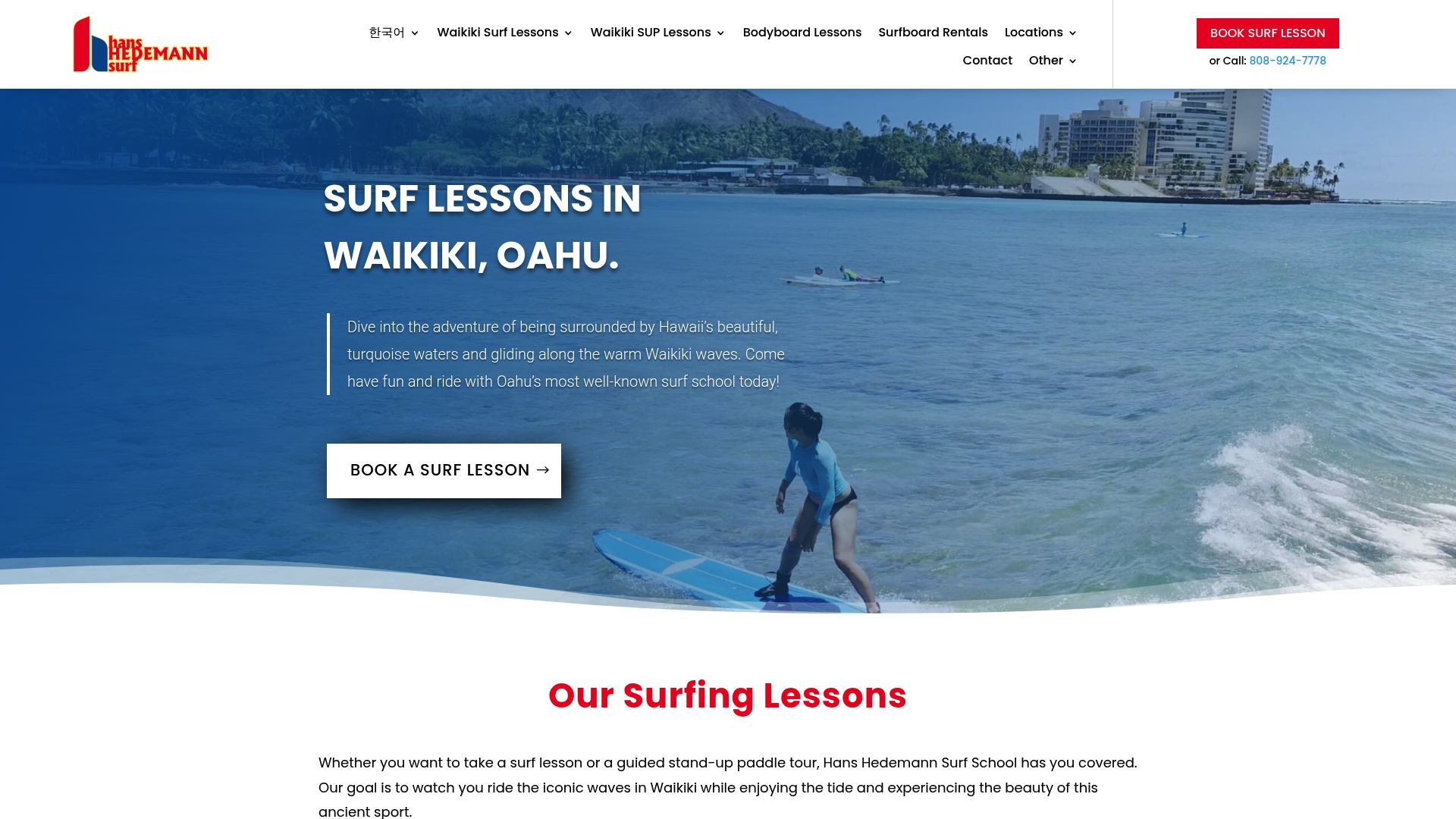
Students at Hhsurf consistently stand up on their boards within their first lesson. That result comes from patient, empathetic instructors who use structured land drills, celebrate every small win, and choose gentle Waikiki conditions suited to new surfers. Whether you are booking for yourself or your child, beginner surf lessons at Hhsurf deliver the safety, encouragement, and technique that first-time surfers need to build real confidence in the water.
FAQ
What certifications should a beginner surf instructor have?
A qualified surf instructor holds recognized credentials from the ASI or ISA, plus current First Aid and CPR water safety training. These certifications confirm the instructor can both teach effectively and respond to emergencies.
What is a safe instructor-to-student ratio for beginner surf lessons?
Reputable surf schools maintain a ratio of 1:3–5 instructors to students. Ratios beyond 1:6 reduce individual feedback and compromise safety oversight for beginners.
Why does emotional intelligence matter more than surfing skill for instructors?
Technical surfing ability does not translate directly into teaching ability. Instructors who read student fear, adapt their pace, and use positive reinforcement produce better learning outcomes than those who rely on personal skill alone.
What red flags should I watch for when choosing a surf instructor?
Key warning signs include no verifiable certification, large unmanaged groups, skipping land drills, dismissing student fears, and continuing lessons when ocean conditions worsen. Any one of these signals a poor fit for beginners.
How do I know if a surf lesson is structured for beginners?
Ask whether the instructor uses land drills before water entry, follows a written lesson progression, and limits group size. A structured beginner lesson starts on the sand with repeated takeoff drills before any student enters the water.
0 Comments