
Canoes is the best surf lesson location in Waikiki for beginners, thanks to its long, forgiving waves that make standing up on the first try realistic. Book a small-group or private lesson rather than a large class, and aim for an early-morning session when winds are calm. Queen’s is the natural next step once you can catch whitewater on your own. Confirm your school’s permitted meeting point before you show up.
TL;DR:
- Beginners should book lessons at Canoes early in the morning on calm days for the best chance of standing up quickly on forgiving waves.
- Lessons at White Plains and Canoes remain suitable for most of the year due to their gentler swell conditions, unlike other breaks that depend more on daily swell.
- A private lesson provides quicker progress with more personalized correction, while group lessons are more affordable and better for casual first experiences.
- The cost ranges from $100 for group lessons to $180 for private instruction, with extras like photos, videos, and transportation available separately.
- Confirm the location is within a permitted beach park, and check weather forecasts before booking, to ensure safety and compliance with local regulations.
Table of Contents
- Best Waikiki breaks for lessons and what makes each one work
- Which lesson format actually fits your goals
- What surf lessons and rentals typically cost in Waikiki
- What actually happens during a Waikiki surf lesson
- Why permits and location rules matter for your safety
- How to pick the right surf lesson provider
- Inside a Waikiki surf school’s teaching method
- Instructor perspective: what actually gets beginners standing up fast
- Book a Waikiki surf lesson built around your skill level
- Sources
- FAQ
Best Waikiki breaks for lessons and what makes each one work
Not every wave in Waikiki suits a first-timer, and picking the right break matters more than picking the right day. Canoes, near the Waikiki Canoe Club area, produces long, slow-rolling waves that give new surfers extra seconds to find their feet. It is widely regarded as the most beginner-friendly break in Waikiki, and it holds up as a learning spot for most of the year because the swell here stays gentle even when other spots get choppy, according to Moon Travel Guides.
Queen’s, sometimes called Queen’s Surf, is the logical next stop. The waves here have more shape and a bit more push, which rewards someone who has already caught a few whitewater rides and wants to practice angling down the line. Longboarders and early-intermediates tend to gravitate here once Canoes starts to feel too easy.
Pops, also known as Populars, and Puakenikeni, sometimes called White Plains, round out the progression. Pops sits farther offshore and breaks a little more consistently for intermediate riders, while White Plains offers a quieter, less crowded alternative on the west end of the south shore, a useful option when Waikiki’s main breaks fill up with tourists and longboards. Local surf guides note that Canoes and White Plains are the only Oahu spots considered genuinely beginner-appropriate through most of the year, while other breaks demand more attention to daily conditions according to Learn to Surf in Hawaii.
A few practical notes apply across all four spots:
- South shore swells run gentlest from late spring through early fall, though Canoes and White Plains stay rideable for beginners nearly year-round.
- Early morning, roughly 7 to 9 a.m., brings calmer wind and a glassier surface, which makes catching your first wave noticeably easier.
- Crowds build fast after mid-morning as rental stands and tour groups arrive, so an early booking also means more room to practice.
- Meeting points shift depending on which section of the beach a school is permitted to use, so confirm the exact spot the morning of your lesson.
Waikiki has more surf schools clustered along its shoreline than anywhere else in Hawaii, and that concentration of instructors, lifeguards, and rental stands is part of why it works so well for first-timers, according to Learn to Surf in Hawaii. Experienced surfers looking for a challenge should skip the learner breaks entirely. Steer clear of reef breaks like Ala Moana Bowls or Kaiser’s, which combine shallow reef with a crowded local lineup and are not suited to learning according to Moon Travel Guides.
Which lesson format actually fits your goals
Surf schools in Waikiki generally offer four formats, and the right one depends on how fast you want to progress and how much one-on-one coaching you want.
- Group lessons put four to six students with one instructor, splitting attention across the group but keeping cost lower, and they work fine for a first taste of surfing.
- Semi-private lessons pair two or three students with one instructor, giving each surfer more correction time while still sharing the session with a friend or family member.
- Private lessons are one-on-one, built for someone who wants to stand up quickly or work through a specific sticking point like timing or wave selection.
- Kids lessons adjust the pace and board size for younger surfers, usually with a tighter instructor ratio and extra attention to water safety.
Most formats include the board, a rash guard, and hands-on assistance getting into position for each wave, and many schools offer an on-water photo or video package as an add-on rather than a standard inclusion. The format you choose changes more than your budget. A crowded group lesson means less individual feedback on your pop-up, while a private lesson or semi-private session lets an instructor correct your foot placement wave by wave, which tends to shorten the time it takes to stand up consistently. Bodyboarding is worth considering too, particularly for younger kids or anyone who wants time in the water without the learning curve of standing up, and dedicated bodyboard lessons are widely available in Waikiki.
What surf lessons and rentals typically cost in Waikiki
Pricing in Waikiki varies by format, group size, and how much individual attention you want, but a few patterns hold across most schools.
- Group lessons generally run in the lower range per person, since the cost is split across several students.
- Semi-private lessons cost more per person than a group class but less than going fully private.
- Private, one-on-one instruction sits at the top of the price range and delivers the most direct coaching time.
- Board rentals without instruction are usually a flat daily rate, a cheaper option for someone who already knows how to surf and just needs equipment.
Waikiki has the highest concentration of surf schools of any surf destination in Hawaii, which keeps competition, and pricing, relatively transparent according to Learn to Surf in Hawaii. Most schools include the surfboard and a rash guard in the lesson price, so the only common extras are on-water photo or video packages, transportation to the beach if you are not staying nearby, and gratuity for your instructor, which is appreciated but not required. Booking in advance is standard practice in Waikiki, especially during peak season, and most schools have a cancellation window, typically 24 hours, so confirm that policy before you pay a deposit. If you are unsure whether to rent a board and paddle out on your own or book a guided lesson, a rental versus lesson comparison can help clarify which makes more sense for your skill level and budget.
What actually happens during a Waikiki surf lesson
A typical lesson follows a predictable arc, and knowing the sequence ahead of time takes a lot of the nervousness out of your first session.
- Check-in and gear fitting, where your instructor sizes your board and rash guard and gives a quick safety briefing.
- A land-based demo of the pop-up motion, practiced on the sand until the sequence feels natural.
- Shallow-water practice in the whitewater, where you get a feel for balance before dealing with an unbroken wave.
- Coached attempts at catching and standing on real waves, with your instructor pushing you into position and calling timing.
- A wrap-up, often including a quick debrief and any photos or video captured during the session.
A realistic goal for a first lesson is standing up on whitewater and riding it into shore a few times, not carving a full wave face. Early-intermediates can push further, working on angling down the line at breaks like Queen’s or Pops. Watch your instructor’s hand signals closely, since they are coordinating your timing with the wave behind you, and always paddle back out along the shoulder of the break rather than straight through incoming surfers.
Pro Tip: Keep your eyes on the beach, not the water, while you’re paddling into a wave. It helps you stay balanced and pop up square to the shore.
Why permits and location rules matter for your safety
Where a school can legally teach in Waikiki is not just a matter of convenience. The City and County of Honolulu issues commercial swimming and surfing instruction permits only for specific listed beach parks, and some parks are excluded from commercial instruction entirely under the city’s Department of Parks and Recreation rules according to City and County of Honolulu. That matters to you as a student for a few reasons:
- A permitted school has a confirmed, legal meeting point, which reduces the odds of a last-minute location change.
- Permitted operators coordinate with lifeguards on duty, which adds a layer of safety if conditions shift during your lesson.
- Schools without a clear permit status may be operating outside approved areas, which can affect both safety oversight and liability if something goes wrong.
Beyond permits, check conditions before you book. The National Weather Service Honolulu publishes daily surf forecasts and advisories for Oahu’s south shore, and it is worth a look the morning of your lesson. Booking early in the day also tends to sidestep the wind and crowding that build up by midday, giving you calmer water and more of your instructor’s attention.
How to pick the right surf lesson provider
A few direct questions before you book will tell you a lot about whether a school is worth your money.
- Ask where exactly the lesson meets and whether that location is a permitted city beach park.
- Ask how many years the instructors have taught in Waikiki specifically, not just how long they have surfed.
- Ask what the instructor-to-student ratio is for the format you are booking.
- Ask whether the school carries liability insurance and what safety protocols are in place if conditions change mid-lesson.
- Ask exactly what is included: board, rash guard, photos, and whether gratuity is expected on top of the listed price.
Red flags are usually easy to spot once you know to look for them: a vague or shifting meeting point, heavy pressure to add expensive extras before you have even seen a wave, or an instructor steering total beginners toward an intermediate break because it is less crowded. On the other hand, trust signals worth prioritizing include a clearly published safety protocol, instructor bios with real local experience, and reviews that specifically mention progress on the board, not just a fun day at the beach.
Inside a Waikiki surf school’s teaching method
Most effective surf instruction breaks the learning curve into two distinct phases. Land-based pop-up drills isolate the balance and footwork sequence before a student ever deals with a moving wave, which removes one variable at a time instead of overwhelming a first-timer with everything at once. Hands-on water coaching then layers in wave timing, positioning, and selection, with an instructor physically guiding the board into place for each attempt.

Hans Hedemann Surf School applies this same land-then-water structure across its Waikiki lesson formats: group lessons, semi-private, private, bodyboard lessons, and kids lessons, plus board rentals for surfers who already know the basics. The school’s instructors are professional surfers with local Waikiki experience, and the approach centers on individual attention rather than a one-size-fits-all class, aiming to get students riding waves within their first lesson.
Instructor perspective: what actually gets beginners standing up fast
Book the earliest slot you can get. Calm morning water forgives mistakes that afternoon chop will not. Pick a format that matches your patience level: private if you want fast correction, group if you are happy to watch and learn between turns. Listen for your instructor’s timing call more than you watch the wave itself, and expect small wins first. Standing on whitewater for a few seconds on lesson one is a real result, not a consolation prize.
— Johann
Book a Waikiki surf lesson built around your skill level
Hans Hedemann Surf School runs group, semi-private, and private lessons in Waikiki, with every session including your board and rash guard so there is nothing extra to arrange before you arrive.
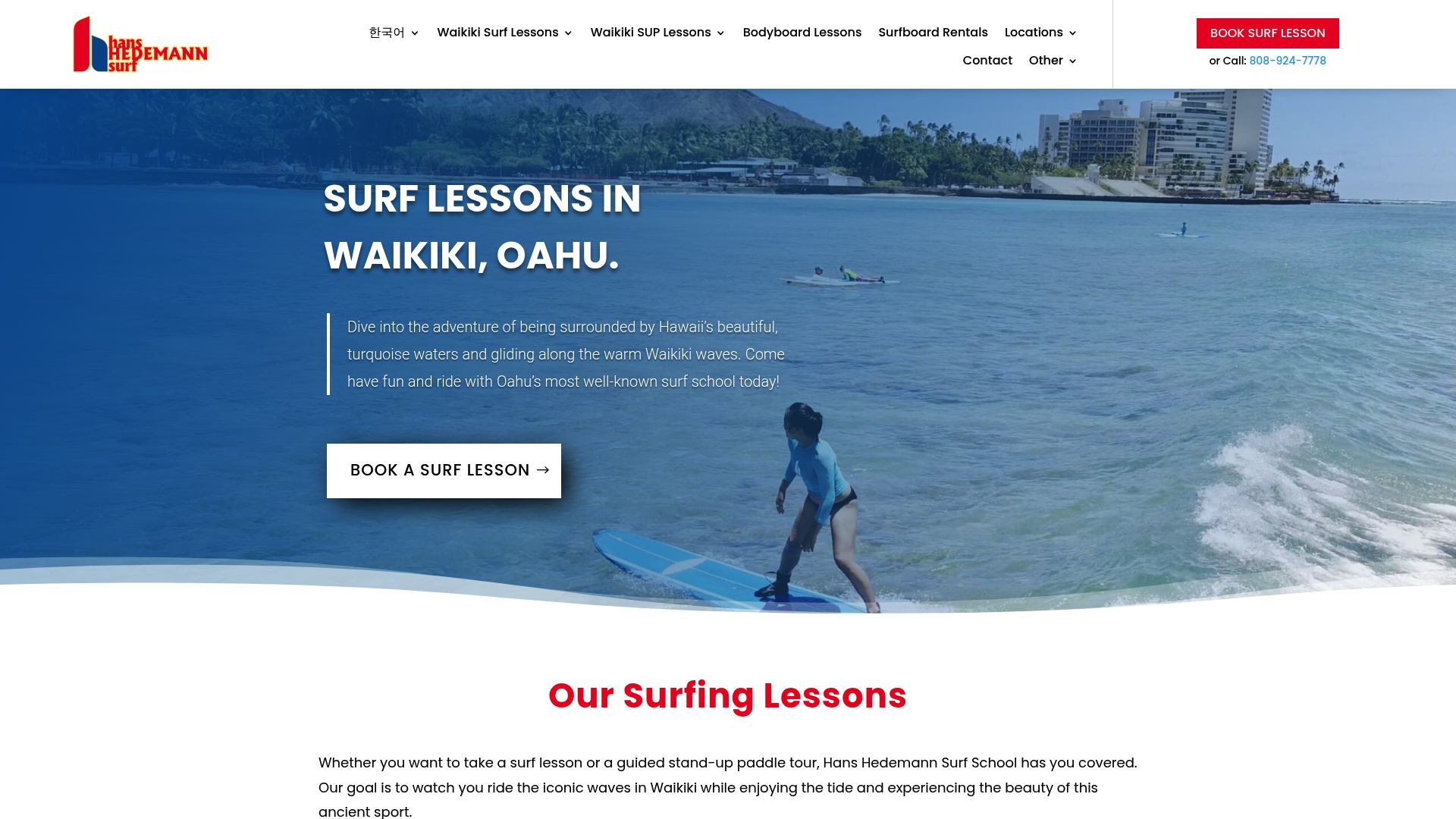
- Choose a group lesson if you want an affordable first try with a few other beginners.
- Book a private lesson for one-on-one coaching focused on standing up quickly.
- Add kids lessons for a family booking with instruction paced for younger surfers.
Instructors are professional surfers with decades of combined experience teaching on this exact stretch of coast, and every lesson keeps safety and individual attention at the center. Check availability and book your Waikiki lesson online today.
Sources
Permit details in this article come from the City and County of Honolulu’s commercial swimming and surfing rules. Break descriptions draw on Moon Travel Guides and Learn to Surf in Hawaii. Surf conditions should always be checked against the National Weather Service Honolulu forecast before you head to the beach.
- Best Surf Spots in Waikiki | Moon Travel Guides
- Best Beginner Surf Spots in Oahu | Learn to Surf in Hawaii
- City and County of Honolulu — Commercial Swimming and Surfing (Part IX)
- Surf Forecast for the State of Hawaii | National Weather Service Honolulu
FAQ
Where can I find the best surf lessons in Waikiki?
The best beginner lessons happen at Canoes, where long, slow waves give first-timers time to find their balance. Queen’s works well once you are ready for more shape and speed, and both breaks host multiple established surf schools with permitted meeting points.
How much does a surf lesson cost in Waikiki?
Group lessons start at $100 per person, semi-private lessons run $150 per person, and private one-on-one instruction is $180 per person. A premium option pairing you with a professional surfer, called Surf with a Pro, runs $400 per person.
Where is the best place to learn surfing for beginners in Hawaii?
Canoes and White Plains in Waikiki stand out because they hold beginner-friendly conditions for most of the year, unlike breaks that depend more heavily on daily swell direction according to Learn to Surf in Hawaii. Waikiki also has the largest concentration of surf schools in Hawaii, which means more instructors and lifeguards nearby if you need help.
What should I bring to a Waikiki surf lesson?
Bring sunscreen, a swimsuit you can move in, and water to stay hydrated between sets, since your board and rash guard are typically included in the lesson price. A towel and a change of clothes for afterward round out what you need.
Why do surf schools avoid certain Waikiki beaches?
Some Waikiki beach parks are excluded from commercial surfing permits under city rules, which means schools legally cannot hold lessons there regardless of how good the waves look according to City and County of Honolulu. Sticking to a permitted meeting point also keeps lifeguard coordination and safety oversight in place during your lesson.
0 Comments