
Check the online booking calendar first, then call if you need a slot the calendar doesn’t show. Waikiki surf schools, including Hans Hedemann Surf School, typically run multiple sessions a day, with mornings booking up fastest because the water is calmer and less crowded. Reserve your earliest convenient morning slot through the live booking widget, and you’ll lock in both the best conditions and the widest choice of add-ons.
TL;DR:
- Booking a morning group lesson is best for calm water and lower costs, but private lessons offer more flexible start times for tight schedules.
- Mid-morning remains the most popular window, especially during busy seasons, so booking two to three weeks ahead ensures availability for peak dates.
- Lessons last around an hour to an hour and a half, with front-loaded safety and technique instruction followed by in-water coaching.
- Checking real-time availability via the online booking calendar is faster and more accurate than calling or booking through hotels, especially during peak seasons.
- Booking early, especially for family or kids lessons, and arriving 15 to 30 minutes before start is crucial to avoid missing your session.
Table of Contents
- Group, Semi-Private, and Private Lessons: What Fits Your Schedule
- What Are the Best Times to Book a Surf Lesson in Waikiki?
- How Long Does a Surf Lesson Actually Last?
- How Do You Check Availability and Book a Lesson?
- What Does a Surf Lesson Cost, and How Does Price Affect Scheduling?
- What Should You Bring, and How Does Weather Affect the Schedule?
- What Are the Cancellation and Rescheduling Policies?
- How Far in Advance Should You Book?
- Where Do Lessons Meet, and How Do You Find the Spot?
- Are There Age or Skill Restrictions on Scheduling?
- What Travelers Get Right (and Wrong) When Booking a Surf Lesson
- Book Your Lesson With Hans Hedemann Surf School
- Where to Verify Times, Reviews, and Meeting Points
- Sources
Group, Semi-Private, and Private Lessons: What Fits Your Schedule
The lesson format you pick determines how much control you have over your start time. Group lessons run on fixed schedules, usually with a handful of set start times each day, because instructors need enough students signed up to make a session work. Semi-private lessons (two to four people booking together) often slot into those same time blocks but with more individual coaching per person.
Private lessons work differently. Because you’re not waiting on a group to fill, private surf lessons in Waikiki can often start earlier, later, or at an off-peak hour that a group class wouldn’t offer. That flexibility matters if you’re squeezing a lesson between a cruise excursion and a dinner reservation.
Here’s how the formats typically break down on a daily schedule:
- Group lessons: Fixed start times, usually multiple sessions per day, most popular in early and mid-morning.
- Semi-private lessons: Similar fixed windows to group lessons, smaller class size.
- Private lessons: Flexible start times, can often accommodate early or last-minute requests.
- Kids and family lessons: Scheduled around shorter attention spans, often mid-morning when kids are fresh and the beach is quieter.
- SUP and bodyboard lessons: Frequently run alongside surf sessions on a similar time grid.
Morning group sessions tend to sell out first, since they combine the best conditions with the lowest price point. If your travel dates are tight, book that slot as soon as your plans firm up rather than waiting.
What Are the Best Times to Book a Surf Lesson in Waikiki?
Most Waikiki surf lesson schedules cluster around several windows including early morning, mid-morning, and midday to early afternoon. A handful of schools add a late-afternoon session, but that’s less common and more weather-dependent.
Mornings are usually the smart pick for beginners. The water is generally calmer before the wind picks up, and Waikiki’s lineup hasn’t filled with other surfers, swimmers, and outrigger canoes yet. That’s not a scheduling gimmick, it’s a real difference in how easy it is to catch a wave without dodging traffic.
- Early morning: calmest water, best for nervous first timers.
- Mid morning: still good conditions, slightly busier lineup.
- Midday and afternoon: warmer air temperature, but more wind and more people in the water.
Holidays, cruise ship days, and peak season (roughly June through August, plus the winter holidays) push demand higher across every window. Booking two to three weeks ahead during those stretches gives you real choice instead of leftovers.
Pro Tip: If your trip dates are flexible, ask whether a weekday morning session has more openings than a weekend one. Weekday mornings are consistently the easiest slots to land on short notice.
How Long Does a Surf Lesson Actually Last?
A typical Waikiki surf lesson lasts about an hour to an hour and a half, split between land instruction and time in the water. Most schools front load the safety and technique portion so you’re not wasting water time fumbling with a board you don’t understand yet.
Here’s the usual sequence:
- Check-in and waiver (5 to 10 minutes): sign paperwork, confirm payment, get matched with your instructor.
- Land briefing (15 to 30 minutes): ocean safety, paddling technique, and practicing the pop-up on the sand.
- In-water coaching (about 60 minutes): your instructor positions you for waves and coaches you through the takeoff.
- Wrap-up (5 minutes): quick debrief, gear return, photo or video pickup if you booked one.
Most beginners stand up on at least one wave during that single lesson. Details on the exact surf lesson length breakdown in Waikiki can help you plan the rest of your day around it, especially if you’re stacking activities into one morning.
How Do You Check Availability and Book a Lesson?
The fastest way to see real open slots is the live FareHarbor booking calendar, which shows exact times still open on any given day and lets you reserve on the spot. This kind of live booking widget has become the standard across Waikiki’s surf schools, not just one operator, so you’ll see similar tools if you compare options elsewhere.
If you’d rather talk to a person, or you’re booking from somewhere with spotty Wi-Fi, calling the school directly works just as well. Some travelers also book through their hotel concierge. Several Waikiki resorts, including the Alohilani Resort, list surf school partnerships right on their activity pages, which is convenient if you’re already coordinating other excursions through the front desk.
- Online calendar: fastest, shows real-time openings, best for locking in a specific hour.
- Phone booking: useful for questions about group size, skill level, or custom requests.
- Hotel concierge: convenient if you’re bundling activities, though selection may be narrower than booking direct.
- If your ideal time is full: ask about a waitlist, a nearby time slot the same day, or switching to a private lesson, which has more scheduling room.
What Does a Surf Lesson Cost, and How Does Price Affect Scheduling?
Group lessons in Waikiki generally run on the lower end of the price scale, semi-private lessons cost more per person than group but less than private, and private lessons sit at the top of the range. Kids’ lessons are often priced similarly to group format but scheduled around shorter, more focused sessions.
Price and flexibility move together. A group lesson gets you a lower rate but locks you into a fixed start time. A private lesson costs more, but it buys you the ability to request an unusual hour, a same-day booking, or a start time that works around a flight departure.
- Group lessons: lowest cost, fixed schedule, best for budget-conscious travelers with open mornings.
- Semi-private lessons: moderate cost, small class, some schedule flexibility if the group books together.
- Private lessons: highest cost, most flexible start times, best for tight itineraries.
- Kids and family lessons: priced near group rates, scheduled for shorter, kid-friendly windows.
Expect a deposit at booking and a defined cancellation window, both of which tend to tighten during peak season when demand for every time slot goes up.
What Should You Bring, and How Does Weather Affect the Schedule?
Arriving late is the single most common reason a booked slot gets disrupted, since instructors run on a tight rotation between sessions. Plan to arrive 15 to 30 minutes before your scheduled start.
- Bring a photo ID and your booking confirmation so check-in goes fast.
- Wear a swimsuit or rash guard, and pack reef-safe sunscreen, since Hawaii restricts sunscreens containing oxybenzone and octinoxate near reef areas.
- Bring a towel and water, but leave valuables at your hotel.
- Expect a set instructor-to-student ratio, which keeps lessons safe but also means your session runs on schedule rather than waiting around for extra staff.
Conditions can shift a lesson. High surf advisories, strong wind, or unsafe currents can push a session to a different time or day. Schools will typically offer to reschedule rather than cancel outright.
Pro Tip: Pack your sunscreen and swimsuit the night before. Fumbling with gear in a hotel room fifteen minutes before checkout is the easiest way to walk in late and lose part of your lesson time.
What Are the Cancellation and Rescheduling Policies?
Most Waikiki surf schools require notice, commonly 24 to 48 hours before your scheduled time, to cancel or reschedule without a fee. Cancel or reschedule within that window and you’ll usually forfeit some or all of your deposit, since the instructor slot was held specifically for you.
Weather is the exception. If high surf, dangerous currents, or storms force a cancellation on the school’s end, most operators will rebook you at no extra cost rather than charge a rescheduling fee. That’s worth confirming at the time you book, since policies can vary slightly between group, semi-private, and private lessons.
If your travel plans are uncertain, ask about the exact cancellation window before you pay a deposit. Private lessons sometimes carry a longer notice requirement, precisely because that slot is harder for the school to fill on short notice. A group lesson, by contrast, may be easier to shift to a different day if another student can take your spot.
Building a buffer day into your itinerary, especially if you’re visiting during winter swell season when surf conditions change quickly, gives you a built-in backup without losing your deposit. Ask directly whether a missed lesson due to weather can roll over to a different date within your trip rather than being lost entirely.
How Far in Advance Should You Book?
For a standard group lesson during average season, booking three to five days ahead usually secures your preferred time. During peak season, roughly June through August and the winter holidays, push that to two to three weeks out, especially for morning slots.
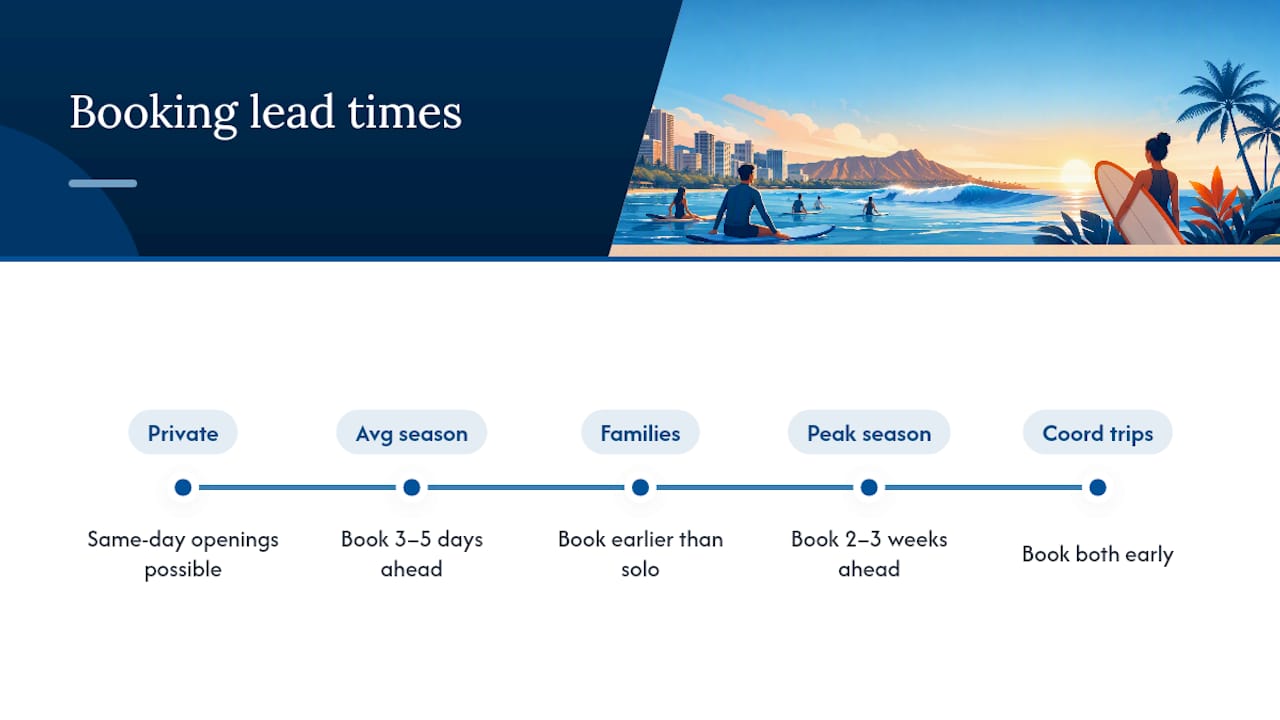
Private lessons benefit from earlier booking too, but they also tend to have more last-minute openings since fewer people commit to the higher price point without a set plan. If you land in Waikiki without a lesson booked, checking the live calendar the same day can still turn up a private slot even when group sessions are full.
Families booking kids surf lessons should book slightly earlier than solo travelers, since morning slots for younger students fill quickly. And if you’re coordinating a surf lesson around other big-ticket excursions on your trip, like a private whale watching charter, booking both early prevents a scheduling collision on your one flexible morning.
Where Do Lessons Meet, and How Do You Find the Spot?
Waikiki surf lessons meet at a designated beach stand, not a storefront, so knowing the exact meeting point matters more than it might for a typical tour. Most confirmation emails include a pin or address for the meeting spot, and it’s worth checking that against a map service before you leave your hotel.

Travel time from most Waikiki hotels to the beach stand is short, often a 10 to 15 minute walk, but that window shrinks fast if you’re carrying gear or navigating an unfamiliar street grid for the first time. Using a map or place listing to confirm the exact meeting point ahead of time removes the guesswork on the morning of your lesson.
If you’re staying outside the immediate Waikiki strip, build in extra travel time. A lesson that starts at 8:00 AM sharp doesn’t wait for a rideshare stuck in beach-parking traffic.
Are There Age or Skill Restrictions on Scheduling?
Age affects which lesson slot makes sense more than it restricts booking outright. Most schools welcome kids starting around age 5 to 6 for family and kids lessons, typically scheduled for mid-morning when energy and patience are both highest.
Skill level matters more for scheduling than most first-time visitors expect. Complete beginners are funneled toward standard group or private lessons regardless of age, while surfers with some experience might request a session focused on technique refinement rather than basics. That distinction affects which time slots are open to you, since some schools group students by skill level within a given session window.
There’s no upper age limit for group or private lessons, and instructors regularly work with older adults and first-time surfers well into their sixties and seventies. If you have physical limitations or specific concerns, mentioning them when you book helps the school match you with the right instructor and time slot rather than adjusting on the fly at check-in.
What Travelers Get Right (and Wrong) When Booking a Surf Lesson
The travelers who get the best experience are the ones who book their morning slot before their trip even starts, not the morning of. The two mistakes I see most often: waiting until arrival day to book, when the best slots are already gone, and underestimating how long it takes to walk from a hotel room to the beach stand with wet gear in hand afterward. Book early, arrive early, and let the instructors do the rest.
— Johann
Book Your Lesson With Hans Hedemann Surf School
Hans Hedemann Surf School is the direct route to a confirmed Waikiki surf lesson time, without the guesswork that comes from booking through a third party. Booking straight through the surf lesson page shows you real-time openings, not a stale schedule, and lets you add extras like a photo package the moment you reserve.

Whether you need a group session for the whole family, a private lesson that bends around a tight itinerary, or a kids-specific time slot, booking direct means the instructor roster, the meeting point, and the cancellation terms all come from the same source, with nothing lost in translation through a hotel desk or a booking agent. Pull up the live calendar, pick your morning slot, and confirm it before someone else takes it.
Where to Verify Times, Reviews, and Meeting Points
Confirm real-time openings on the FareHarbor booking calendar, then read firsthand accounts on TripAdvisor before you lock in your date.
Sources
- FareHarbor booking embed — HHSurf calendar
- Hans Hedemann Surf School reviews — TripAdvisor
- Alohilani Resort — school of surf / partner listing
- G
0 Comments