
Purpose-built prescription surf goggles or wraparound surf sunglasses are the safest way to handle vision correction in the water, full stop. If that gear isn’t available yet, most people fall back on one of two options, each with real trade-offs.
- Daily disposable contact lenses, worn with strict hygiene habits
- Everyday prescription glasses, modified with a buoyant frame and a secure strap
The catch with each backup option is specific: contacts carry an infection risk because water exposure lets microorganisms reach the eye, according to the FDA, while standard glasses risk breaking or washing away the moment a wave takes you down.
Key Takeaways
Purpose-built prescription surf eyewear beats both contacts and standard glasses because it’s the only option engineered to resist impact, block UV, and stay on your face during a wipeout.
| Point | Details |
|---|---|
| Choose surf-specific eyewear first | Impact-rated lenses and retention straps cut both loss and injury risk compared to alternatives. |
| Daily disposables if using contacts | Wear only single-use lenses, carry spares and saline, and discard immediately after water exposure. |
| Skip standard glasses in real surf | Regular frames break easily and rarely survive a wipeout intact. |
| Watch for infection and pterygium signs | Severe pain, discharge, or a growth on the eye’s surface needs prompt medical attention. |
| Get a private lesson if unsure | One-on-one instruction lets your instructor adjust pacing and positioning around your vision needs. |
Ready to test any of these options in real waves? Hhsurf’s private surf lessons in Waikiki give you one-on-one attention from an instructor who can adjust break selection and positioning around your vision correction setup, so your first sessions stay safe while you figure out what actually works for you.
Table of Contents
- Prescription Surf Goggles and Surf Sunglasses: The Safest Option
- Contact Lenses for Surfing: Daily Disposables Done Right
- Everyday Prescription Glasses: The Riskiest Backup Plan
- Comparing Your Three Options at a Glance
- Your Pre-Session Eyewear Checklist
- Watching for Eye Trouble: When to See a Doctor
- What Surf Instructors Actually Do for Students Who Wear Glasses
- What to Prioritize First
- Sources
Prescription Surf Goggles and Surf Sunglasses: The Safest Option
Purpose-built surf eyewear exists because regular glasses simply weren’t designed to survive a wipeout. The lenses are usually polycarbonate, which shrugs off impact far better than glass or standard plastic, and a good pair pairs that toughness with a hydrophobic coating so water beads off instead of blurring your view mid-ride.
Look for these features when you’re shopping:
- Polycarbonate or similar impact-resistant lenses
- An integrated strap or head tie, not just temple arms
- 100% UV protection, ideally rated against UVA and UVB
- Hydrophobic or anti-fog coating on the lens surface
- Buoyant frame material that floats if it comes off
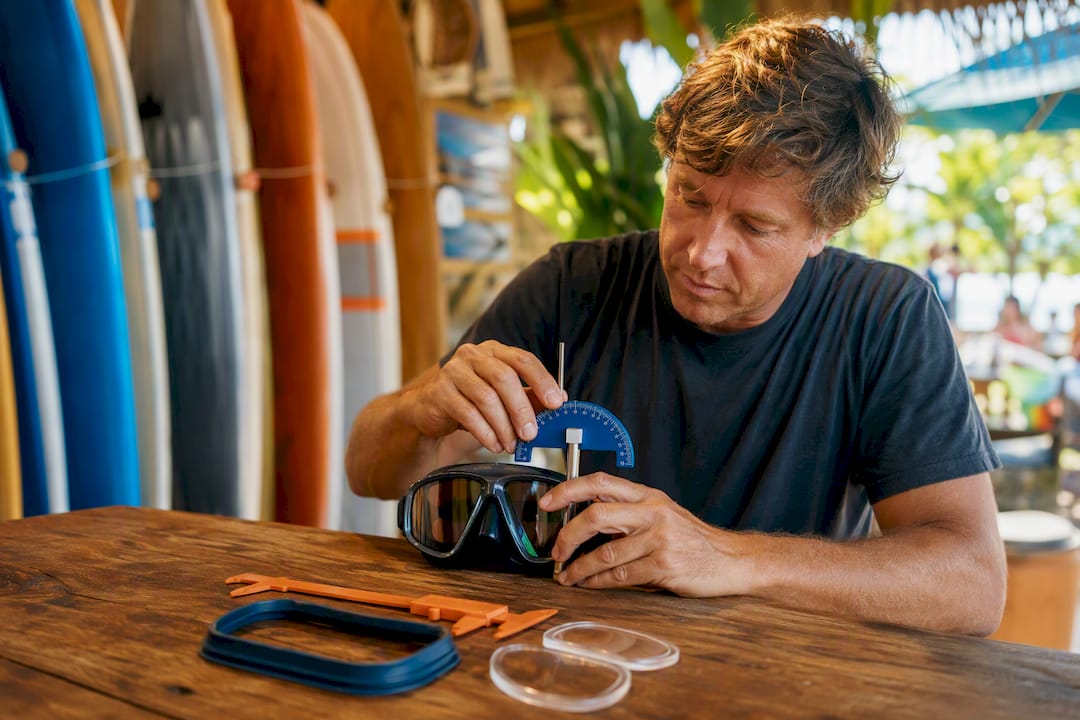
Prescriptions get built into surf eyewear one of two ways. Some brands grind your actual prescription directly into the lens, which gives the cleanest optical result. Others use clip-in prescription inserts that snap behind a standard tinted or clear lens, a setup that’s often cheaper to adjust as your prescription changes. Either way, talk to your optician before you buy. They can flag whether your astigmatism or lens strength works well with a curved, wraparound shape, since sharp curves can distort peripheral vision for some prescriptions.
Pro Tip: Bring your surf goggles or sunglasses to your next eye exam so your optician can check the fit and curvature against your actual prescription, not just guess from a catalog photo.
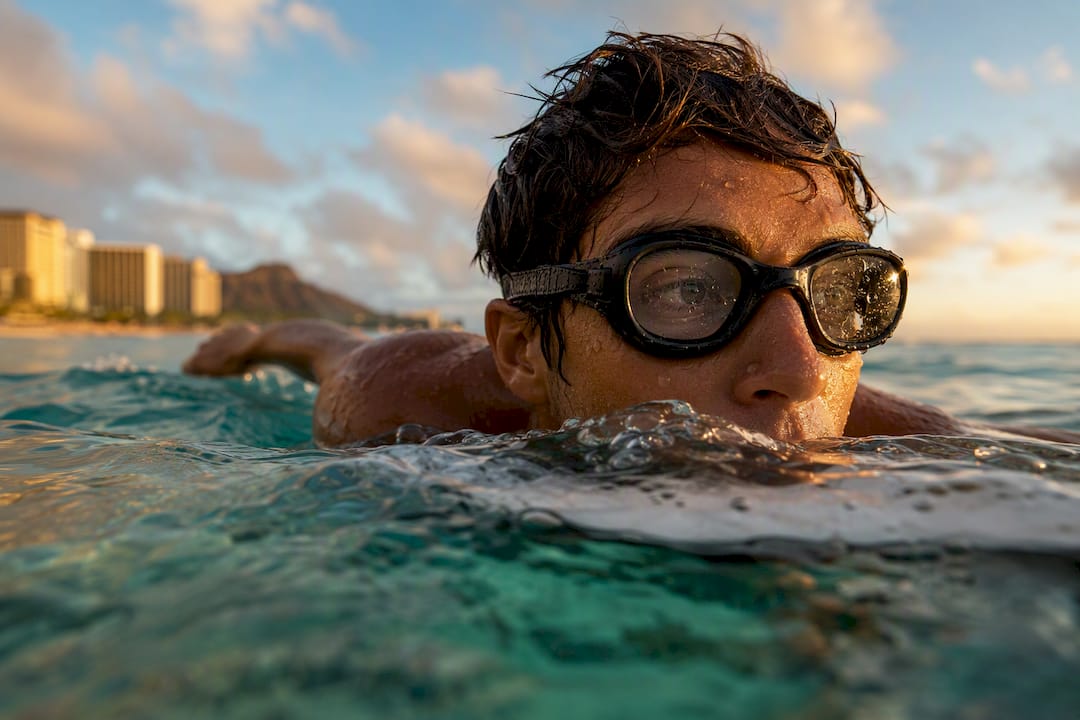
Compared to contacts, expect slightly reduced peripheral vision and a bit more weight on your face, but zero infection risk and a much lower chance of losing your correction mid session.
Contact Lenses for Surfing: Daily Disposables Done Right
Contacts remain the most popular workaround for surfers who want a wide, unobstructed field of vision, and it’s easy to see why: no frame, no fogging, nothing pressing on your temples during a duck dive. But the FDA warns against exposing any contact lens to water, because ocean, lake, and even tap water carry microorganisms that can trigger microbial keratitis, a serious corneal infection that can threaten your vision if it goes untreated.
If you’re going to surf in contacts anyway, daily disposables are the safer format, since you’re not reusing a lens that’s already been exposed to open water. A workable checklist looks like this:
- Wear daily disposables only, never monthly or extended-wear lenses, in the surf.
- Carry sealed single-use saline vials and a spare pair in a small watertight case.
- Remove your lenses immediately after your session, not hours later.
- Never reuse a lens once it’s touched ocean water, even if it seems fine.
- Close your eyes during duck dives and any moment your head goes under.
- Avoid rubbing your eyes in the water, and check for obvious water quality issues before paddling out.
Water-sport surveys suggest roughly two-thirds of contact-lens wearers lose at least one lens during activity, which is exactly why the spare pair matters as much as the saline.
Everyday Prescription Glasses: The Riskiest Backup Plan
Standard prescription glasses are the option surfers reach for out of convenience, and they’re also the one eye doctors are least likely to recommend. WebMD notes that regular glasses aren’t built for impact and can break near the eye during a fall, on top of the far more mundane problem: they come off in whitewater and sink.
If you’re determined to wear your regular glasses for a session anyway, a few adjustments cut the risk meaningfully:
- Choose plastic or buoyant frames over metal, which sinks fast and holds a sharper edge if it breaks
- Attach a proper retention strap designed for water use, not a random shoelace
- Stick to smaller, low-swell days rather than anything with real power behind it
- Keep a spare pair on the beach and a spotter who knows to watch for you
Honestly, if the swell has any real size or the lineup is crowded, leave the glasses on the towel and go with contacts or borrowed goggles instead. No frame is worth a corneal scratch.
Comparing Your Three Options at a Glance
Every option trades safety for convenience somewhere. Here’s how the three stack up across the factors that actually matter in the water.
- Impact safety: Surf goggles and purpose-built sunglasses rank highest, contacts carry no impact risk at all since there’s no frame, and regular glasses rank lowest.
- Infection risk: Contacts carry the highest risk due to water exposure; goggles, sunglasses, and regular glasses carry essentially none.
- Loss risk in waves: Regular glasses are the most likely to disappear in whitewater; surf goggles with retention straps are the least likely; contacts fall in between, since a strong wipeout can still dislodge them.
- Vision and peripheral clarity: Contacts win here, closely followed by well-fitted surf goggles; regular glasses trail behind due to frame edges cutting into your side vision.
- Convenience and cost: Contacts are cheapest to start; purpose-built surf eyewear costs more upfront but pays off over repeated sessions.
A simple rule of thumb: if you surf often or have a strong prescription, invest in dedicated surf eyewear. If you’re trying surfing once on vacation, daily disposables are the more practical call.
Your Pre-Session Eyewear Checklist
Getting your gear right before you paddle out saves you from fumbling with it once you’re already in the lineup.
- Pack sealed saline vials or single-use rinse packets, not a shared bottle.
- Bring spare daily disposables in a small watertight case, even for a short session.
- Pack a microfiber cloth and your surf goggles’ strap or leash.
- Choose sunscreen labeled sweat-resistant so it doesn’t run into your eyes and sting.
- Fit-check your goggles or sunglasses on the beach, tightening the strap enough to stay put without pinching.
- Simulate a duck dive on the sand, head down, to confirm nothing slips.
- Attach any tether short enough that it can’t wrap around your neck.
- After your session, remove contacts immediately and rinse your eyes with clean water if they feel irritated.
- Clean and fully dry your surf eyewear before storing it, so no residue builds up.
Pro Tip: Do the duck-dive simulation on dry sand before every session, even one you’ve done a hundred times. Straps loosen over months of use, and you want to know that on the beach, not underwater.
Watching for Eye Trouble: When to See a Doctor
Water exposure and impact both carry real medical risk, and it helps to know what’s normal irritation versus what needs a professional. The FDA’s guidance is unambiguous: don’t expose contact lenses to water, since the infection risk from microbial keratitis is serious enough to threaten vision. Separately, UV exposure and chronic wind or salt irritation raise the risk of pterygium, sometimes called surfer’s eye, a growth on the eye’s surface tied to years of sun and particle exposure without proper protection.
Watch for these red flags:
- Severe or worsening eye pain, especially after wearing contacts in water
- Sudden vision changes or persistent blurriness
- Discharge, unusual redness lasting more than a day, or light sensitivity
- A visible growth or thickening on the white of the eye that doesn’t fade
Any of those symptoms after a surf session warrants a same-week visit to an eye doctor, not a wait-and-see approach. Bring photos or specs of the eyewear you were using so your doctor can weigh in on whether it’s actually protecting you.
What Surf Instructors Actually Do for Students Who Wear Glasses
Instructors who teach beginners regularly see students show up worried about their vision, and the adjustments are usually simple. Positioning matters most: keeping a student closer during instruction lets an instructor read their reactions faster and call out hazards sooner.
Common adjustments include:
- Choosing gentler, more predictable breaks for the first lesson
- Adding an extra spotter when a student can’t see approaching waves clearly
- Practicing falls with eyes closed on land first, so the motion feels familiar before it happens in surf
- Encouraging students to speak up immediately if their vision correction shifts or slips during a session
Small-group settings make these adjustments realistic in a way a crowded lineup never allows, which is part of why beginner-focused instruction tends to work better for anyone managing a vision limitation in the water.
What to Prioritize First
Most advice on this topic treats contacts and glasses as equally valid choices, and that’s where it falls short. They’re not equal. Contacts trade a real, documented infection risk for convenience, and regular glasses trade near-certain loss or breakage for familiarity. Purpose-built surf eyewear is the only option built specifically to survive what surfing actually does to a face.
The conventional wisdom also undersells how much fit and prescription accuracy matter. A surf goggle bought off a rack without checking curvature against your astigmatism can distort your vision worse than wearing nothing corrective at all. That’s a detail most gear roundups skip entirely.
If you’re serious about surfing more than once, skip the contacts-versus-glasses debate and go straight to dedicated eyewear, fitted properly. If you’re testing the water on a single trip, daily disposables with strict hygiene are a reasonable stopgap, but they’re a stopgap, not a long-term plan. Prioritize fit and impact resistance over price every time you’re deciding what to wear in the lineup.
— Johann
Sources
- Pterygium (Surfer’s Eye) — WebMD
- Contact lens risks — U.S. Food and Drug Administration (FDA)
- Pterygium (surfer’s eye) — Cleveland Clinic
- Wearing contacts for water sports — WearSurfGlasses
This article is general information, not a substitute for advice from a qualified doctor. Consult a qualified healthcare professional about your own circumstances before acting on anything here.
0 Comments