
Yes, swimming is required for surfing. You don’t need to be a competitive swimmer, but you should be able to float, tread water for a couple of minutes, and swim a short distance without panicking. If that’s not you yet, the smart move is swim lessons first, or a strictly supervised shallow-water surf lesson designed for non-swimmers.
TL;DR:
- Most surf instructors require beginners to swim 75 to 100 meters and tread water for two to five minutes to ensure they can self-rescue in open water.
- Ocean conditions, currents, and waves make surf swimming harder than pool tests, even for those who pass in calm, shallow water.
- Non-swimmers can still take lessons in shallow water with instructor supervision or practice balance and paddling in wave pools.
- Safety protocols include confirming swim ability, limiting water depth, and maintaining low student-to-instructor ratios during lessons.
- Building swimming confidence through targeted drills in the pool is essential for safety and can significantly improve surf readiness within weeks.
Table of Contents
- Is Swimming Required for Surfing, and How Good Do You Need to Be?
- Why Swimming Matters More Than You Think in Surfing
- Can Non-Swimmers Still Take Surf Lessons?
- How Surf Instructors Actually Manage Beginner Safety
- Swim Drills That Actually Prepare You for Surfing
- What to Ask a Surf School Before You Book
- An Honest Take on Swimming Before You Surf
- How Hans Hedemann Surf School Builds Swimming Confidence into Every Lesson
- Sources
Is Swimming Required for Surfing, and How Good Do You Need to Be?
Most surf instructors aren’t looking for lap-swimming champions. They’re looking for a specific, testable baseline: can you keep yourself calm and afloat if things go wrong?
The benchmark that shows up again and again in instructor guidance is swimming three to four pool lengths and floating or treading water for a few minutes. Other practical guidance points to comfort treading water plus swimming around 100 meters as a reasonable target before you paddle out unsupervised.
Statistic: A common instructor test asks students to swim 3 to 4 pool lengths (roughly 75 to 100 meters) and tread water for one to five minutes. That’s the working line most reputable schools use to decide who’s ready for open water versus who needs a controlled setup first.
You can run this test on yourself before you ever book a lesson:
- Swim four lengths of a 25 meter pool without stopping to hang on the wall.
- Tread water or float for two full minutes while breathing normally.
- Swim 25 meters using only a breaststroke or basic front crawl, no fins.
- Try it once fully clothed, since a rash guard and boardshorts drag differently than a swimsuit.
Ocean conditions make all of this harder than the pool version. Waves push against your rhythm, currents add resistance you don’t control, and a wetsuit adds buoyancy but also weight and drag when you’re swimming against it. A person who breezes through the pool test might still find open water humbling on day one.
Why Swimming Matters More Than You Think in Surfing
Surfing puts you in the water without your board more often than beginners expect. You fall. The leash snaps. A wave holds you under for a few seconds longer than feels comfortable. None of that is dangerous if you can swim and stay calm. All of it can turn dangerous if you can’t.
The scenarios where swim skill isn’t optional:
- Wipeouts far from shore. You need to swim back to your board or to shore under your own power, sometimes against a current.
- Rip currents. These pull you away from the beach; the standard escape is swimming parallel to shore until you’re out of the pull, not fighting straight against it.
- Lost boards. Leashes break. If yours does, you’re swimming, period.
- Breath control during hold-downs. Panic burns oxygen fast. Calm floating burns far less.
Pro Tip: If you feel a current pulling you sideways, don’t fight it head-on. Swim parallel to the beach first, then angle back in once you’re clear of the pull.
A leash, a life vest, or a soft-top board can help, but none of them replace the ability to self-rescue. Reputable surf schools are blunt about this: flotation gear reduces risk, it doesn’t eliminate the need for real swim competence.
Can Non-Swimmers Still Take Surf Lessons?
There’s a narrow but real path for people who can’t swim well yet, and it looks nothing like a regular surf lesson.
- Shallow-water, instructor-in-water sessions. Some programs designed for non-swimmers keep the water between waist and chest depth the entire time, with an instructor physically in the water beside the student, and they schedule around tides to guarantee that depth stays consistent, as described in detail in this overview of pavasara aktivitātes Latvijā.
- Controlled artificial waves. Wave pools and FlowRider-style attractions let you practice balance and pop-up mechanics without ocean hazards like rip currents or unpredictable swell. They’re a fine confidence builder, but they teach board feel, not ocean survival.
- Standard ocean lessons for confident swimmers. This is the default format, and it assumes you can self-rescue if separated from your board.
The red flag to watch for: any school willing to put you in chest-deep-or-deeper open water without confirming you can swim first. That’s not flexibility, it’s a shortcut around a safety check that exists for a reason.
How Surf Instructors Actually Manage Beginner Safety
A good instructor isn’t just teaching pop-ups. They’re running a small risk-management operation every single session.
Common protocols include an informal swim check before anyone touches a board, careful selection of tide windows so the water stays waist to chest deep for beginners, and tight instructor-to-student ratios so nobody drifts unnoticed. Lesson progression typically moves from lying prone on the board with hands-on support, to catching small whitewater waves with the instructor nearby, to standing up only once that foundation feels solid.
- Swim ability confirmed before water entry
- Session timed to a tide window that limits depth
- Low student-to-instructor ratio during the standing progression
- Lessons paused or moved if wind, swell, or crowding changes the risk picture
At Hans Hedemann Surf School, that same logic shapes how Waikiki surf lessons are run: instructors work in the water with beginners rather than shouting instructions from the sand.
A calm, controlled shallow-water start does more for a nervous beginner’s confidence than any amount of encouragement from shore. Getting the depth and pacing right is what actually keeps people safe while they learn.
Instructors will delay or reshape a lesson when conditions shift, even mid-session, rather than push through for the sake of the schedule.
Swim Drills That Actually Prepare You for Surfing
You don’t need a swim coach to close the gap between “can swim” and “surf ready.” A few weeks of targeted pool time makes a real difference.
- Float and tread drills. Practice floating on your back for two minutes, then treading water for two more, twice a week.
- Breath control sets. Do underwater breath holds of 15 to 20 seconds between laps to build the calm you’ll need during a hold-down.
- Short swim sets. Start with four pool lengths and add one length per week until it feels easy.
- Open-water practice. Once the pool feels simple, try the same drills in a calm lake or protected bay with a buddy watching.
Paddling strength and core endurance carry over directly, so pairing swim drills with cross-training for surfers speeds up the whole process.
Pro Tip: Practice treading water in the clothes you’ll actually surf in, not a swimsuit. Boardshorts and rash guards change how your body sits in the water.
What to Ask a Surf School Before You Book
Booking pages don’t always spell out swim requirements, so ask directly before you show up.
- “Do you run a swim test, and what does it involve?”
- “Will an instructor be in the water with me the whole time?”
- “What’s the maximum water depth during a beginner lesson?”
- “What’s the student-to-instructor ratio in group lessons?”
If your swimming is shaky, say so plainly and ask about a private lesson or a morning low-tide session instead of guessing your way through a group class.
| What to check | Why it matters |
|---|---|
| Swim test or informal check | Confirms the school actually screens for readiness |
| In-water instructor support | Reduces response time if something goes wrong |
| Max session depth | Waist to chest depth is the safer beginner range |
| Group size | Smaller groups mean faster help if you need it |
An Honest Take on Swimming Before You Surf
Encouragement first: almost anyone can get to “surf ready” swimming level with a few weeks of consistent pool practice. The bar is genuinely not high. It’s calm floating, short-distance swimming, and comfort with your face in the water, not athletic swimming.
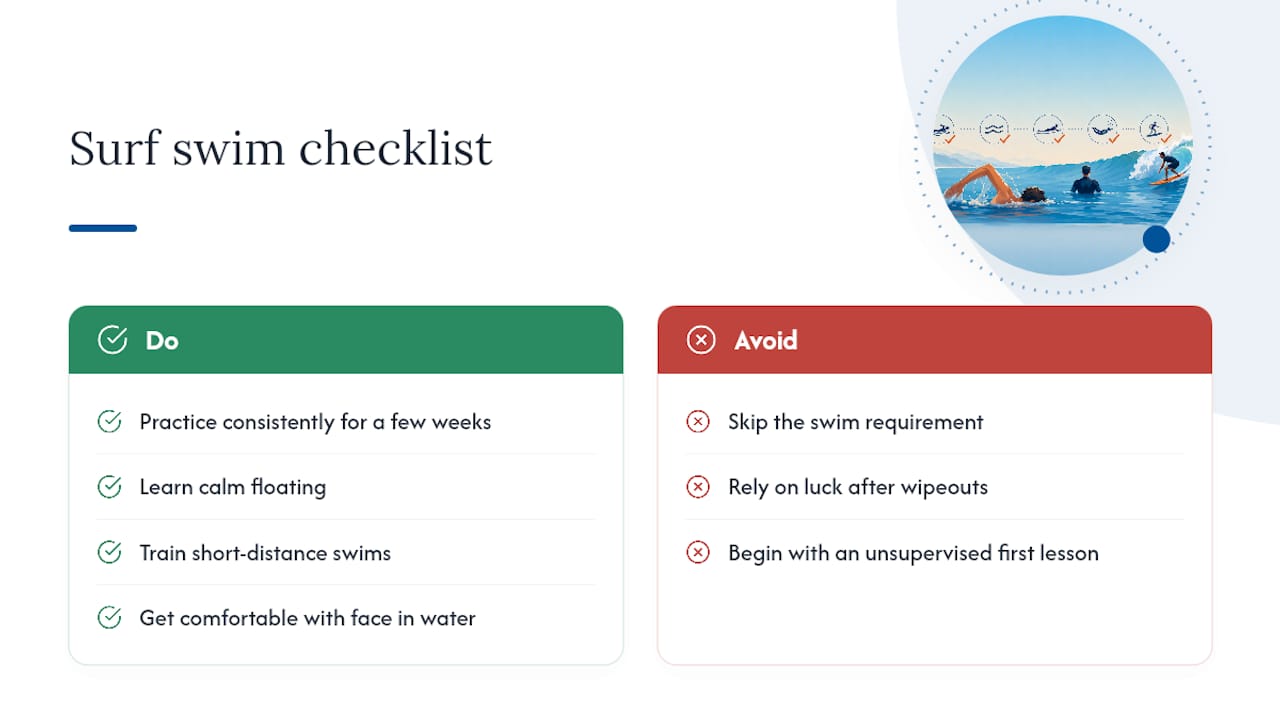
Here’s the part beginners underrate: the swim requirement isn’t a gatekeeping formality schools invented to sound serious. It’s the single biggest predictor of whether a bad wipeout stays a non-event or becomes a real problem. Skip it, and you’re betting your safety on nothing going wrong. Handle it first, and a supervised first lesson becomes what it should be: exciting, not risky.
If you’re already comfortable in water, pair a little extra practice with a properly supervised first lesson, and let the instructor take it from there.
— Johann
How Hans Hedemann Surf School Builds Swimming Confidence into Every Lesson
First-timers, tourists on a short Waikiki trip, and families with mixed ability levels tend to get the most out of a lesson built around in-water instruction rather than shouted directions from the beach. Some surf schools use in-water instruction, with sessions progressing from prone paddling to standing only once the basics feel solid, and shallow-water zones to keep the learning curve manageable for nervous beginners.

If your swimming is a little rusty, a private lesson gives you one-on-one attention and lets the pace adjust to your comfort level instead of the group’s. If you’re already confident in the water, a standard Waikiki surf lesson gets you standing up faster than you’d expect. Either way, book ahead of your trip so you land a morning slot when the water tends to be calmest.
Sources
For a deeper look at the numbers and policies behind this guide: SELF breaks down the swim benchmarks instructors commonly use, Surf Club Maui explains its no-exceptions swim policy, Xanadu Surf covers fitness and swim readiness, and GetYourGuide documents how non-swimmer lessons manage water depth.
- 9 Things You Need to Know Before Going Surfing for the First Time | SELF
- Learn to Swim Before Learning to Surf | Surf Club Maui
- What level of fitness is required to learn surfing? | Xanadu Surf
0 Comments