
Taking turns while surfing means waiting your position in the lineup and yielding priority to whoever sits closest to the breaking peak. That’s the whole rule. Follow it and you cut the odds of a board-to-head collision, keep the vibe in the water friendly, and actually get more waves over the course of a session, because nobody’s fighting for the same peak at once.
This isn’t some quirky local custom limited to one beach. Surfing England teaches it as a core safety habit, groups like WAHA Surf spell it out in their lineup guidance, and it’s one of the first things instructors at Hans Hedemann Surf School drill into first-timers before they ever paddle past the whitewater. The rule sounds simple. Applying it in a moving, unpredictable lineup is where most beginners get stuck.
Key Takeaways
Taking turns in surfing means yielding priority to whoever sits closest to the peak, and mastering that one habit prevents most lineup collisions and conflicts.
| Point | Details |
|---|---|
| Core definition | Taking turns means waiting your position and yielding to the surfer closest to the peak. |
| Priority cues | Proximity to the peak, depth on the wave, and rotation order all determine who goes next. |
| Main breaches | Dropping in, snaking, and aggressive back-paddling are the top causes of lineup conflict. |
| Mistake repair | Check for injury, control your board, move to whitewater, then apologize clearly and specifically. |
| Supervised practice | Hans Hedemann Surf School builds lineup positioning and rotation drills directly into its lessons. |
Table of Contents
- What Taking Turns Looks Like in Practice: Priority and Right-Of-Way
- Dropping In, Snaking, and Back-Paddling: The Big Three Breaches
- How to Avoid Lineup Conflicts
- What to Do If You Make a Mistake
- Etiquette in Crowded Lineups and Respecting Locals
- Beginner’s Quick Checklist and Memory Aid
- How Instructors Teach Taking Turns
- Learning the Lineup the Hard Way (and the Better Way)
- Practice Lineup Etiquette Where It Actually Counts: In the Water
- Frequently Asked Questions
- Sources
What Taking Turns Looks Like in Practice: Priority and Right-Of-Way
Priority in a lineup isn’t decided by seniority or who’s the best surfer out there. It comes down to position, and specifically, who’s closest to the peak when a wave starts to break.
A few cues determine who goes:
- Proximity to the peak. The surfer sitting nearest the spot where the wave first breaks gets first right to it.
- Depth on the wave. If two people are paddling for the same wave, whoever is further into the curl (deeper) has priority over someone catching it from the shoulder.
- Position in the rotation. Lineups run on an informal rotation where surfers who’ve been waiting longest, without catching a wave, often get an unspoken nod from others.
Lineups form as clusters of surfers sitting near a break, watching the horizon and adjusting position as sets roll in. According to Surf Learner’s breakdown of how lineups work, the rotation isn’t written down anywhere. It’s just paddlers taking a wave, riding it out, then paddling back and rejoining near the back of the pack rather than muscling into the front again.
Here’s a scenario that plays out at almost every beginner-friendly break: two paddlers spot the same swell forming. One is sitting fifteen feet closer to where the wave will actually break; the other is further out on the shoulder. The surfer closer to the peak has priority, full stop, even if the other paddler started stroking first. The correct move for the outside surfer is to let it go and wait for the next one.

Dropping In, Snaking, and Back-Paddling: The Big Three Breaches
Most lineup conflict traces back to one of three moves, and knowing what they look like helps you spot them before you accidentally commit one yourself.
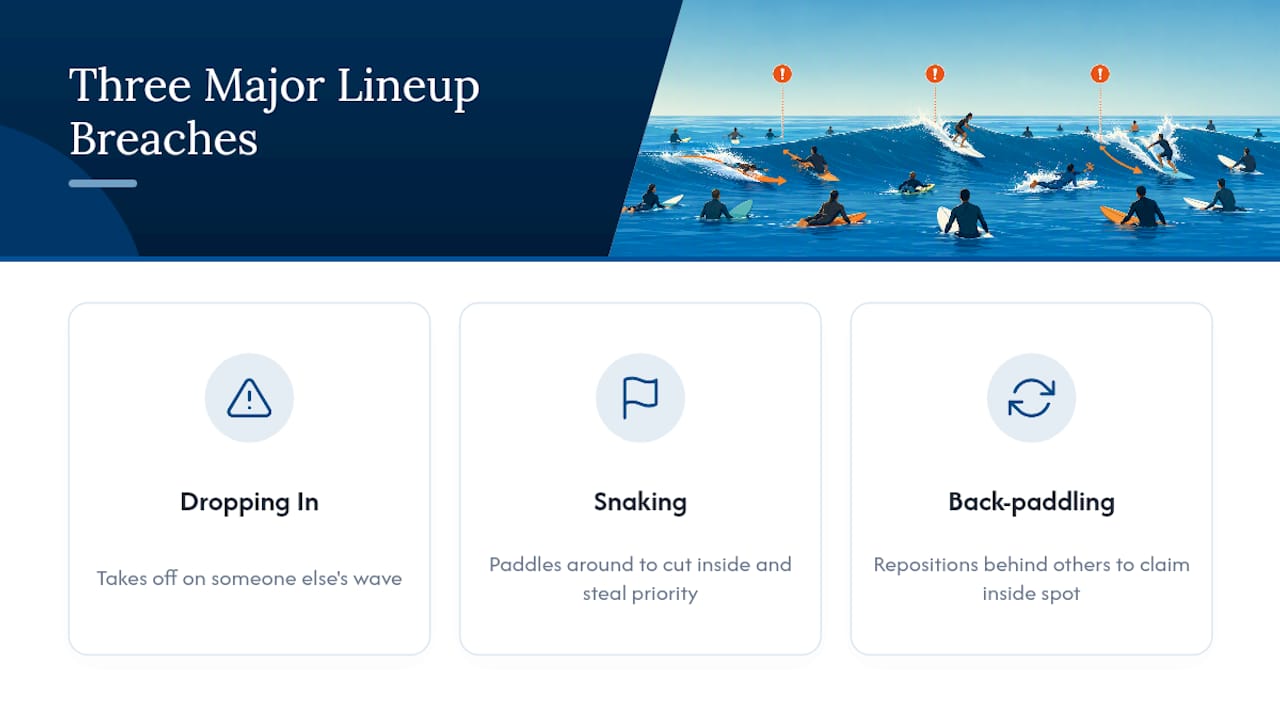
Dropping in means taking off on a wave someone else is already riding, usually because the second surfer either didn’t look or didn’t care who had priority. Surfer calls this out as one of the fastest ways to end up in a shouting match, and for good reason: two surfers converging on the same wave at speed is a real collision risk, not just an annoyance.
Snaking is sneakier. It’s when a surfer paddles around another person, cutting inside them to steal the priority position right as a set approaches. Billabong’s surf rules guide describes both moves as deliberate breaches that create friction because they’re rarely accidental. Everyone in the water can see it happening.
Aggressive back-paddling is the more subtle cousin: constantly repositioning behind other surfers to claim the inside spot on every set, wearing people down through sheer persistence rather than one obvious violation.
The social fallout is predictable. Locals stare, someone yells “my wave,” and repeat offenders get frozen out of a lineup entirely. That said, an honest mistake, misjudging distance in a chaotic peak, isn’t the same as a deliberate snake. A quick apology (more on wording below) usually defuses it. Deliberate, repeated breaches are what actually damage a surfer’s reputation at a spot.
How to Avoid Lineup Conflicts
Good positioning prevents most conflicts before they start. Here’s the sequence experienced surfers run through almost automatically:
- Read the lineup before paddling out. Watch for five minutes from the beach or the channel. Note where waves are peaking and who’s sitting where.
- Position slightly wide of the main peak at first. Don’t paddle straight into the most crowded spot on your first wave of the session.
- Check over your shoulder toward the peak every single time before you commit to paddling for a wave. Surfing England’s safety guidance treats this as a non-negotiable habit, not an optional extra.
- If someone’s closer to the peak, pull back. Stop paddling, let the wave go, and reposition for the next one.
- Commit fully once you’ve confirmed priority. Half-hearted paddling into a wave you have every right to take causes as much confusion as taking a wave you shouldn’t.
Pro Tip: Instructors often tell new surfers to start lower and wider than they think they need to, then paddle incrementally closer to the peak wave by wave as they get a feel for the lineup’s rhythm. Trying to sit right on the peak from your very first wave is how most beginners end up in someone else’s way.
Communication matters as much as positioning. A raised hand or a shouted “go!” tells another surfer you’re yielding. Eye contact before a set arrives often settles a priority question without a word said. These small, nonverbal cues, a nod, a glance, a hand wave, are what keep experienced lineups running smoothly even when nobody’s spoken.
What to Do If You Make a Mistake
Everyone drops in on someone eventually, usually early on, usually by accident. What you do in the next thirty seconds matters more than the mistake itself.
- Check for injury first. Yours and theirs. A collision that looked minor from the beach can still bruise a rib or crack a board.
- Keep control of your board. A loose board is a bigger hazard to everyone nearby than the initial mistake.
- Move toward the whitewater or the channel, away from the takeoff zone, so you’re not blocking the next wave for someone else.
- Apologize clearly and specifically: something like “Sorry, I didn’t see you, that’s on me” goes a long way toward defusing tension.
If the other surfer seems shaken or the board contact was serious, stick around to make sure they’re okay before paddling off. If it was a minor mixup and everyone’s fine, a quick apology and moving on is usually enough. Lingering to over-explain tends to prolong the awkwardness rather than fix it.
Etiquette in Crowded Lineups and Respecting Locals
Crowded breaks and unfamiliar spots raise the stakes on all of this. A few behaviors separate a respected visitor from someone who gets frozen out fast:
- Ask before paddling directly into an established group sitting tight on the peak, rather than just muscling your way in.
- Avoid dropping into the exact peak locals are working during an obvious set, especially at a spot you’re surfing for the first time.
- Spread out to a secondary peak nearby if the main lineup already looks packed.
- Watch for ten or fifteen minutes before paddling out anywhere new. Local rotation patterns usually become obvious if you pay attention.
Sometimes the right move is simply paddling somewhere else. If a peak is dominated by a tight group of regulars who clearly know each other and the wave, forcing your way in creates friction nobody needs, especially over a wave you can probably find break somewhere else nearby.
It’s also worth knowing that etiquette isn’t identical at every break. According to Barefoot Surf Travel’s guide for beginners, reef breaks and point breaks with one clear takeoff zone tend to keep orderly rotations, while beach breaks with multiple shifting peaks often run looser, less formal etiquette. What counts as respectful in Waikiki won’t necessarily match a heavy reef break elsewhere. Read the room, not just the wave.
Beginner’s Quick Checklist and Memory Aid
Under pressure, in the moment, with a set rolling in, it’s easy to forget everything you just read. A short mental checklist fixes that.
- Position yourself slightly wide of the peak until you’ve read the rotation.
- Peak check: glance over your shoulder before every wave you consider paddling for.
- Wait your turn if someone’s closer or deeper.
- Paddle with full commitment once priority is confirmed.
- Say “nice one” to the surfer who caught the wave, win or lose.
If you want a five-letter shortcut, try PAUSE: Position, Assess the lineup, Understand who has the peak, Signal your intention, then Execute. Run through it mentally every ten or fifteen minutes during a session, especially as the crowd shifts or a new set of surfers paddles out. Lineups change fast, and the mental checklist that worked twenty minutes ago might need a quick update.
How Instructors Teach Taking Turns
Watching from the beach only gets a new surfer so far. Instructors close that gap by putting beginners through drills that simulate real lineup pressure before they’re actually dealing with it.
Common teaching methods include:
- Positioning drills where students practice sitting at different spots relative to a simulated peak and identifying who’d have priority.
- Simulated rotations on smaller, controlled days so students can practice paddling back out and rejoining a line without real consequences for a mistake.
- Guided returns to the lineup after every ride, where an instructor talks a student through where to paddle back to rather than just charging straight back to the peak.
According to Hans Hedemann Surf School’s lesson overview, pairing these drills with real-time coaching in the water speeds up the learning curve considerably compared to figuring it out through trial and error. A beginner who’s practiced reading a peak with an instructor at their side tends to internalize the timing and the nonverbal cues faster than someone left to guess alone in a crowded lineup. That supervised repetition is what turns “wait your turn” from an abstract rule into something a new surfer actually feels coming.
Learning the Lineup the Hard Way (and the Better Way)
I remember watching a student freeze up mid-paddle, stop dead, and let a wave go because someone else was a few feet closer to the peak. She looked almost embarrassed about it afterward, like she’d done something wrong by holding back.
She hadn’t. That hesitation was the entire lesson working exactly as intended. Ten minutes later she caught a clean one with nobody else even close to it, and the shift in her confidence was obvious. Waiting isn’t losing. It’s how you earn the next uncontested wave, and it’s usually a faster path to more waves overall than fighting for every single one.
Practice Lineup Etiquette Where It Actually Counts: In the Water
Reading about priority and rotation only gets you partway there. The real learning happens the moment you’re sitting in an actual lineup, watching a set approach, and having to decide in real time whether it’s your wave or not. Hans Hedemann Surf School builds that decision-making directly into its lessons, with instructors positioned right next to you to call out when to paddle and when to hold back.

Group lessons work well for practicing the drills and rotation basics alongside other beginners, while a private lesson in Waikiki gives you one-on-one correction if you want faster feedback on your positioning and timing specifically. Either way, you leave with more than board skills. You leave knowing how to read a peak and hold your position without guessing. If you’re ready to put the etiquette into practice, book a surf lesson and get that lineup experience with someone watching your back.
Frequently Asked Questions
What does it mean to take turns while surfing?
It means waiting your position in the lineup and yielding priority to whoever is closest to the breaking peak, rather than paddling for every wave that comes your way.
How do you know whose turn it is in a surf lineup?
Check who’s closest to the peak and who’s deepest on the wave when it starts breaking. That person has priority, regardless of who paddled first.
What’s the difference between dropping in and snaking?
Dropping in means taking a wave someone else is already riding. Snaking means paddling around another surfer to steal the inside position before a wave even breaks.
What should I do if I accidentally drop in on someone?
Check that everyone’s uninjured, get control of your board, move clear of the takeoff zone, and offer a direct apology like “sorry, I didn’t see you.”
Do surf lineup rules change from beach to beach?
Yes. Reef breaks and point breaks with one clear peak tend to run orderly rotations, while beach breaks with multiple peaks are often looser and less formal.
Sources
- Stop snaking, getting in the way or dropping in | Surf Etiquette …
- Surfing rules – Billabong expert guides
- Here’s How a Surfing Lineup Works (Every Detail) – Surf Learner
- Surf Etiquette – Surfing England
0 Comments