
Surf progression for kids is the step-by-step process of moving from standing in whitewater to riding green waves independently, with steady progress seen through consistent practice over multiple lessons. Here is what to do right now: get your child in the water at least twice a week, book lessons with a certified instructor who keeps groups small, and start on a wide foam board that matches their height. Within weeks, most kids pop up reliably in whitewater. With regular sessions twice to three times a week, they typically begin catching unbroken waves within 6–10 weeks and move toward riding down-the-line after 3–6 months. Intermediate maneuvers like trimming and basic turns are usually accessible after about 8 months of consistent practice at this frequency. The International Surfing Association (ISA) frames progression around measurable technical milestones rather than time served, and that framing is exactly right: what matters is what your child can repeat, not how many sessions they have logged.
Quick-start checklist:
- Practice 2–3 times per week rather than relying on occasional weekend sessions
- Book lessons with a certified instructor who maintains a ratio of no more than 4–6 students per coach
- Start on a foam longboard (at least 8 feet for most kids) and resist the urge to downsize early
Table of Contents
- What does surf progression for kids actually look like, stage by stage?
- Why do kids often progress faster than adults?
- What actually accelerates your child’s progression?
- When is your child ready to start, and what swim skills do they need?
- What equipment does your child actually need?
- Common mistakes parents make that slow their child’s progress
- How to choose the right kids surf program
- How Hhsurf structures progression for kids
- Key Takeaways
- What coaches wish parents knew
- Hhsurf kids lessons: what you get and how to book
- Further reading and sources
What does surf progression for kids actually look like, stage by stage?
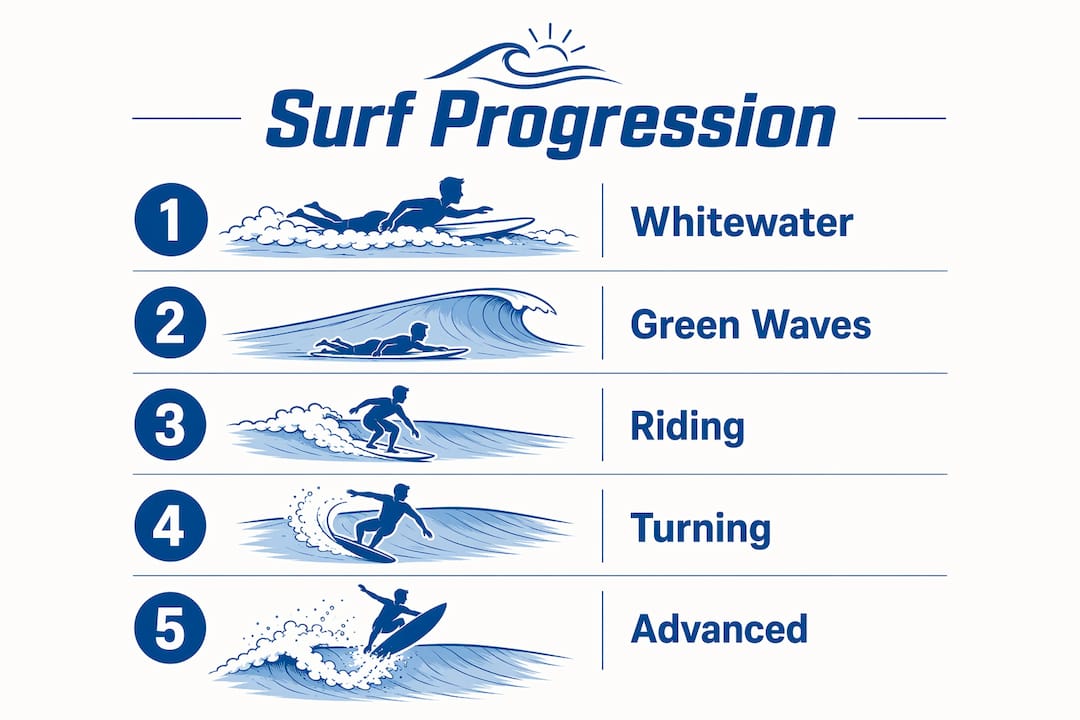
Surf progression follows a logical sequence of milestones: standing in whitewater, catching unbroken green waves, riding down-the-line with speed and control, then learning intermediate maneuvers. Each stage has concrete markers that tell you your child has genuinely moved forward, not just spent more time in the water.
| Stage | What success looks like | Casual (once/week) | Regular (2–3×/week) |
|---|---|---|---|
| Whitewater standing | Consistent pop-up, balanced stance, 3+ rides in a row | 4–8 weeks | 2–4 weeks |
| Green wave entry | Catches unbroken waves independently, paddles into position | 3–6 months | 6–10 weeks |
| Down-the-line riding | Trims across the face, generates speed, reads the wave | 6–12 months | 3–6 months |
| Intermediate maneuvers | Bottom turns, cutbacks, basic nose work | 1–3 years | 8 months |
What each stage actually requires:
- Whitewater: The child paddles without help, times the pop-up to the wave’s push, and holds a balanced stance for the full ride to shore.
- Green waves: They read the peak, paddle into position before the wave breaks, and execute the pop-up under real pressure without foam assistance.
- Down-the-line: They angle the board at takeoff, shift weight to generate speed, and stay ahead of the breaking section.
- Intermediate: They initiate a bottom turn from memory, redirect the board off the top, and choose waves based on shape rather than just size.
The single biggest technical failure when moving kids from whitewater to green waves is inadequate pop-up timing under foam. Moving too early locks in bad habits that take far longer to unlearn than to prevent. Let your child nail the whitewater stage completely before pushing them to unbroken waves.
Variables that shift these timelines:
- Age and body size: Younger kids (5–9) often have a natural balance advantage; teens bring more strength.
- Water time: The single biggest lever. Twice a week beats a one-week camp every time.
- Environment: Small, consistent surf (3 feet and under) produces faster gains than choppy or crowded conditions.
- Coaching quality: Instructors who limit corrections to two per session prevent cognitive overload and produce better motor outcomes.
Why do kids often progress faster than adults?
Kids have a genuine physiological and psychological edge in the water, and understanding it helps you set realistic expectations without either pushing too hard or holding back.
Physical advantages:
- Lower center of gravity relative to body height makes balance on a moving board more natural.
- Greater joint flexibility means the pop-up movement is less mechanically demanding.
- Lighter body weight reduces the board volume needed to generate float, so they get more feedback from the wave.
Neurological advantages:
- Children’s brains are in a high-plasticity phase, meaning motor patterns form and consolidate faster than in adults.
- They have less conscious overthinking. An adult analyzes the pop-up; a kid just does it, which is actually an advantage in early-stage motor learning.
- Repetition sticks faster when the nervous system is still building its movement library from scratch.
Psychological drivers:
- Natural fearlessness in small surf. Most kids do not catastrophize a wipeout the way adults do.
- Play orientation: they are not trying to “learn surfing,” they are playing in the ocean, which keeps motivation high and frustration low.
- Curiosity and social motivation in group settings push them to try things they might hesitate to attempt alone.
Research from Boardriders confirms that play-based instruction and emotional readiness are the critical drivers of steady progress. Forcing performance before a child is emotionally ready does not speed things up. It usually reverses them.
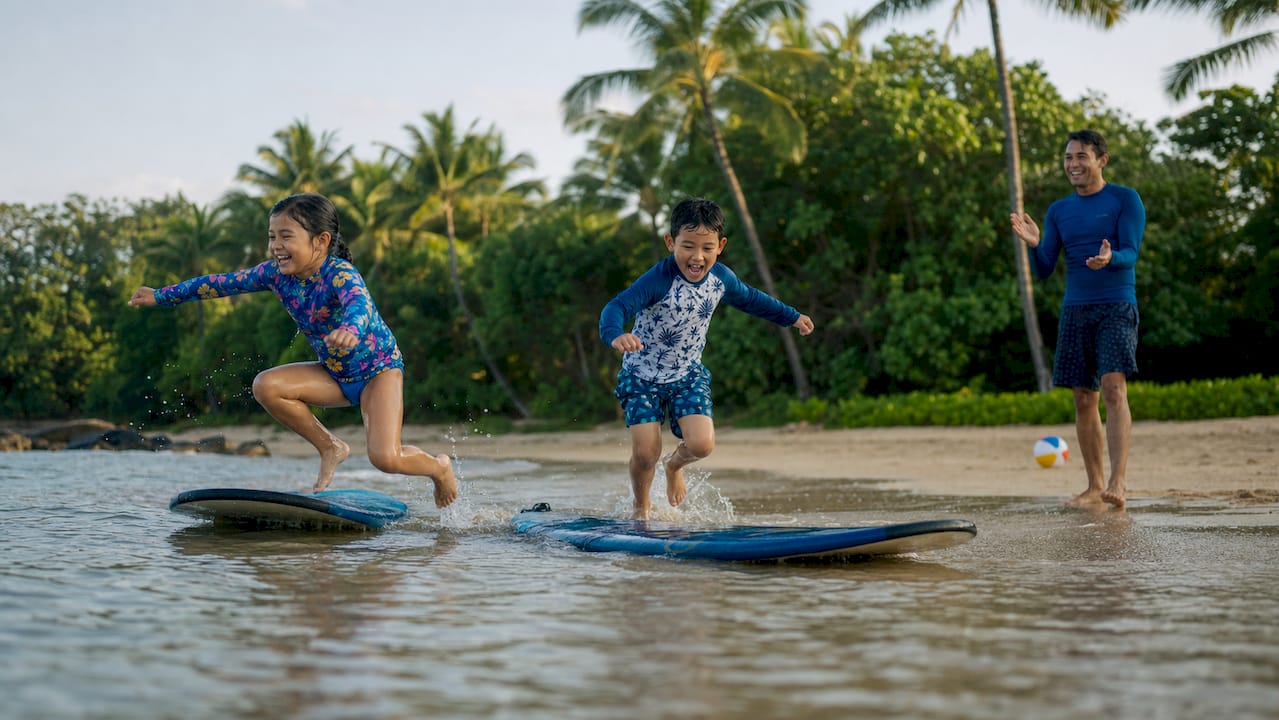
Pro Tip: Let your child’s excitement lead the session. If they want to spend 20 minutes just jumping off the board in the shallows, that is ocean comfort building, and it pays off in the water later. Resist the urge to redirect them to “real” practice.
What actually accelerates your child’s progression?
Practice frequency beats intensity
Consistent water time outweighs occasional high-cost intensives for sustained progression. A child who surfs twice a week for two months will almost always outpace one who attended a single week-long camp and then stopped. The nervous system needs repetition spread over time, not crammed into a few days.
Private vs. group lessons: the real trade-off
Private lessons deliver faster technical correction. Your child gets every wave analyzed, every pop-up adjusted in real time. Group lessons, on the other hand, provide social motivation, more wave attempts per session (because the instructor is not stopping to coach after every ride), and the competitive spark that pushes kids to try harder. For beginners, a small-group format of 4–6 students often produces the best balance. Once your child is working on a specific technical problem, a private session is worth the extra cost.
Recommended practice schedule by age
- Ages 5–7: Two 60-minute sessions per week. Shorter sessions prevent fatigue-driven frustration. Focus entirely on whitewater and pop-up repetition.
- Ages 8–11: Two to three sessions per week, 60–90 minutes each. Add dry-land pop-up drills at home between sessions. Dry-land rehearsal builds muscle memory and reduces cognitive load in the water.
- Ages 12+: Three sessions per week if the goal is real progression. Introduce cross-training (skateboarding, balance boards, swimming) to build complementary strength and coordination.
Parent to-do list:
- Schedule sessions consistently rather than fitting them in when convenient.
- Avoid coaching from shore during lessons. Let the instructor lead.
- Keep post-session conversations positive: ask what was fun, not what went wrong.
- Track milestones (first green wave, first unassisted paddle-out) so your child can see their own progress.
- Consider a surf school vs. self-teaching comparison before deciding on the format.
When is your child ready to start, and what swim skills do they need?
Most kids can begin learning between ages 5 and 7, though some start as young as 4 with close supervision and calm conditions. The number that matters is not their birthday. It is their water confidence, their ability to follow instructions, and their genuine enthusiasm for being in the ocean.
Minimum readiness checklist:
- Can tread water for at least 30 seconds without assistance
- Comfortable submerging their face and recovering calmly
- Able to follow a two-step instruction from an adult they have just met
- Shows genuine interest (not just parental enthusiasm)
- Comfortable in moving water, not just a pool
Safety checklist for every session:
- Certified instructor present with current lifeguard or water safety credentials
- Student-to-instructor ratio of 4:1 or better for beginners
- Leash fitted correctly (ankle leash, length matching board)
- Foam board appropriate for the child’s weight and skill level
- Rash guard and sunscreen applied before entering the water
- Parent or guardian within visual range at all times
Environmental hazards to watch:
- Rip currents: even small ones are dangerous for young surfers. If the water looks discolored or choppy in a channel, reschedule.
- Offshore wind: makes waves hollow and unpredictable for beginners. Onshore or light cross-shore is safer.
- Crowded lineups: a child getting hit by another board is the most common injury in beginner surf. Choose uncrowded breaks or designated beginner zones.
- Wave size: keep it at 3 feet and under for beginners. Bigger surf is not more exciting for a 7-year-old. It is just more dangerous.
When conditions are not right, reschedule without guilt. One bad session in scary surf can set a child back months emotionally.
What equipment does your child actually need?
Board choice is the most consequential gear decision you will make, and most parents get it wrong by downsizing too early.
| Age / Weight | Stage | Recommended board length | Board type |
|---|---|---|---|
| 5–8 yrs / under 60 lbs | Whitewater | 7 feet to 8 feet | Foam longboard |
| 8–11 yrs / 60 lbs | Whitewater to green waves | 8 feet to 9 feet | Foam longboard |
| 11–14 yrs | Green waves to down-the-line | 7’6"–8’6" | Foam or epoxy longboard |
| 14+ yrs | Intermediate | 7 feet to 7.5 feet | Epoxy funboard or shortboard |
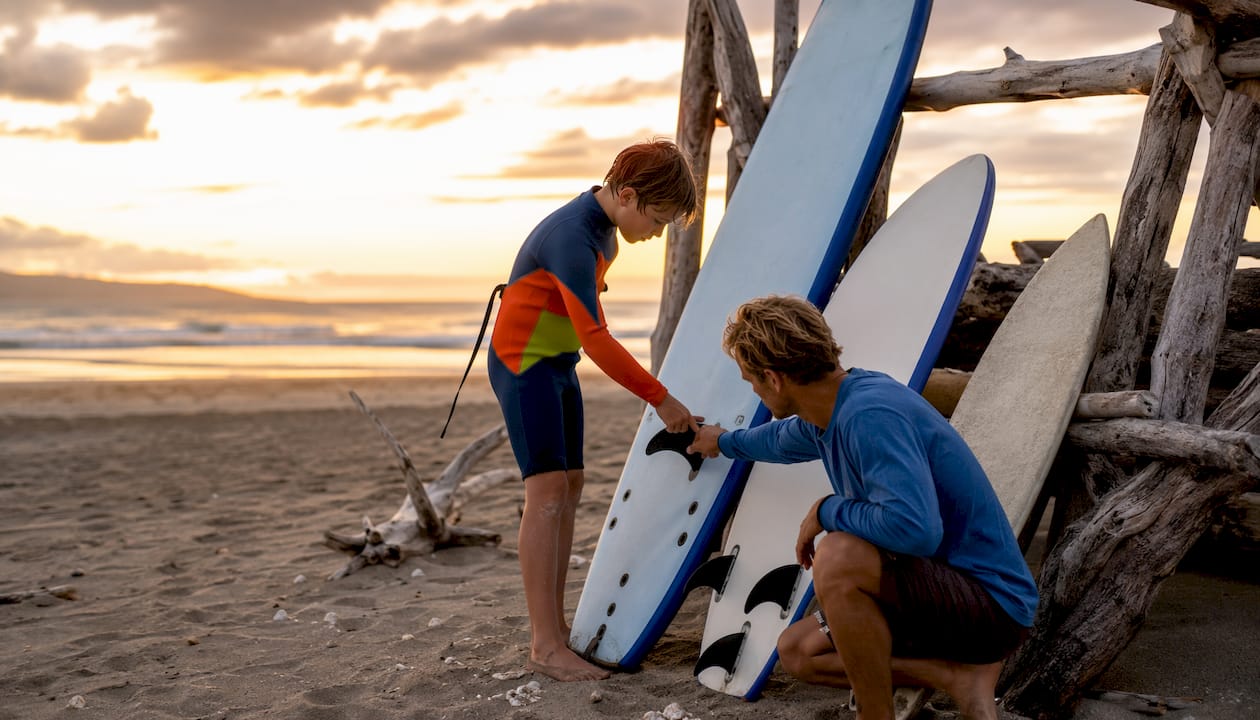
A wider, longer foam board gives your child more wave-catching ability, more stability on the pop-up, and more forgiveness on weight shifts. Transitioning to a smaller board before they are ready is the most common parent mistake in equipment. For a detailed breakdown of board types for kids, Hhsurf’s guide covers sizing by age and weight.
Equipment checklist:
- Leash: Length should match board length. Ankle attachment for beginners. Check the velcro and cord before every session.
- Foam vs. epoxy: Foam boards are safer for beginners (softer impact on wipeouts) and provide more buoyancy. Epoxy boards are lighter and more responsive, appropriate once your child is consistently catching green waves.
- Wetsuit: Match thickness to water temperature. In Hawaii, a 1mm shorty or rash guard is usually enough. In California or the Pacific Northwest, a 3/2mm or 4/3mm full suit is standard.
- Sun protection: Zinc-based sunscreen on face and neck, reapplied every 90 minutes. Rash guard or UV-protective shirt for extended sessions.
Signs it is time to downsize the board:
- Your child is consistently catching green waves without assistance
- Their pop-up is automatic and balanced, not a scramble
- They are actively steering the board rather than just riding straight
- They express frustration that the board feels “too slow” or “too big”
Common mistakes parents make that slow their child’s progress
The most damaging thing a parent can do at a surf lesson is stand at the water’s edge shouting corrections. Instructors see it constantly, and it slows progression by splitting the child’s attention between two authority figures giving different instructions.
What not to do:
- Coach from shore during a lesson. Your child cannot process your voice and the instructor’s simultaneously.
- Push your child into a wave they have not chosen. Wave selection is a skill, and overriding it teaches them to distrust their own judgment.
- Compare your child’s pace to another kid in the group. Progression timelines vary by months even among children the same age.
- Downsize their board because it “looks cooler.” Premature downsizing is the fastest route to entrenched bad habits.
- Schedule sessions so infrequently that skills fade between lessons.
What to do instead:
- Cheer from a distance. Enthusiasm from shore is motivating; instructions from shore are distracting.
- Let certified instructors direct all technical corrections. A good coach limits feedback to two corrections per session to avoid paralysis by analysis.
- Set play-based goals: “Let’s see how many waves you can catch today,” not “Let’s work on your pop-up timing.”
- After a rough session, find one small win to celebrate before leaving the beach.
- Ask the instructor about video analysis. Seeing themselves on video helps kids understand the gap between what they think they are doing and what is actually happening, and it makes corrections stick faster.
How to choose the right kids surf program
Not all surf schools are equal, and the difference between a program that accelerates your child’s progression and one that just keeps them entertained is measurable. Here is what to ask before you book.
Questions to ask every program:
- What certifications do your instructors hold? (Look for ISA, NSSIA, or current lifeguard credentials.)
- What is your student-to-instructor ratio for kids? (4:1 is good; 6:1 is the maximum acceptable for beginners.)
- How long are the lessons, and do you adjust for younger children? (Most kids do better with 60-minute sessions rather than 90.)
- Do you use video analysis or milestone tracking?
- What safety protocols do you follow if conditions change?
Signs of a quality program:
- Curriculum built around measurable milestones, not just “fun in the water”
- High wave count per session (more attempts = faster learning)
- Small, consistent surf conditions prioritized over impressive-looking breaks
- Instructors who focus on independent paddling and pop-up timing as objective markers
- Clear communication with parents after each session
Red flags:
- Praise-heavy sessions with no measurable milestones discussed
- Groups of 10 or more students with one instructor
- No safety briefing before entering the water
- Instructors who push kids into waves the child has not chosen
- No progression tracking between sessions
Practical scheduling tips:
- Morning sessions (before 10 AM) typically offer cleaner, lighter-wind conditions at most U.S. beach breaks.
- Summer crowds at popular breaks can slow learning. Ask programs about their quieter time slots.
- For choosing a kids surf instructor, Hhsurf’s guide covers the specific qualifications and behaviors that signal a genuinely skilled coach.
How Hhsurf structures progression for kids
Hans Hedemann Surf School (Hhsurf) in Waikiki builds its kids program around the same staged milestones described throughout this article, with a few structural choices that set it apart from typical beach-town surf schools.
Methodology highlights:
- Play-based instruction from the first session, with dry-land pop-up practice before any child enters the water
- High wave count prioritized: instructors position kids in small, consistent whitewater to maximize repetitions per session
- Technical milestones tracked across lessons so parents can see concrete progress, not just enthusiasm
- Lesson length adjusted for age, with younger children kept to 60-minute sessions to prevent fatigue
Typical class structure:
- Warm-up and ocean safety briefing on the beach
- Dry-land pop-up drills on the sand (building muscle memory before the water adds complexity)
- Whitewater repetitions with instructor support, focusing on consistent pop-up timing
- Supervised green-wave attempts for children who have demonstrated whitewater competency
- Post-session debrief with parents, including specific milestone notes
Trust signals parents should verify:
- Instructors hold current water safety and lifeguard certifications
- Student-to-instructor ratios kept small for beginner kids groups
- Safety protocols reviewed before every session, including leash checks and condition assessment
- Hhsurf’s lesson methodology is documented and available for review before booking
Most students at Hhsurf stand up on their board within their first lesson. After three to five consecutive lessons, the majority are catching waves with consistent pop-ups and beginning to develop independent paddling skills — the foundation for everything that follows in their surfing progression.
The school’s location in Waikiki provides reliable small surf conditions year-round, which is exactly the environment that produces the fastest early-stage gains for young learners.
Key Takeaways
Children who practice consistently, work with qualified instructors, and stay on appropriately sized boards progress through surf milestones measurably faster than those who rely on occasional sessions or parental coaching from shore.
| Point | Details |
|---|---|
| Consistent water time wins | Surfing 2–3 times per week produces faster gains than occasional intensive camps. |
| Milestones beat time served | Track pop-up consistency and independent paddling, not just how many lessons your child has had. |
| Board size matters | Keep kids on a foam longboard until they are consistently catching green waves independently. |
| Let instructors lead | Parents coaching from shore splits attention and slows progress; cheer from a distance instead. |
| Hhsurf for structured kids lessons | Hans Hedemann Surf School in Waikiki offers play-based, milestone-tracked kids lessons with certified instructors and small group sizes. |
What coaches wish parents knew
Parents come to surf lessons with the best intentions, and that is exactly what makes this worth saying plainly: the most common thing that slows a child’s progression is not the child. It is the parent’s anxiety about the child’s progression.
Kids learn surfing the way they learn everything else that sticks: through play, repetition, and the freedom to fail without an audience grading the attempt. When a child wipes out and comes up laughing, that is a good session. When they come up scanning the shore to see if you looked disappointed, something has gone wrong. The emotional environment around the lesson matters as much as the technical content inside it.
The coaches who produce the fastest-progressing young surfers share a few consistent habits. They celebrate wave count, not wave quality. They give two corrections per session, maximum, and they make those corrections feel like tips from a friend rather than critiques from a judge. They let kids choose which wave to go for, even when a better one is coming. That wave-selection instinct is a skill, and it only develops through practice.
One concrete thing you can do: after every session, ask your child one question. Not “Did you stand up?” Ask “What was the most fun part?” The answer tells you whether they are building a relationship with the ocean or just tolerating lessons to please you. The former produces surfers. The latter produces kids who quit by age 10.
Measurable outcomes follow from this approach. Children who stay in play-based programs with consistent water time develop reliable pop-up timing and independent paddling within months, not years.
Hhsurf kids lessons: what you get and how to book
If you want your child in a program that actually tracks their progression rather than just counting sessions, Hhsurf’s kids lessons in Waikiki are built for exactly that. The school’s instructors are professional surfers with current safety certifications, and the lesson structure prioritizes wave count and milestone tracking over generic encouragement.
What parents consistently report: their child stands up in the first lesson. After three to five sessions, most kids are paddling independently and catching green waves with a consistent pop-up. The small group format keeps instruction focused, and the Waikiki location delivers reliable, gentle surf conditions that are ideal for young beginners year-round.
The program covers everything from dry-land pop-up drills to supervised green-wave attempts, with a post-session debrief so you know exactly where your child stands. Safety protocols, leash checks, and condition assessments happen before every session, not as an afterthought.
Ready to get your child started? Visit the kids surf lessons page to check availability and book a session. For a broader look at lesson formats and what to expect on the day, the surf lessons overview covers everything you need before you arrive.
Further reading and sources
- How long to learn to surf | QuiverSurf: The most useful resource for understanding realistic progression timelines and the role of water time frequency.
- Kids Surf Lessons: A Parent’s Complete Guide | SurfSpotGuide: Covers lesson length, early milestone expectations, and what parents should ask before booking.
- Getting Your Kids into Surfing | Boardriders: Strong on play-based instruction philosophy and dry-land preparation techniques.
- The surf progression audit | Boston Surf Adventures: The most technically detailed source on milestone measurement, video analysis, and avoiding the “time-served” illusion.
- Hhsurf kids lessons page: Program details, instructor credentials, and booking for Hans Hedemann Surf School’s dedicated kids program in Waikiki.
- Hhsurf surfboard types for kids: Detailed board-sizing guidance by age, weight, and progression stage.
- Choosing a kids surf instructor | Hhsurf: Practical checklist for evaluating instructor qualifications and program quality before you commit.
0 Comments