
Surf shoulder awareness is the quick over-the-shoulder head check you do while paddling and before takeoff, so you know who is around you, where the next wave is building, and whether your board is lined up straight. Do this before every single wave you paddle for.
Here is the one-line version: turn your head left, then right, then look toward the peak, before you commit to paddling. If someone is sitting deeper or closer to the peak than you, that wave belongs to them, so pull back and wait for the next one.
Key Takeaways
Surf shoulder awareness works because it turns a split-second head check into the single habit that prevents most beginner collisions and etiquette conflicts in the water.
| Point | Details |
|---|---|
| Check before every wave | Turn left, right, then toward the peak before you paddle for any wave. |
| Yield to peak priority | The surfer closest to the peak has right of way; pull back if that’s not you. |
| Scan every 30 seconds | Do a full 360-degree lineup scan while sitting to track sets and other surfers. |
| Practice the micro-check | A short, efficient head-turn keeps your paddle power and timing intact. |
| Learn it hands-on | Hans Hedemann Surf School builds shoulder checks into Surf Buddy drills from your first lesson. |
Table of Contents
- What Is Surf Shoulder Awareness and Why It’s the First Skill You Learn
- When and Where to Check Your Shoulder in the Lineup
- How to Practice Shoulder Awareness Before You Ever Paddle Out
- Reading the Lineup: Crowds, Currents, and Other Water Users
- How Hans Hedemann Surf School Builds This Habit Into Every Lesson
- What Beginners Get Wrong About Shoulder Checks
- Learn Shoulder Awareness Hands On With Hans Hedemann Surf School
- Sources
What Is Surf Shoulder Awareness and Why It’s the First Skill You Learn
A shoulder check takes about a second. It’s the same reflex a driver uses checking a blind spot before changing lanes, and the comparison isn’t a stretch. Surf safety guidance from the RNLI treats it the same way: a small, repeatable action that prevents a much bigger problem.
That bigger problem is collisions, and the RNLI notes collisions rank among the most common causes of serious injury in surf zones. A board’s nose or fin moving at speed can do real damage to a person in the water, and most of those incidents trace back to one surfer not knowing another was there.
Pro Tip: Treat the shoulder check like checking your mirrors before you change lanes. You do it out of habit, not because you expect danger every time. The habit is what saves you on the one time it matters.
The right-of-way rule in surfing is simple: whoever is closest to the peak, the point where the wave first breaks, has priority. Surfer magazine confirms this is the foundational rule of surf etiquette, and most conflicts in the water come from someone ignoring it.
Two etiquette breaches cause almost all lineup tension:
- Dropping in — paddling for a wave someone deeper already has priority on, cutting them off mid-ride.
- Snaking — paddling around another surfer to grab a better position on the peak at the last second.
Both happen because someone skipped the check. You can’t yield to a surfer you never looked for. That’s the entire case for building this habit early, before it costs you a board ding or somebody else a bruised rib.
When and Where to Check Your Shoulder in the Lineup
Timing separates a surfer who paddles with confidence from one who is constantly startled by waves and people. There are really only two moments that matter, plus one running background task.
- While sitting in the lineup: do a slow, full scan roughly every 30 seconds. Look at the horizon for incoming swell lines, check both directions along the peak, and glance behind you toward the beach.
- Right before you paddle for a wave: do one final, quick left-right-and-peak check. This is the non-negotiable one. Skipping it is how drop-ins happen.
- During the paddle itself: a half-second glance toward the peak confirms nobody popped up closer to it while you were digging in.
Guidance on lineup awareness from Rapture describes this as a continuous 360-degree process, not a one-time glance. Surfers who scan regularly can often spot set waves 10 to 15 seconds before they arrive, which is enough time to reposition instead of scrambling.
What you do with that information depends on what you see. If someone is deeper on the wave, pull back, no exceptions. If someone is already riding toward you, paddle hard toward the whitewater and clear the impact zone rather than trying to guess their line. Hesitation in that moment is worse than either choice made quickly.

How to Practice Shoulder Awareness Before You Ever Paddle Out
You can build this habit on land, and you should, because the water is a bad place to learn a new motor pattern for the first time.
- Rehearse the head-turn timeline on the beach. Lie on a towel or a board in the sand, pick a landmark on the real horizon, and practice the left-right-peak sequence until it takes under a second.
- Use a partner drill in the water. Hans Hedemann Surf School builds this into lessons as a “Surf Buddy” exercise: two students watch out for each other, calling out when a wave is approaching or when the lineup shifts. It turns an internal habit into a shared, verbal one, which sticks faster.
- Practice the micro-check, not a slow scan. A short, efficient turn of the head keeps your paddling rhythm intact. A long, slow look costs you the exact power and timing you need to catch the wave you just checked for.
- Watch your posture. Keep your chest lifted and your eyes tracking naturally rather than twisting your whole torso, which throws off your board’s balance right when you need it steady.
Pro Tip: Over-rotating your neck to look behind you is a common beginner reflex, and it can strain the same muscles that get stiff from hours of desk work. A quick chin-to-shoulder turn does the job without you having to crane your whole neck around. Simple neck mobility work off the water, like the drills covered in resources on fixing forward head posture, can make that quick turn feel more natural.
None of this needs to slow you down. A well-practiced check adds a fraction of a second to your routine and saves you from the wasted paddle of chasing a wave that was never yours to take.
Reading the Lineup: Crowds, Currents, and Other Water Users
A shoulder check only works if you know what to do with what you see. A few situations come up constantly for beginners.
- Crowded lineups: yield more often than you think you should, avoid paddling straight across the peak, and use a quick verbal heads-up (“going left!”) instead of assuming everyone tracked your position.
- Rip currents and drift: pick a fixed landmark on the beach and check it periodically. If it’s shifted position relative to you, you’ve drifted, and you need to paddle back into position before your next wave.
- Mixed water users: stand-up paddlers and swimmers move less predictably than surfers. Give them extra room, and don’t assume they’ve seen you coming.
- When you mess up: a drop-in happens to everyone eventually. Raise a hand, say sorry, and pull off the wave. That single gesture defuses almost every lineup conflict before it starts.
Surf etiquette guides consistently recommend that beginners choose mellow beach breaks over crowded reefs or points while these habits are still forming, since a forgiving sandy bottom and a spread-out crowd give you room to make mistakes safely.
How Hans Hedemann Surf School Builds This Habit Into Every Lesson
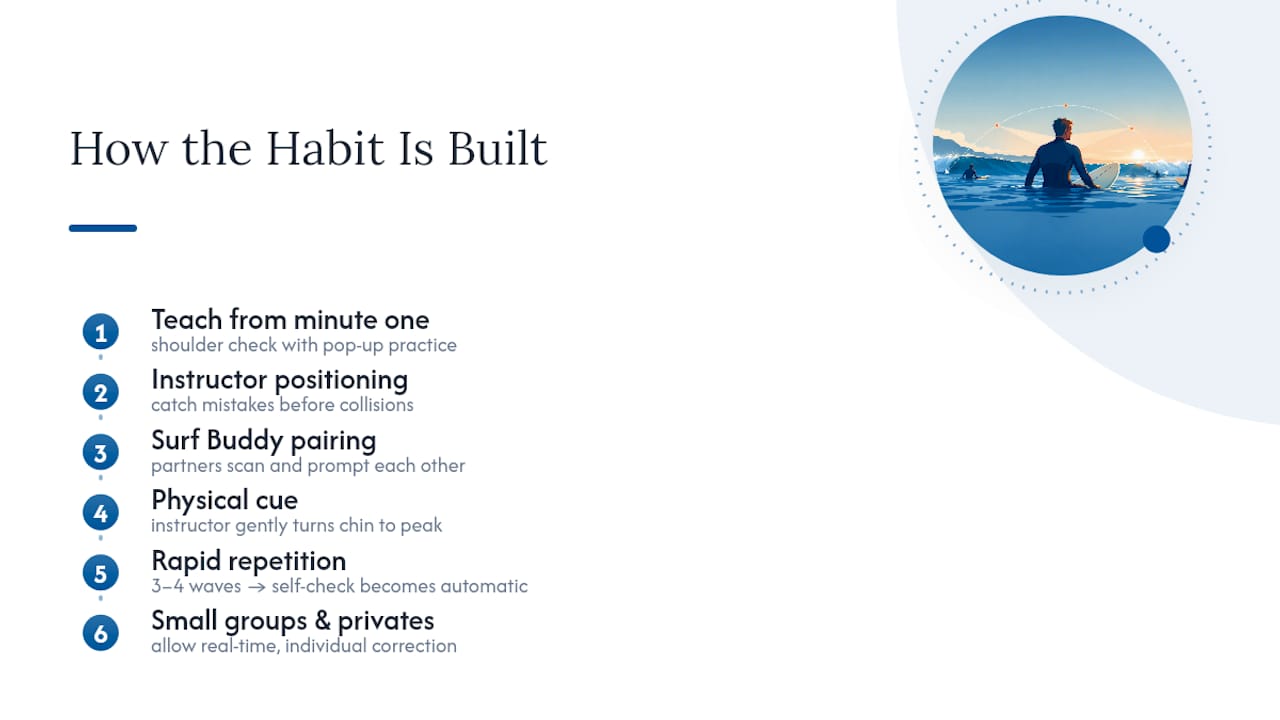
Hans Hedemann Surf School structures its beginner lessons so students are standing up and riding waves in their first session, and shoulder awareness gets taught alongside the pop-up from the very first minute in the water. Instructors are professional surfers who position themselves to catch mistakes before they turn into a collision, not after.
The Surf Buddy system pairs students so they’re checking for each other, not just themselves. It’s a small structural fix that does a lot of work: a beginner who is nervous about scanning the whole lineup alone gets a second set of eyes, and the habit forms faster because it’s social instead of solitary.
A student’s first head check often happens with an instructor’s hand gently turning their chin toward the peak. By the third or fourth wave, they’re doing it on their own without being told. That’s the entire goal: making the check automatic before the lesson ends.
Individual attention is the backbone of the school’s approach, and it shows up directly in this skill. A crowded group lesson makes it hard for any one instructor to catch every missed check; smaller groups and private sessions let that correction happen in real time, wave after wave.
What Beginners Get Wrong About Shoulder Checks
Most surf advice treats shoulder awareness as a courtesy tip, something you pick up eventually to avoid annoying the locals. That framing undersells it. It’s a collision-prevention reflex first, and etiquette second.
The bigger miss is that most guides describe the check but never say how long it should take or how it fits into your paddle rhythm. Beginners who overthink it end up doing a slow, deliberate scan every time, which throws off their paddle timing and makes them miss waves they were actually entitled to catch. The fix isn’t more awareness. It’s a faster, more automatic version of the same awareness, which is exactly why the drill needs repetition before it needs explanation.
If you take one thing from this: don’t wait until you’re sitting in a lineup to think about this for the first time. Rehearse the head-turn on the sand, pair up with someone in the water, and treat the check as part of the paddle stroke itself rather than a separate step you remember to add. The surfers who look calmest in the water aren’t the most fearless ones. They’re the ones who checked early enough that they never had to react in a panic.
— Johann
Learn Shoulder Awareness Hands On With Hans Hedemann Surf School
Reading about a head check only gets you so far. The habit locks in when an instructor is standing next to you in the water, correcting your timing wave after wave, which is exactly what happens in a Hans Hedemann Surf School lesson.

Group lessons introduce the Surf Buddy drill so you’re practicing shoulder checks with a partner from your very first wave. Private lessons go further: one instructor, one student, and constant feedback on exactly when your check is too slow, too fast, or missing the peak entirely. For families, kids’ lessons build the same habit early, with instructors adjusting the pace so younger surfers pick up the reflex without feeling rushed.
A lesson compresses weeks of trial-and-error into a single session, because someone experienced is watching your form on every wave instead of you guessing afterward what went wrong. If you’re planning a Waikiki session, you can book a surf lesson directly and start building the habit under supervision instead of learning it the hard way in a crowded lineup.
Sources
- RNLI — Surfing safety guidance
- Surfer — Surfing rules & etiquette
- Rapture — Surf lineup awareness
- Surfolio — Surf etiquette basics
0 Comments