
Children learn surfing faster than adults because their bodies and brains are physically built for rapid skill acquisition in the water. Lower center of gravity, natural flexibility, and dopamine-driven neuroplasticity give kids a measurable edge over adult beginners. Understanding why kids learn surfing faster helps you support your child’s progress without getting in the way of it. This guide breaks down the science, the psychology, and the practical steps that make the difference between a child who stands up on their first wave and one who struggles for weeks.
Why do kids learn surfing faster than adults?
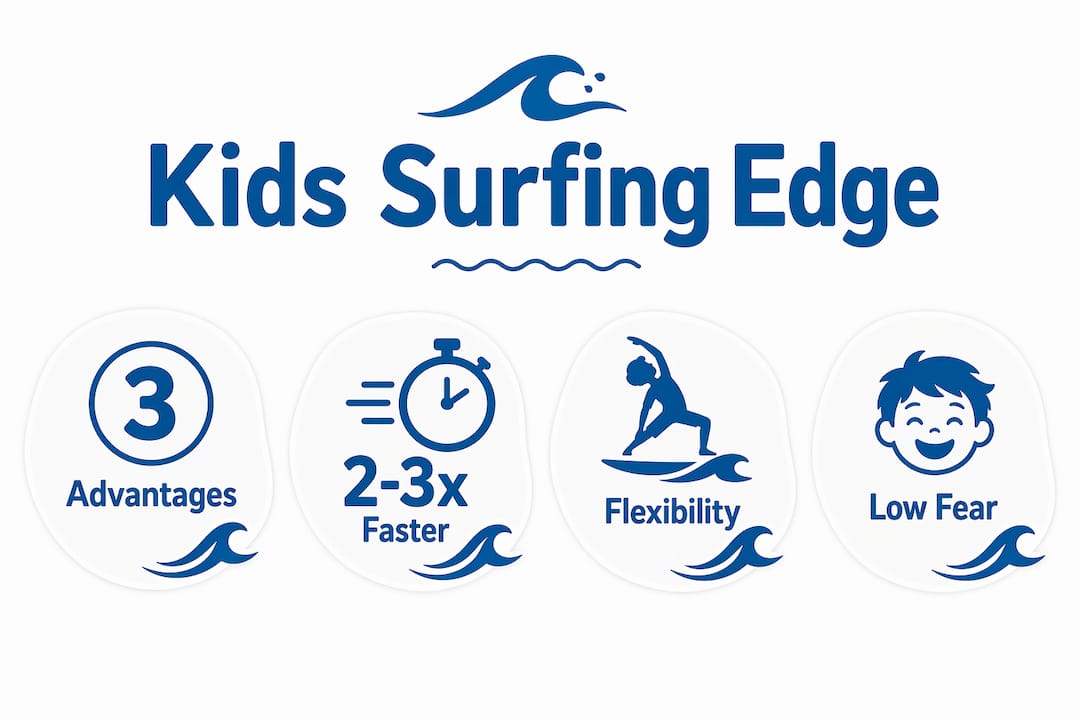
Children hold three core physical advantages over adult beginners: higher flexibility and lower center of gravity, lighter body weight, and a natural sense of balance that adults have to consciously rebuild. These traits directly translate to faster board control and quicker pop-ups. Adults rely on muscle strength to compensate for stiffness. Kids simply move the way surfing demands.
The physical traits that give kids an edge
Here is what sets children apart biomechanically:
- Lower center of gravity. Kids carry their mass closer to the board, which makes balancing on a moving surface far more natural.
- Greater flexibility. Children’s joints and muscles bend without resistance, so the twisting and shifting that surfing requires feels effortless.
- Lighter body weight. Less mass means the board responds more gently to movement, giving kids more margin for error.
- Faster reflexes relative to body size. Small corrections happen almost automatically before the brain consciously registers a wobble.
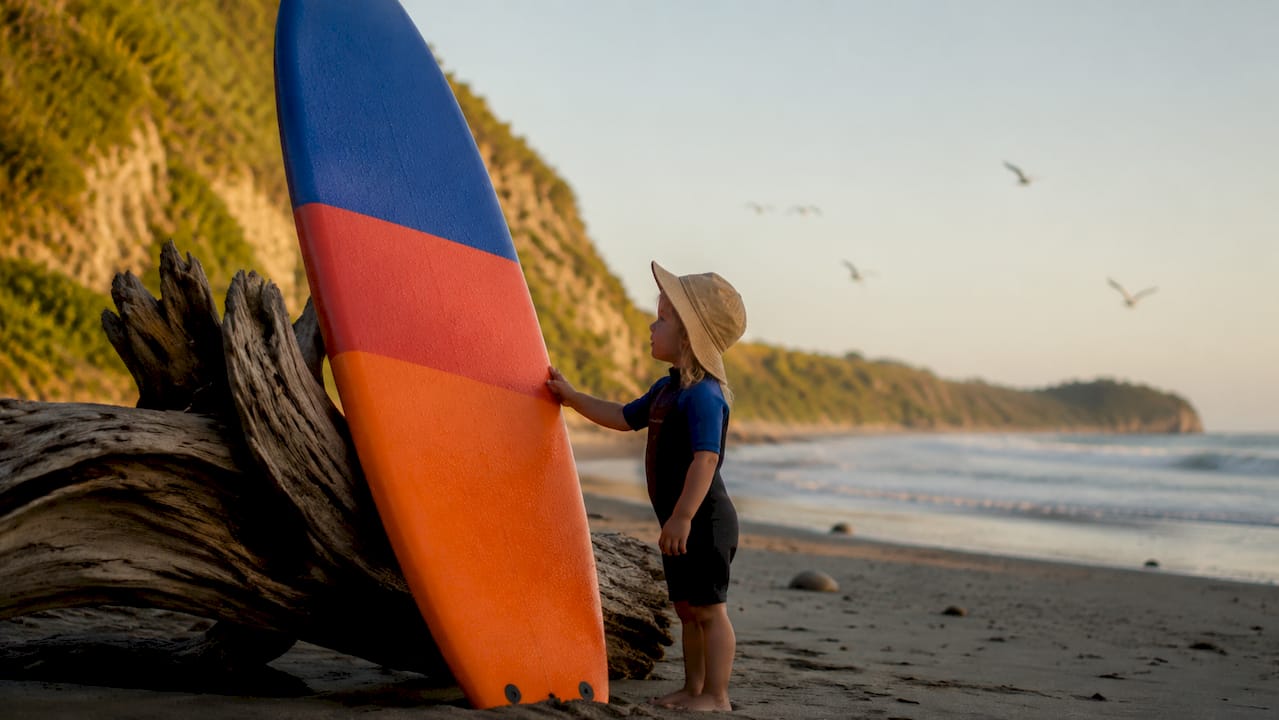
Equipment matters just as much as biology. Large, soft-top beginner boards provide the buoyancy and stability that let kids focus on movement rather than survival. A board that is too small or too rigid removes the safety margin that makes early success possible.
Pro Tip: Choose a soft-top board at least 8 feet long for children under 10. The extra volume keeps them stable long enough to feel what balance actually feels like.
How does the child’s brain speed up surfing skill development?
Children’s brains form new neural connections at a rate adults cannot match. This process, called neuroplasticity, is especially active during play-based physical learning. Dopamine-driven neuroplasticity means that every successful ride releases a reward signal that locks the movement pattern into memory faster. The brain essentially says: do that again.
Adults tend to analyze technique consciously. They think about foot placement, arm position, and timing all at once. That mental load creates hesitation. Kids bypass the analysis entirely. They feel the wave, react, and adjust without overthinking. This “flow state” is not a personality trait. It is how the developing brain processes new motor skills.
The practical result is striking. A child who wipes out laughs and paddles back. An adult who wipes out mentally reviews what went wrong. The child gets more attempts per session. More attempts mean faster skill reinforcement.
- Play-based repetition builds neural pathways faster than drill-based instruction.
- Low self-consciousness keeps kids experimenting freely rather than protecting their ego.
- Shorter attention spans actually help. Kids reset between waves instead of carrying frustration forward.
- Emotional engagement with the ocean as a fun environment keeps motivation high across sessions.
Why does a child’s mindset accelerate surfing skills?
Fear is the single biggest brake on adult surfing progress. Children have a lower fear response to physical challenges, which means they attempt skills adults would hesitate to try. A child who falls off a board does not associate the fall with danger. They associate it with the game.
Motivation plays an equally large role. Kids who see the ocean as a playground stay motivated naturally. That intrinsic drive is far more powerful than any external reward system. Research from a 6-week surf therapy program found measurable reductions in anxiety and hyperactivity in youth participants. Surfing does not just teach balance. It regulates the nervous system in ways that reinforce the desire to keep going.
Parents shape this mindset more than they realize. Keeping sessions short, positive, and pressure-free preserves the child’s natural motivation. The moment surfing feels like a test, the dopamine loop breaks.
Pro Tip: Never end a session on a failure. If your child wipes out on the last wave, paddle back out for one more easy ride so the final memory of the day is success.
Does private coaching make kids progress faster?
Coaching format is one of the most underrated factors in how quickly children pick up surfing skills. Private one-on-one lessons produce results 2 to 3 times faster than group lessons for beginners. That gap is even wider for young children, who need immediate, specific feedback to connect instruction to movement.
| Factor | Private lessons | Group lessons |
|---|---|---|
| Feedback speed | Immediate, wave by wave | Delayed, shared across students |
| Wave time per child | Maximum | Reduced by waiting turns |
| Instruction specificity | Tailored to the child’s body and style | Generalized for the group |
| Confidence building | Direct encouragement every attempt | Diluted across multiple students |
| Progress speed | 2–3 times faster for beginners | Slower, especially for younger kids |
Group lessons work well for social motivation and for children who already have basic skills. For a child learning to stand up for the first time, private instruction removes every obstacle between the lesson and the wave. Most professional surf schools, including Hhsurf, recommend starting with kids surf lessons designed specifically for younger learners before transitioning to group formats.
Most surf schools recommend starting formal lessons around age 7, when children have the coordination and focus to follow instruction consistently. That does not mean younger children cannot benefit. It means the lesson format needs to match the child’s developmental stage.
What practical steps help parents support their child’s surfing progress?
Parents who see the fastest results in their children follow a consistent pattern. They prioritize comfort and confidence over technique, choose the right equipment, and stay out of the coaching role during sessions.
- Start with water comfort. Building water confidence before formal technique produces better long-term results, especially for children under 7. Let them play in the shorebreak, float, and get comfortable with waves washing over them.
- Choose the right board. A large, soft-top board designed for beginners is not optional. It is the single piece of equipment that most directly affects how fast a child progresses.
- Keep sessions short and positive. Forty-five minutes of engaged, happy surfing beats two hours of tired frustration every time.
- Avoid over-coaching. Over-judging performance slows progression. Your job as a parent is to make sure your child is hydrated, safe, and having fun. Leave the technique to the instructor.
- Make it regular. Consistent sessions, even short ones, reinforce neural pathways far more effectively than occasional long days at the beach.
- Celebrate every stand-up. Positive reinforcement after each successful ride locks in the motivation to try again. The stoke factor is not a cliché. It is the engine of long-term progression.
Key Takeaways
Children learn surfing faster because their physical traits, brain wiring, and natural fearlessness combine to create ideal conditions for rapid motor skill development.
| Point | Details |
|---|---|
| Physical advantage | Lower center of gravity and flexibility give kids faster balance and board control than adults. |
| Brain wiring | Dopamine-driven neuroplasticity makes play-based repetition the fastest path to surfing skill. |
| Mindset matters | Low fear and high intrinsic motivation keep kids attempting new skills without hesitation. |
| Coaching format | Private lessons produce results 2–3 times faster than group lessons for young beginners. |
| Parent’s role | Avoiding over-coaching and keeping sessions positive preserves the motivation that drives progress. |
What I’ve learned watching kids surf that most parents miss
I have watched hundreds of children take their first waves, and the pattern is always the same. The kids who progress fastest are not the most athletic. They are the ones whose parents stand back and let the ocean do the teaching.
The most common mistake I see is parents narrating the session from the shore. “Bend your knees. Look forward. Paddle harder.” The child hears all of it, tries to process it mid-wave, and falls. The instruction that was meant to help becomes the distraction that causes the wipeout. Surf instructors are trained to give one cue at a time, at the right moment. Parents give five cues simultaneously from twenty meters away.
The second thing I notice is how quickly children forget bad sessions when the next one starts well. Adults carry yesterday’s frustration into today’s lesson. Kids do not. That emotional reset is not immaturity. It is a genuine cognitive advantage. If you can protect that reset by keeping the experience positive, your child will progress at a rate that will genuinely surprise you.
The long view matters here. A child who loves the ocean at age 7 and surfs casually through age 10 will outperform a child who was pushed hard early and burned out by age 9. The goal is not the fastest possible progression. The goal is a kid who still wants to paddle out at 15.
— Johann
Give your child the fastest start possible
The science is clear: children who receive focused, age-appropriate instruction in a supportive environment stand up on their boards far sooner than those in generic group settings. Hhsurf at Hans Hedemann Surf School in Waikiki has built its entire approach around this reality.
Hhsurf offers kids surf lessons designed specifically for young learners, with professional instructors who understand child development as well as they understand waves. For parents who want the fastest possible results, private surf lessons in Waikiki deliver the one-on-one attention that turns a first session into a first ride. Book a lesson and let your child experience what Waikiki’s turquoise waves and expert coaching can do in a single afternoon.
FAQ
What age do kids learn to surf most easily?
Most professional surf schools recommend starting formal lessons around age 7, when children have the coordination and focus needed to follow instruction. Younger children benefit most from water comfort activities and play-based ocean exposure.
Why do children pick up surfing skills faster than adults?
Children have greater flexibility, a lower center of gravity, and dopamine-driven neuroplasticity that makes physical skill acquisition faster. They also have less fear and fewer mental barriers than adult beginners.
Are private surf lessons worth it for kids?
Private lessons produce results 2–3 times faster than group lessons for young beginners. The immediate, wave-by-wave feedback and dedicated wave time make a measurable difference in how quickly children stand up and ride.
How can parents help without slowing their child’s progress?
Avoid coaching from the shore during sessions. Focus on keeping your child hydrated, safe, and emotionally positive. Over-correcting performance undermines the confidence that drives fast progression.
What board should a child use for their first surf lessons?
A large, soft-top beginner board provides the buoyancy and stability that accelerates learning. Boards that are too small or too rigid remove the safety margin children need to experiment freely.
0 Comments