
A little rain rarely stops a good session, but brown or murky water changes everything. Stay out of the ocean near stream mouths, storm drains, or harbor channels for 72 hours after heavy rain, and let lifeguards, posted advisories, and Hawaii Department of Health guidance make the final call. Clear water at the takeoff is your green light; discolored water anywhere in the lineup is your signal to paddle back in.
TL;DR:
- Surfer illness risk increases significantly if paddling out within 72 hours of heavy rain, especially near stream mouths, storm drains, and harbor channels.
- Visible signs such as murky, discolored water or floating debris indicate runoff contamination, signaling it is unsafe to surf.
- Storms can cause dangerous shifting sandbars, rip currents, and debris, making storm surf hazardous for all but experienced surfers aware of local conditions.
- Professional instructors use water clarity and upstream drainage checks to determine safety, often postponing lessons or shifting to safer spots during and after rain.
- Proper gear maintenance, including rinsing and drying equipment after rain, is essential to prevent damage and bacterial infections from runoff-heavy water.
Table of Contents
- Hawaii Surf in Rain: What the Science Says About Illness Risk
- When Is It Actually Safe to Surf After Rain in Hawaii?
- Storm Hazards That Have Nothing to Do With Bacteria
- Your Rainy-Day Surf Safety Checklist
- How Instructors Read Rainy Conditions Before a Lesson
- Protecting Your Board and Gear From Rain and Salt
- Rain Runoff and Hawaii’s Marine Ecosystem
- Author Perspective: Balancing Opportunity and Safety
- Want Safer Water Time After Rain? Book a Supervised Lesson
- Authoritative Places to Check Before You Surf
- Sources
- FAQ
Hawaii Surf in Rain: What the Science Says About Illness Risk
Surfing near runoff after a storm carries a real, measurable health cost, not just a theoretical one. A multi-season Surfrider Foundation and SCCWRP study tracked surfer health across thousands of sessions and found gastrointestinal illness rates climbed noticeably among people who paddled out during or within 72 hours of a storm event. That data point is why the 72-hour guideline exists at all, and it’s the backbone of most Hawaii rainy surf conditions advice you’ll see from lifeguards and health officials.
The 72-hour signal: repeated evidence of higher GI illness rates tied to entering the water shortly after wet weather is the single strongest reason surf schools and county lifeguards push the wait rule instead of a “use your judgment” approach.
Rain doesn’t contaminate ocean water on its own. It’s what the rain carries downhill that matters:
- Sewage systems can overflow or bypass treatment during heavy downpours, sending raw or partially treated waste toward the coast.
- Stormwater runoff sweeps fertilizer, oil, trash, and animal waste off streets and yards straight into streams and harbors.
- Agricultural and pasture runoff adds bacterial load in areas near farmland or grazing land.
Surfline’s reporting on post-rain surf risk notes that infection risk climbs fastest near river mouths and drainage outlets, which is exactly where visible warning signs show up first. Brown or tea colored water, floating leaves and trash, and a noticeable murkiness near a stream mouth are the visible tells that runoff has reached the surf zone. If you can see it, treat it as a warning rather than an inconvenience.
When Is It Actually Safe to Surf After Rain in Hawaii?
The 72-hour window is a guideline, not a guarantee. A light passing shower that drops a quarter inch over an hour behaves nothing like a slow-moving Kona Low that dumps several inches over a weekend. Storm size, how fast a watershed drains, and whether a break sits near a stream mouth all shift the real answer.
Some spots carry structurally lower risk after rain, and some carry structurally higher risk no matter how light the shower was:
- Lower risk: open-ocean breaks, deep-water reef passes, and leeward-side spots far from any stream or drainage outlet.
- Higher risk: anywhere near a river or stream mouth, storm drain outfalls, harbor channels, and developed shorelines with heavy stormwater infrastructure.
- Always check first: posted lifeguard signage, county beach advisories, and Hawaii DOH brown-water notices before trusting your own read on a spot.
Instructors who work these breaks daily use a simple two-part check before anyone paddles out: is the water clear at the takeoff and across the whole lineup, and are there stream mouths or storm drains visible upstream? If either answer is no, they don’t enter, and that same rule works just as well for visitors deciding for themselves. Official postings override personal judgment every time, because lifeguards and county officials often know about upstream discharge events that aren’t visible from the beach.
Storm Hazards That Have Nothing to Do With Bacteria
Heavy rain changes the ocean itself, not just the water quality. Flash flooding pushes logs, branches, and loose sediment straight into the surf zone, and that debris doesn’t just float, it collides with boards and swimmers in the impact zone. Reporting on North Shore flash floods has documented red dirt and debris turning familiar lineups unrecognizable within hours of a downpour.
Sandbars shift fast during storm surges, and a break you rode last week can hide a new, unmarked rip current or a sudden ledge that turns an ordinary wipeout into a hard hold-down. The USGS’s work on coastal change hazards confirms sediment can move enough overnight to reshape a spot entirely. A major storm can also shut down surf tourism outright: coverage of a Kona Low system hitting Hawaii described brown, debris-choked lineups that kept even experienced local surfers on the beach for days.
- Expect flash-flood debris (logs, sediment, trash) in and near any stream-fed lineup after heavy rain.
- Expect altered sandbars and unfamiliar rip currents at spots that seemed predictable a week earlier.
- Skip storm surf entirely if you’re a beginner, unfamiliar with the spot, or surfing alone.
One widely covered incident showed a Hilo man riding a flooded drainage canal after record rainfall, a stunt NPR covered alongside the real risks: getting pulled out to open water fast, hitting submerged debris, and running into local police enforcement.
Pro Tip: If visibility in the lineup drops because of rain squalls, treat it the same as fog. You can’t dodge a set, a paddler, or a piece of debris you never saw coming, so sit it out until the shower passes.
Your Rainy-Day Surf Safety Checklist
Running through a quick sequence before, during, and after a session in Hawaii rainy surf conditions takes less time than waxing your board, and it covers most of what actually goes wrong.
- Before paddling out: check recent rainfall totals for your area, scan the lineup and shoreline for brown or murky water, and confirm there’s no posted lifeguard advisory or DOH notice for that beach.
- Choosing your spot: avoid stream mouths, storm drains, and harbor channels; favor open-ocean or leeward breaks with better flushing.
- In the water: try not to dunk your head or swallow water, keep distance from any visible drain outfall, and wear a rash guard or wetsuit to cover open cuts.
- After your session: rinse off with fresh water as soon as possible, clean and cover any scrapes or cuts, and watch for stomach cramps, nausea, or fever over the next few days.
Pro Tip: A cut earned on a reef is a bigger deal after rain than on a clear day. Runoff-heavy water carries more bacteria, so treat and cover even a minor scrape before it has a chance to get infected.
If GI symptoms or a skin infection show up within 72 hours of a session near runoff, that timing pattern is worth mentioning to a doctor, since it lines up with the same exposure window the SCCWRP research flagged.
How Instructors Read Rainy Conditions Before a Lesson
Professional instructors don’t guess when weather turns unpredictable. They run the same site checks lifeguards use: water clarity at the takeoff, proximity to stream mouths, and how a specific break tends to behave in wind and swell after rain. That local knowledge is what separates a supervised session from a solo guess.
Lessons get adjusted rather than automatically canceled. An instructor might move a group to a better-flushed, leeward spot, tighten supervision distance, or simplify the day’s goals from wave-riding drills to paddling and safety fundamentals until conditions clear. Depending on storm severity and any posted advisory, a lesson might get pushed back 24 to 72 hours rather than canceled outright. Booking with instructors who make that call for you, instead of eyeballing a break on your own, is one of the more practical signs of a good beginner surf instructor worth checking before you commit to a lesson.
Protecting Your Board and Gear From Rain and Salt
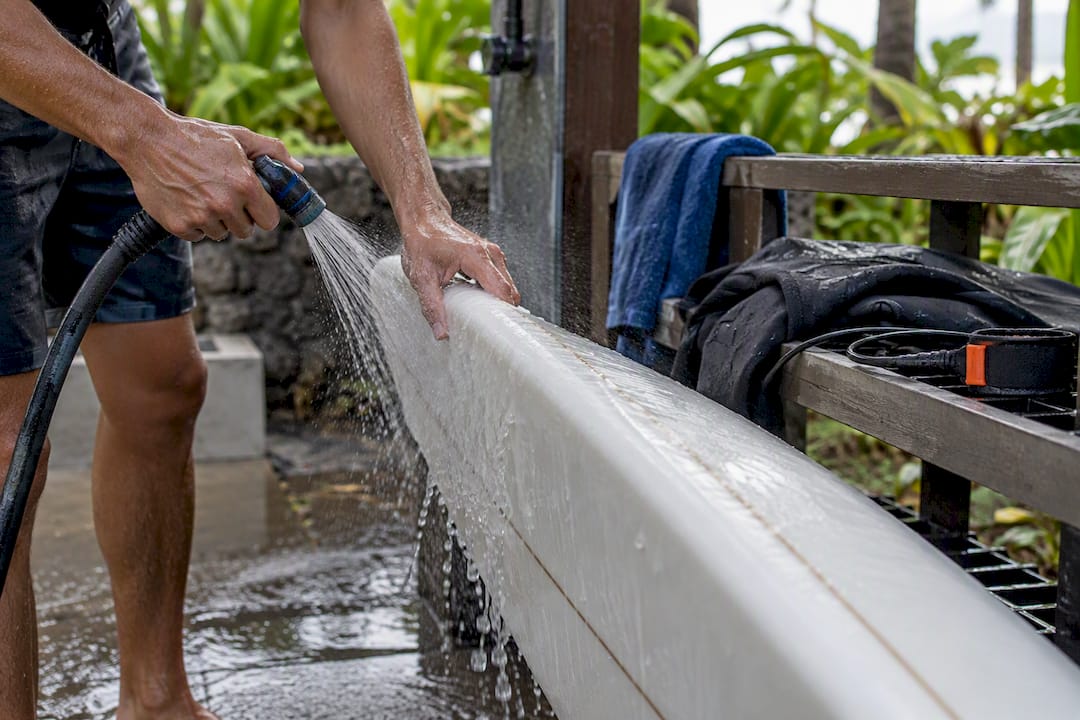
Rain does quiet damage to surf gear that saltwater alone doesn’t cause, and most of it is preventable with a five-minute routine. Fresh rainwater sitting on foam or fiberglass can seep into small dings and cracks, and once moisture gets trapped inside a board, it can lead to delamination or a waterlogged, heavier deck over time. Salt left to dry on a wetsuit or leash also breaks down neoprene and stitching faster than fresh water does.
Rinse boards, leashes, and wetsuits in fresh water after every session, rain or not, and dry them fully before storing them, since trapped moisture in a bag is worse than a quick shower outdoors. Check for new dings after a rainy session in particular; storm debris in the water raises the odds of a fresh crack that needs patching before saltwater and rain both get inside it. Store boards in a cool, shaded, ventilated spot rather than a sealed car trunk or plastic bag, where humidity builds up fast in Hawaii’s climate. A quick wax check matters too: wax that’s been sitting under rain and sun can soften and lift, leaving a slicker deck right when traction matters most.
If you’re renting rather than hauling your own gear through wet weather, surfboard rentals in Waikiki skip the gear-maintenance headache entirely, since the equipment gets checked and reconditioned between uses.
Rain Runoff and Hawaii’s Marine Ecosystem
The same runoff that raises illness risk for surfers is also stressing the reef systems many of Hawaii’s best breaks depend on. Sediment and freshwater runoff can smother coral, block the sunlight reef-building coral needs, and shift the nearshore ecosystem in ways that show up as murkier water and fewer fish around popular surf spots over time. Nutrient-heavy runoff, from fertilizer and agricultural sources, can also trigger algae blooms that further choke reef health along developed coastlines.
Surfers see the effects up close in ways plenty of other beachgoers don’t. Reef breaks near storm drains or stream mouths often show visibly reduced coral cover and murkier water compared to less-developed stretches of coast, and that pattern tracks closely with how much impervious surface (roads, roofs, parking lots) sits upstream of a given watershed. Checking EPA watershed mapping tools before a trip can show you which specific beaches sit downstream of heavier development, which is useful information whether you’re worried about bacteria or just want to know why a favorite reef break has looked different the last few seasons.
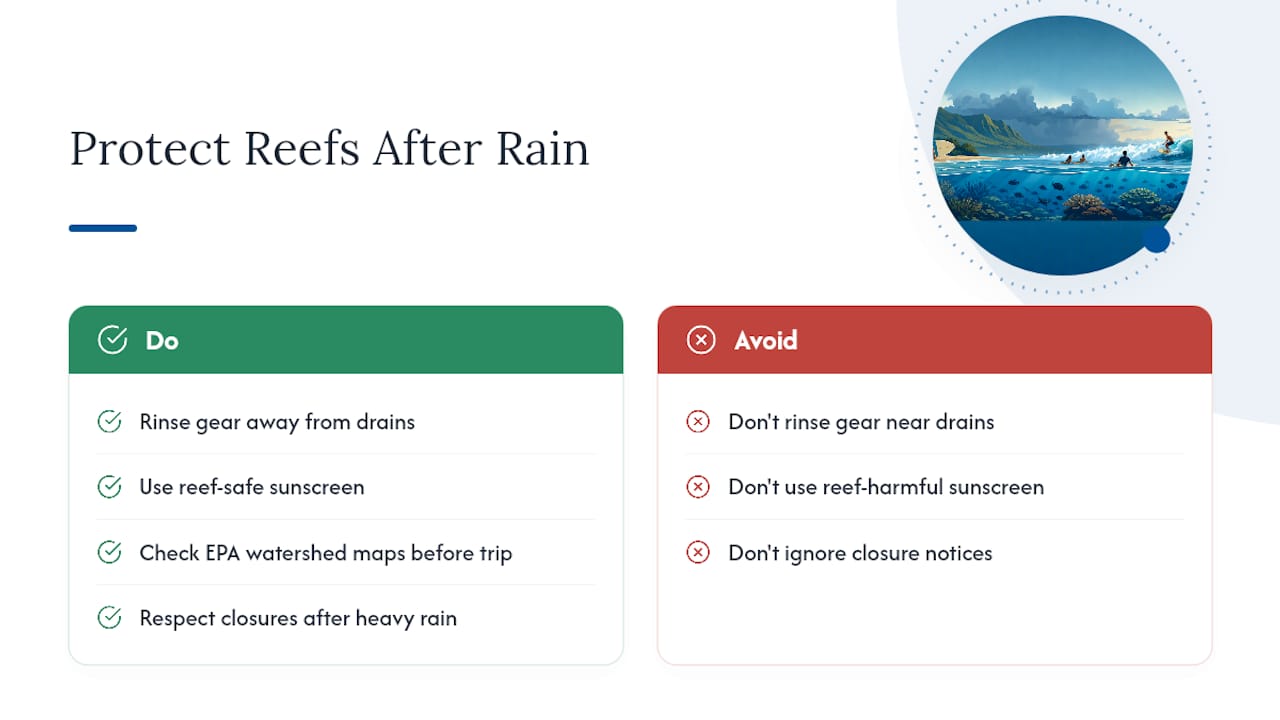
Small choices add up here too. Rinsing wetsuits and gear away from storm drains, skipping sunscreen with reef-harming chemicals, and simply respecting posted closures after big rain events all reduce the cumulative runoff load a reef has to absorb.
Author Perspective: Balancing Opportunity and Safety
Rain-fed swell can look tempting, and I understand the pull to paddle out anyway. But a public-health rule backed by real GI illness data and a lifeguard’s posted advisory aren’t suggestions to negotiate with. Respecting stream mouths and drainage areas protects the reef as much as it protects you, and that’s worth more than one marginal session.
— Johann
Want Safer Water Time After Rain? Book a Supervised Lesson
Hhsurf is the alternative to guessing your way through marginal conditions alone: over 30 years of local instruction means every lesson comes with someone who reads water clarity, storm drains, and swell direction before you ever touch a board. That local judgment call, made by professional instructors rather than a stranger on Instagram, is the real value of booking supervised time in the water instead of paddling out solo on a rainy forecast.

Group Lessons, Private Lessons, and attentive supervision are offered, providing support especially when rain affects conditions. If a storm rolls through close to your booking, instructors will move your session to a better-flushed, leeward spot or shift the schedule by a day rather than send you out into brown water. Ready to lock in a lesson that adjusts around Hawaii’s weather instead of ignoring it? Visit the surf lessons page in Waikiki to check current availability and book your spot.
Authoritative Places to Check Before You Surf
Before paddling out after rain, check the Hawaii DOH’s brown-water advisory guidance, the Heal the Bay bacterial risk checker, and local lifeguard postings for the beach you plan to surf.
This article is general information, not a substitute for advice from a qualified doctor. Consult a qualified healthcare professional about your own circumstances before acting on anything here.
Sources
- Surfer health study (SCCWRP technical report)
- The Dangers of Surfing After a Rain — Surfline
- EPA Beacon watershed tools
- WATCH: Hawaii Man Surfs Drainage Canal ‘Like Ninja Turtles’ After Record Rainfall — NPR
FAQ
Is It Okay to Surf While It’s Raining?
Light rain by itself usually doesn’t make ocean water unsafe, since rainfall alone doesn’t carry bacteria into the surf zone. The real risk comes from runoff after heavy rain, especially near stream mouths and storm drains, where Surfrider and SCCWRP’s surfer health data shows a clear rise in gastrointestinal illness among people who entered the water during or shortly after storms.
Was Eddie Aikau Ever Found?
No. Eddie Aikau disappeared while attempting to paddle for help after the canoe Hokule’a capsized in rough seas near Molokai, and he was never found despite an extensive search. His memory lives on through the Quiksilver in Memory of Eddie Aikau big-wave event held at Waimea Bay.
Is Hawaii the Wettest Place in the World?
Hawaii isn’t the wettest place on Earth overall, but Mount Waiʻaleʻale on Kauai ranks among the rainiest spots anywhere, with rain falling on the mountain’s summit on most days of the year. That extreme, localized rainfall is exactly why runoff and Hawaii rainy surf conditions vary so much from one coastline to the next.
What Is a Female Surfer Called?
A female surfer is simply called a surfer; there’s no separate gender-specific term in common use within the sport. The word applies equally regardless of who’s riding the wave, from beginners in a group lesson to professional competitors.
How Long Should You Wait to Surf After Heavy Rain in Hawaii?
Hawaii Department of Health guidance and local lifeguards generally recommend staying out of the water near stream mouths and storm drains for 72 hours after significant rainfall. That window can extend longer after a major storm, so checking posted advisories before paddling out matters more than watching the clock alone.
0 Comments